Transientik Master Review: Is Deterministic Mastering Better Than AI-Assisted Workflows?
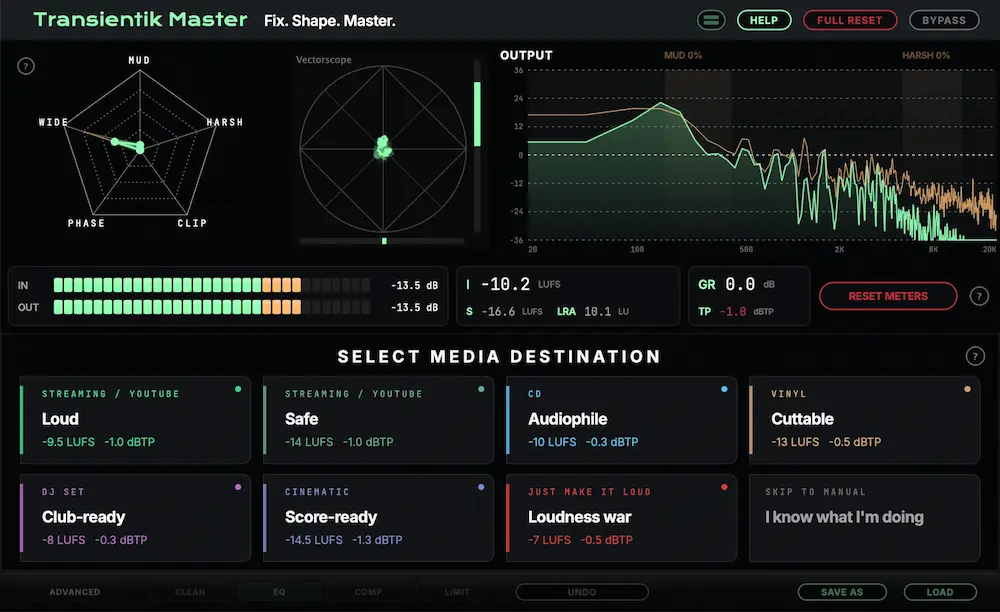
Mastering plugins have become increasingly automated. AI-assisted processors analyze a mix, suggest settings, and in some cases generate an entire mastering chain with minimal user input. Transientik Master takes a different approach. Rather than positioning itself as another AI mastering assistant, it introduces a deterministic workflow designed to make processing decisions repeatable, explainable, and easier to verify.
That distinction sounds technical, but it addresses a practical production problem. As more mastering tools rely on adaptive algorithms, consistency becomes harder to evaluate across revisions, alternate releases, and long-term project recalls. A deterministic system aims to produce the same analytical outcome from the same source material every time, making the workflow more predictable without removing the engineer from the decision-making process.
This review looks beyond the feature list to evaluate how Transientik Master fits into modern mastering practice. We’ll examine where its analytical workflow can improve efficiency, where conventional mastering techniques still have the advantage, and whether deterministic processing represents a meaningful evolution or simply another variation of automated mastering.
Contents
Why Deterministic Mastering Matters in Today’s Production Workflow
 Automation is no longer the defining conversation in mastering. Most engineers already rely on software that analyzes audio, suggests processing, or accelerates repetitive tasks. The real question is no longer whether automation belongs in the workflow, but how much authority it should have over critical mastering decisions.
Traditional mastering remains processor-driven. Engineers build their own signal chains using EQ, dynamics, clipping, saturation, stereo processing, loudness control, and metering, making every adjustment according to the material, monitoring environment, and delivery format. AI-assisted mastering follows a different philosophy, analyzing the mix and proposing processing automatically. Solutions like LANDR prioritize speed, while platforms such as iZotope Ozone combine automated analysis with extensive manual refinement.
Transientik Master introduces a third approach. Instead of relying on adaptive machine-learning models, it centers its workflow around deterministic analysis—a system designed to produce consistent, repeatable results from identical source material. The emphasis is less on automating creative decisions and more on making technical evaluation transparent and reproducible.
That distinction has practical implications in commercial mastering. One of the recurring criticisms of AI-assisted systems is inconsistency. Software updates, revised models, or changes to recommendation engines can alter processing behavior even when the source mix remains unchanged. For engineers managing album projects, label archives, client recalls, or multiple release formats, predictable analysis is often more valuable than increasingly complex automation.
A deterministic workflow doesn’t guarantee a better master, but it does simplify repeatability. Recall sessions become easier to manage, alternate versions remain more consistent, and revision workflows become easier to document. Those advantages matter in professional production, where maintaining continuity across releases is often as important as achieving the initial result.
The concept also reflects broader changes in music production. Independent artists release music more frequently than ever, collaborative workflows span multiple studios, and AI-generated material has become part of everyday production rather than an exception. Engineers increasingly spend their time validating mixes, identifying technical issues, and ensuring reliable translation across playback systems instead of assembling mastering chains from scratch.
Viewed through that lens, Transientik Master aims to solve a workflow problem rather than an audio-quality problem. Its success will depend less on how its processing sounds in isolation and more on whether its analytical model consistently helps engineers reach better decisions with less time spent on technical verification.
How Transientik Master Fits Into a Professional Mastering Workflow
Most mastering plugins compete on processing quality. They promise cleaner limiting, more transparent dynamics, or improved loudness with fewer artifacts. In practice, experienced engineers rarely choose a tool based on those claims alone. Workflow efficiency, session recall, and reliable decision-making often have a greater impact on commercial mastering than marginal improvements in signal processing.
That’s where Transientik Master takes a noticeably different direction. Rather than introducing another limiter or analog-modelled processor, the plugin focuses on the stage that precedes processing itself: technical evaluation. That philosophy mirrors a broader trend seen in tools such as Steinberg SpectraLayers 13, where improving analytical visibility is often more valuable than adding another processing algorithm.
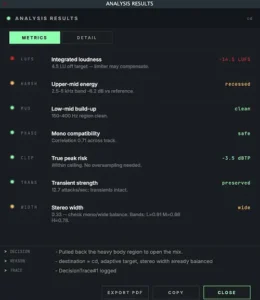
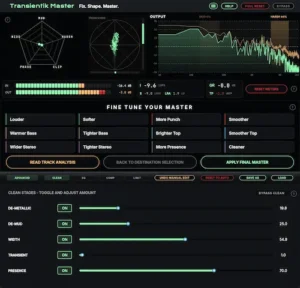
According to the developer, its DecisionTrace system analyzes multiple characteristics of a mix and records the reasoning behind subsequent processing decisions instead of presenting the result as a black box.
For engineers accustomed to conventional mastering chains, this changes the order of operations rather than the fundamentals of mastering. The workflow begins with structured analysis before EQ, dynamics, or loudness adjustments are applied, making technical assessment part of the processing chain instead of a separate step.
That approach closely mirrors how experienced mastering engineers evaluate new material. Before touching a limiter or equalizer, they’re typically asking a series of technical questions:
- Is the tonal balance fundamentally stable?
- Are transient peaks unnecessarily restricting available headroom?
- Is excessive low-frequency energy reducing overall efficiency?
- Will stereo information remain stable after lossy encoding?
- Does the dynamic profile suit the intended release format?
Answering those questions normally requires moving between multiple analyzers, meters, and listening references. Transientik Master attempts to consolidate that process into a single analytical stage. Whether that ultimately improves mastering quality depends on the engineer, but it has clear potential to improve workflow efficiency.
The biggest advantage becomes apparent in high-volume production environments. Engineers working on multiple client projects each week spend considerable time validating mixes before making creative decisions. Faster identification of spectral imbalance, transient bottlenecks, or headroom limitations reduces repetitive technical work and also highlights issues that are often easier to solve before a mix reaches the mastering stage.
The same applies to revision management. Commercial projects often involve alternate versions for streaming platforms, instrumental releases, radio edits, Dolby Atmos downmixes, or late client revisions months after delivery. If DecisionTrace provides meaningful documentation rather than cosmetic reporting, it could simplify project recall and improve consistency across multiple deliverables.
Where the concept reaches its limit is musical judgment.
No analytical model can determine whether brighter vocals better support the record, whether a restrained low end is an artistic choice rather than a technical flaw, or whether preserving dynamic contrast matters more than maximizing perceived loudness. Those decisions remain inseparable from genre, arrangement, monitoring accuracy, and the engineer’s experience.
That distinction is particularly relevant in modern streaming production. Loudness normalization has reduced the incentive to maximize LUFS at any cost, but it hasn’t standardized mastering aesthetics. Pop, hip-hop, orchestral, jazz, electronic, and cinematic productions continue to demand fundamentally different balances of dynamics, density, transient impact, and perceived energy. A deterministic workflow can standardize technical evaluation, but it cannot standardize creative priorities.
Integration into existing workflows is another practical consideration. Professional mastering chains rarely revolve around a single processor. Transparent equalizers, analog hardware or emulations, clipping stages, loudness meters, codec monitoring, and quality-control tools remain essential regardless of how sophisticated a new plugin becomes. Transientik Master is therefore more convincing as a front-end diagnostic tool than as a replacement for an established mastering chain.
Viewed in that context, the plugin’s value isn’t measured by how much processing it automates. Its real contribution lies in reducing the time spent validating technical conditions before creative mastering decisions begin. If its analytical model consistently identifies the issues engineers already listen for, it becomes a practical workflow accelerator rather than simply another automated mastering assistant.
How Transientik Master Actually Works Inside the DAW
Most mastering plugins begin with processing. Engineers load the plugin, adjust a limiter, tweak EQ, refine dynamics, and evaluate the result by listening and metering. Transientik Master reverses that sequence. Instead of asking the user to build a processing chain immediately, it starts with structured analysis intended to define why processing may be necessary before determining how it should be applied.
The workflow begins with an analysis pass. Rather than measuring loudness alone, the plugin evaluates multiple technical characteristics of the incoming stereo mix that influence later mastering decisions. Spectral balance, transient distribution, dynamic behavior, stereo stability, and available headroom become part of a single analytical model instead of being inspected separately through multiple plugins and meters.
This approach differs from conventional mastering assistants. AI-driven systems often produce recommendations that appear as finished processing chains with limited visibility into how individual decisions were reached. Transientik Master attempts to expose that reasoning instead of hiding it. The engineer remains responsible for the final judgment while the software provides a structured explanation of the technical conditions it has identified.
One of the plugin’s more distinctive concepts is DecisionTrace. Rather than presenting analysis as isolated graphs or numerical values, DecisionTrace documents the sequence of observations that influenced subsequent processing recommendations. In practical terms, this creates a technical record of why particular adjustments were suggested, making it easier to revisit a project weeks or months later without relying entirely on memory.
For commercial mastering, that documentation has practical value. Album revisions, instrumental versions, radio edits, streaming deliverables, and catalog updates often require engineers to reconstruct earlier decisions long after the original session has been completed. A repeatable analytical record can simplify those recalls even when processing itself remains largely manual.
Another notable element is the use of Destination Profiles. Instead of assuming every master targets the same playback environment, the plugin allows analytical priorities to change depending on the intended release format. While mastering fundamentals remain unchanged, the balance between dynamics, loudness, transient preservation, and technical optimization may differ for streaming services, downloadable releases, or other delivery scenarios. Organizing those priorities before processing begins can reduce repetitive setup work across multiple projects.
Fine Tune controls then allow engineers to refine the proposed direction rather than accepting an entirely automatic result. That distinction is important. The plugin does not remove manual intervention from the mastering process. Instead, it attempts to shorten the path between technical evaluation and informed engineering decisions.
Manual mode remains equally important. Experienced mastering engineers rarely want software making irreversible decisions without supervision. Instead, they typically use analytical tools to validate observations before adjusting processors according to the artistic goals of the project. Transientik Master appears designed around that philosophy, functioning as a decision-support environment rather than an autonomous mastering engine.
This architecture also explains why the plugin should not be evaluated solely by comparing its limiter or EQ against competing products. Those processors are only part of the overall workflow. The more meaningful question is whether the analytical stage consistently reduces the amount of time required to identify genuine technical issues before creative mastering begins.
For engineers working on isolated projects, the difference may be modest. For studios processing dozens of releases every month, however, small reductions in repetitive analysis accumulate quickly. If the analytical model remains predictable across repeated sessions, the workflow benefits may ultimately prove more significant than any individual processing algorithm included with the plugin.
Technical Specifications & Platform Support
| Feature | Specification |
|---|---|
| Plugin Formats | VST3, AU |
| Operating Systems | Windows, macOS |
| Apple Silicon | Native Support |
| Cloud Processing | No |
| Offline Processing | Supported |
| Local Audio Analysis | Yes |
| AI-Based Processing | No |
| Deterministic Analysis Engine | Yes |
| DecisionTrace Workflow | Yes |
| Destination Profiles | Included |
| Manual Fine-Tuning | Available |
Installation & Compatibility
Transientik Master is available as a native desktop plugin for both Windows and macOS, supporting modern VST3 and Audio Unit workflows. A dedicated AAX version is not currently available. The current release runs locally without requiring cloud-based audio processing, allowing mastering sessions to remain fully offline once the software has been installed.
For professional engineers, that distinction is more important than it may initially appear. Offline processing eliminates concerns about upload times, internet latency, subscription-based rendering, or external servers becoming part of the mastering workflow. Projects remain entirely under local control, making the plugin suitable for commercial studios handling confidential client material.
The plugin integrates naturally into virtually any modern DAW that supports standard plugin formats. Whether mastering inside Cubase, Nuendo, Studio One, REAPER, Ableton Live, Logic Pro, FL Studio, or another professional production environment, Transientik Master behaves like a standard mastering plugin rather than requiring a separate application or cloud service.
Apple Silicon compatibility is particularly relevant for modern mastering workstations. Native support avoids the performance penalties associated with translation layers while allowing the plugin to benefit from current-generation Mac hardware. Windows users likewise receive a standard native implementation without relying on external services.
Latency is unlikely to become a workflow concern in typical mastering sessions. Unlike large multitrack mixing projects, mastering usually involves a limited number of processors on a stereo file, making analytical overhead relatively insignificant compared to virtual instruments or complex mixing templates.
From a workflow perspective, installation is intentionally uncomplicated. Engineers can incorporate the plugin into an existing mastering chain without changing routing architecture, export procedures, or project organization. That simplicity makes experimentation considerably easier than adopting an entirely new mastering ecosystem.
The Strengths—and Practical Limits—of Deterministic Mastering
 Every new mastering platform promises greater consistency, faster workflows, and fewer technical decisions. Those claims deserve scrutiny because mastering quality has never been determined by automation alone. The value of Transientik Master lies less in its processing and more in how it organizes technical evaluation before the first processor is engaged.
That’s a meaningful distinction. Experienced mastering engineers don’t build a chain by instinct—they first evaluate spectral balance, transient behavior, available headroom, stereo integrity, and delivery requirements before deciding what actually needs processing. If Transientik Master consistently identifies those relationships, it reduces repetitive technical work without replacing the engineer’s judgment.
Its emphasis on documented analysis is arguably more valuable than another automated mastering preset. Commercial mastering regularly involves project recalls, label revisions, alternate streaming versions, instrumentals, clean edits, and updated deliverables months after the original release. Remembering why a decision was made often matters more than remembering the exact threshold or EQ value that was used.
That advantage has clear limits.
No software can distinguish between a technical flaw and a deliberate production choice. A restrained low end may be preserving arrangement clarity rather than indicating missing energy. Conservative transient shaping may be essential to the feel of an indie record instead of representing unused loudness potential. Those decisions depend on musical context, not measurable data.
The same principle applies across genres. Streaming normalization has reduced the obsession with maximum loudness, but it hasn’t made mastering more standardized. Hip-hop, orchestral music, jazz, modern pop, and electronic production all prioritize dynamics, density, and transient response differently. Analysis can identify measurable conditions. It cannot decide which artistic direction serves the record.
That distinction explains where deterministic workflows fit into professional mastering. They accelerate technical validation without replacing critical listening. Engineers still decide whether a measurement represents a problem worth solving or simply reflects the creative intent of the mix.
There’s also a broader industry trend behind products like Transientik Master. As processing quality converges across modern mastering plugins, developers increasingly compete through workflow innovation instead of purely sonic improvements. AI assistants, adaptive processing, intelligent gain staging, and automated analysis all attempt to shorten the path from finished mix to final master. Deterministic analysis belongs to that same evolution, but it prioritizes repeatability over automation.
That philosophy makes the plugin more appealing to experienced engineers than to users looking for one-click mastering. Professionals typically want better information, not fewer decisions. Less experienced producers, on the other hand, may see structured analysis as additional confidence while they develop their own critical listening skills.
Scalability is another area where deterministic workflows have practical advantages. Album mastering, episodic content, catalog remastering, and large production libraries all benefit from consistent technical evaluation. Maintaining continuity across dozens of related releases becomes easier when analytical decisions are documented alongside processing rather than reconstructed from memory.
The monitoring environment also changes how much value the plugin provides. Engineers working in treated mastering rooms already trust calibrated monitoring as their primary reference. Producers working on headphones or in untreated rooms are more likely to benefit from objective diagnostics that expose issues their listening environment may conceal.
For that reason, it makes more sense to view Transientik Master as an engineering support tool than a mastering solution. The concepts behind deterministic analysis—measurement, repeatability, structured evaluation, and documentation—have been part of professional mastering for decades. What the plugin changes is how efficiently those principles can be integrated into a modern production workflow.
Pricing & Licensing
At the time of writing, Transientik Master is available under a perpetual license model rather than a subscription-based licensing system. That distinction will matter to engineers who prefer building long-term mastering workflows around locally installed software instead of recurring cloud platforms.
From a commercial perspective, the purchase decision isn’t simply about price. Most professional studios already own capable limiters, equalizers, and loudness processors. The real question is whether Transientik Master saves enough time during technical evaluation to justify adding another stage to an existing mastering workflow.
For occasional users mastering a few personal releases each year, the workflow benefits may be relatively modest. Engineers handling multiple client projects every week are more likely to recover that investment through faster analysis, improved project recall, and more consistent technical validation across revisions.
Prospective buyers should also consider future development rather than the current feature list alone. Because deterministic analysis represents a relatively new category, its long-term value will depend on continued refinement of the analytical engine and regular platform updates rather than the addition of increasingly complex processing modules.
Ultimately, Transientik Master should be evaluated as a productivity investment rather than another processor purchase. If it consistently reduces the amount of time spent validating mixes before mastering decisions begin, its value extends well beyond the individual processing algorithms included with the plugin.
Who Should Skip This Plugin
Despite its innovative workflow, Transientik Master isn’t the right solution for every mastering engineer or producer.
- If your mastering workflow already revolves around iZotope Ozone Advanced and you’re satisfied with its AI-assisted ecosystem, the practical gains may be smaller than expected.
- If you’re looking for fully automatic one-click mastering with minimal user interaction, this plugin deliberately takes a more engineering-oriented approach and may require more manual involvement than online mastering services.
- If your primary goal is adding analog color, harmonic saturation, or console character, dedicated analog-modelled processors will have a much greater influence on the final sound than an analytical workflow.
- If your current mastering process is already highly optimized, repeatable, and thoroughly documented, Transientik Master may improve efficiency only marginally rather than fundamentally changing how you work.
On the other hand, engineers who frequently evaluate unfamiliar mixes, manage large numbers of client revisions, or want greater consistency in technical analysis are likely to benefit the most from the plugin’s deterministic workflow.
Transientik Master vs iZotope Ozone: Different Approaches to Modern Mastering
Comparisons between Transientik Master and iZotope Ozone are inevitable, but they can also be misleading. While both products operate within the mastering stage, they were designed to solve different problems. Ozone has evolved into one of the industry’s most comprehensive mastering environments, combining advanced processing modules, AI-assisted analysis, loudness tools, imaging, dynamics, equalization, and codec preview inside a single ecosystem. Transientik Master takes a considerably narrower approach by focusing on structured technical evaluation before processing decisions are made.
| Category | Transientik Master | iZotope Ozone |
|---|---|---|
| Primary Goal | Structured technical analysis | Complete mastering environment |
| Processing Philosophy | Guided engineering workflow | Comprehensive processing suite |
| AI Integration | No | Yes |
| Manual Control | High | High |
| Learning Curve | Moderate | Higher |
| Best Suited For | Consistent technical evaluation | Complete mastering workflows |
The key difference is philosophical rather than technical. Ozone is designed to provide virtually every processor needed to complete a master inside a single plugin. Engineers can build an entire mastering chain without leaving its ecosystem, making it particularly attractive for users who prefer an all-in-one workflow.
Transientik Master approaches mastering from the opposite direction. Instead of replacing an existing processing chain, it attempts to improve the quality of the decisions that precede processing. The plugin assumes that engineers may already own preferred equalizers, limiters, clipping tools, or analog hardware, and focuses on organizing technical evaluation before those processors are engaged.
That distinction makes direct audio comparisons less meaningful than many reviews suggest. A mastering engineer is unlikely to replace Ozone with Transientik Master—or vice versa—because the two products occupy different stages of the workflow. In practice, they could even complement one another. Structured deterministic analysis before entering a comprehensive mastering suite is a perfectly realistic production scenario.
Ultimately, the choice depends less on sound quality than on workflow priorities. Engineers looking for an integrated mastering environment will naturally gravitate toward Ozone. Those interested in improving analytical consistency, project recall, and repeatable technical evaluation may find Transientik Master offers value that extends beyond another collection of processors.
Where Transientik Master Fits Among Modern Mastering Tools
Comparing Transientik Master to the rest of the mastering market requires looking beyond processing quality. Most professional engineers already have access to transparent limiters, surgical EQs, sophisticated dynamics processors, and comprehensive metering. The question isn’t whether this plugin can replace those tools. It’s whether it changes the decision-making process that happens before processing begins.
That makes its competitive landscape slightly different from a conventional mastering plugin. Instead of competing directly with every limiter or mastering suite, Transientik Master sits between automated mastering platforms and traditional engineer-driven workflows.
| Workflow Category | Representative Tools | Primary Focus | Trade-Off |
|---|---|---|---|
| Automated Mastering | LANDR, eMastered | Speed and instant results | Limited creative control and minimal transparency |
| AI-Assisted Mastering | iZotope Ozone | Automated analysis with manual refinement | Complex workflows and a larger learning curve |
| Engineer-Driven Mastering | FabFilter, DMG Audio, Weiss, Sonnox | Maximum precision and complete manual control | Requires experience and slower decision-making |
| Deterministic Analytical Workflow | Transientik Master | Structured technical evaluation before processing | Still depends on engineering judgment for final decisions |
That positioning is arguably the plugin’s biggest differentiator. Rather than trying to outperform established processors on raw audio quality, it attempts to reduce the amount of repetitive technical evaluation that precedes mastering decisions.
Whether that matters depends largely on who’s using it.
A producer mastering occasional singles may appreciate the structured guidance because it provides a repeatable evaluation process without requiring years of mastering experience. A commercial mastering engineer is less likely to discover entirely new information, but may value the plugin for a different reason: faster validation, improved project recall, and more consistent documentation across large numbers of client sessions.
It’s also worth recognizing that professional mastering has never been limited by a lack of processing tools. Today’s market already offers transparent equalizers, highly refined limiters, advanced clipping algorithms, precise loudness metering, and sophisticated codec monitoring. The bottleneck is increasingly human rather than technical—evaluating mixes efficiently, maintaining consistency across revisions, and making reliable decisions under production deadlines.
That shift also explains why many recent plugin releases focus on workflow rather than raw sound quality. Even processors designed around analog character, such as Acustica Audio Cream 3, ultimately succeed or fail based on how efficiently they integrate into real production workflows rather than on tonal coloration alone.
Viewed from that perspective, Transientik Master addresses workflow efficiency instead of processing capability. That’s a subtle distinction, but an important one. It isn’t competing to become the industry’s next reference limiter or mastering suite. It’s attempting to streamline the analytical stage that precedes every mastering session.
For professionals managing high project volumes, that proposition is easier to justify than promises of dramatically better sound. Workflow improvements compound over hundreds of sessions. Audio quality, meanwhile, still depends primarily on monitoring accuracy, engineering experience, and the quality of the mix arriving at the mastering stage.
Why Playback Translation Still Defines Mastering Quality
 The quality of a master isn’t determined inside the DAW. It’s determined everywhere the record is played afterward. Earbuds, car audio systems, Bluetooth speakers, televisions, smart devices, club sound systems, and streaming platforms all expose different aspects of the same production. A mastering process succeeds only if the mix remains balanced, intelligible, and emotionally consistent across those environments.
That remains the benchmark every mastering plugin is ultimately measured against. Analytical precision inside the software means very little if the finished master falls apart during real-world playback.
Deterministic analysis can identify measurable problems before export, but it cannot predict how listeners will perceive tonal balance under wildly different listening conditions. Room acoustics, playback level, consumer hardware, codec behavior, and platform-specific loudness management all influence translation in ways that no mastering processor can fully anticipate.
Streaming delivery adds another layer of complexity. Loudness normalization has reduced the industry’s focus on peak loudness, yet codec implementation continues to influence transient clarity, stereo imaging, low-frequency stability, and perceived detail. Those challenges become especially noticeable after Spotify loudness normalization, where aggressive limiting or excessive stereo enhancement can translate very differently than expected.
If Transientik Master’s analytical engine can reliably identify conditions that compromise codec performance before distribution, that may prove more valuable than another incremental increase in loudness. Translation has become a more meaningful performance metric than peak level alone.
The usefulness of analytical software also depends heavily on the monitoring environment. Engineers working in professionally calibrated mastering rooms already rely on accurate loudspeakers, controlled acoustics, and years of critical listening experience. In those studios, analytical tools primarily validate decisions that have already been made by ear.
The situation is very different for producers working in untreated rooms or exclusively on headphones. Acoustic limitations often conceal low-frequency buildup, exaggerate room resonances, or distort stereo perception. Objective analysis cannot replace monitoring, but it can expose technical conditions that the listening environment fails to reveal.
Workflow efficiency deserves equal consideration. Commercial mastering engineers handling dozens of projects every month rarely spend most of their time adjusting processors. A significant portion of each session is devoted to technical validation, quality control, revision management, and consistency checks across multiple deliverables. Reducing that overhead can have a greater impact on productivity than adding another processor to the mastering chain.
CPU performance is unlikely to influence purchasing decisions for this type of plugin. Mastering sessions generally place modest demands on modern workstations, and analytical processing consumes only a small fraction of the resources required by large-scale mixing or virtual instrument projects. Workflow integration, reliability, and analytical accuracy are likely to matter far more than raw CPU efficiency.
Ultimately, that’s the question Transientik Master has to answer. Not whether it can automate mastering, but whether it helps engineers make better technical decisions before creative judgment takes over. Faster analysis is valuable, but only if it consistently leads to masters that translate more reliably outside the studio—because that’s where every release is ultimately judged.
Verdict: An Interesting Workflow Innovation, Not a New Standard for Mastering
Transientik Master stands out for a reason that has little to do with signal processing. Its most interesting contribution is the attempt to formalize the analytical stage of mastering rather than automate the entire process. In a market increasingly dominated by AI branding and one-click promises, that alone makes it worth paying attention to.
Structured analysis, documented decision-making, and repeatable evaluation can improve efficiency, simplify project recalls, and reduce the amount of routine technical validation that precedes every professional mastering session. Those are tangible workflow benefits, particularly for engineers managing a steady volume of commercial projects.
Its limitations are equally clear. Deterministic analysis cannot distinguish between a technical issue and a creative decision, nor can it evaluate arrangement, emotion, genre conventions, or artistic intent. Those responsibilities remain with the engineer, regardless of how sophisticated the analytical model becomes.
Whether Transientik Master gains long-term relevance will depend less on marketing claims and more on how reliably its analytical framework performs in everyday production. If it consistently helps engineers identify meaningful technical issues faster than conventional workflows, it will earn a place alongside established mastering tools rather than compete directly against them.
For experienced professionals, the plugin is best approached as an additional layer of technical insight—not a substitute for critical listening, accurate monitoring, or engineering experience. If deterministic mastering has a future, it will be because it improves decision-making, not because it replaces it.
Overall Rating
| Category | Rating |
|---|---|
| Analytical Workflow | 9.5/10 |
| Decision Transparency | 9/10 |
| Professional Workflow Integration | 8.5/10 |
| Workflow Flexibility | 8.5/10 |
| CPU Efficiency | 9/10 |
| Long-Term Value | 9/10 |
| Overall | 8.9/10 |
Transientik Master is one of the more interesting mastering releases of the year—not because it promises better sound, but because it approaches mastering from a different angle. Its greatest strength is structured technical analysis that helps engineers reach informed decisions more efficiently. It doesn’t replace critical listening or mastering experience, but it has the potential to become a valuable workflow companion for professionals who prioritize consistency, project recall, and repeatable evaluation over one-click automation.

Yurii Ariefiev is a mastering engineer and audio production editor specializing in commercial music releases, playback translation, and modern mastering workflows. His editorial research focuses on how emerging audio technologies perform in real production environments rather than under marketing claims.
This review evaluates Transientik Master from the perspective of everyday mastering practice, examining workflow efficiency, technical decision-making, monitoring reliability, and translation across today’s streaming platforms instead of simply summarizing product specifications.
Frequently Asked Questions
Is deterministic mastering the same as AI mastering?
No. AI mastering relies on adaptive models that generate processing recommendations based on learned behavior, while deterministic mastering follows predefined analytical rules designed to produce repeatable results from identical source material. The goal is consistency rather than autonomous decision-making.
Who benefits most from Transientik Master?
The plugin is best suited to producers, mixing engineers, and mastering engineers who already understand mastering fundamentals but want a faster way to evaluate technical issues before processing. Beginners may still need to learn how to interpret the results.
Can Transientik Master replace a professional mastering engineer?
No. It can assist with technical analysis, but it cannot evaluate musical intent, client expectations, arrangement, or genre-specific aesthetics. Those decisions still depend on experience and critical listening.
How does it compare with iZotope Ozone?
Ozone is a comprehensive mastering environment that combines AI-assisted analysis with a full collection of processing modules. Transientik Master focuses on deterministic evaluation and workflow organization rather than replacing an entire mastering chain.
Does deterministic analysis improve playback translation?
Only indirectly. It can help identify technical conditions that often reduce translation quality, but successful playback across streaming services and consumer devices still depends on monitoring accuracy, mix quality, and mastering decisions.
Can it be integrated into an existing mastering workflow?
Yes. It makes the most sense as an analytical stage before EQ, dynamics processing, limiting, and final quality control rather than as a replacement for established mastering tools.
Is Transientik Master designed for album mastering or single releases?
It can support both. Repeatable analysis may simplify album consistency, revision management, and alternate deliverables, but sequencing and track-to-track balance still require manual evaluation.
Does CPU usage matter for this type of plugin?
For most modern systems, no. Mastering sessions typically involve relatively small projects, making workflow efficiency and analytical reliability more important than raw CPU performance.
How does Transientik Master differ from automated online mastering services?
Online mastering platforms prioritize convenience and speed by generating a finished master with minimal user involvement. Transientik Master is designed to support engineering decisions, giving users analytical insight while keeping manual control over the mastering process.
Is Transientik Master worth adding to an established mastering toolkit?
If its analytical workflow consistently saves time during mix evaluation and project recall, it can become a valuable addition to an existing mastering workflow. Engineers looking for dramatically different processing algorithms, however, may find its biggest advantages lie in workflow rather than sound quality.