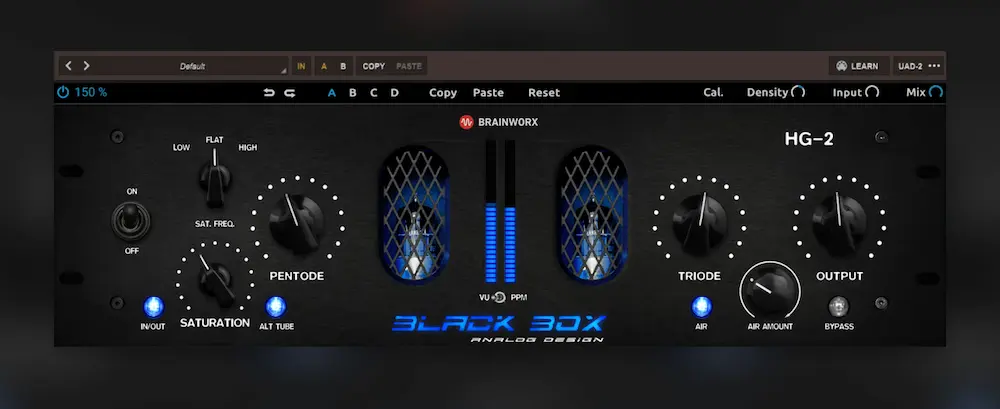
The UAD Black Box HG-2 is not difficult to make sound impressive. Drive it harder and a mix can feel denser, louder and more finished within seconds. The harder question is whether those changes survive level matching — and whether the plugin is improving the mix or simply replacing transient contrast with harmonic density.
That distinction matters because the HG-2 is built for more than obvious distortion. Its serial Pentode and Triode stages work alongside a separate parallel saturation path, giving engineers several ways to change weight, edge and perceived intensity without reaching for another compressor. On a mix bus or mastering chain, small adjustments can be more useful than heavy drive. The same architecture, pushed too far, can flatten depth, soften important attacks and make an already dense production harder to translate.
Developed by Brainworx for the UAD platform, the UAD Black Box Analog Design HG-2 models the boutique HG-2 hardware and extends the workflow with Density, Air, Calibration, additional gain-staging control and a global Mix parameter.
Quick verdict: The UAD Black Box HG-2 is one of the stronger saturation options for Apollo and UAD-2 users who want layered tube density, transient softening and mix-bus enhancement from a single processor. Its main weaknesses are high DSP consumption, the lack of native operation and significant overlap with HG-2MS. After testing it across mix buses, drums, bass and mastering chains, our overall rating is 8.5/10.
UAD Black Box HG-2 at a Glance
| Specification | Details |
|---|---|
| Developer | Brainworx for Universal Audio |
| Processor Type | Tube saturation and harmonic enhancement |
| Platform | UAD-2 DSP |
| Hardware Required | Compatible Apollo or UAD-2 hardware |
| Native Version | No |
| Best Uses | Mix bus, drum bus, bass and mastering |
| Overall Rating | 8.5/10 |
Why the UAD Black Box HG-2 Still Matters in a Saturation-Heavy Plugin Market
 Saturation is no longer a scarce or specialized function. A modern mixing engineer can choose between tape and tube models, transformer emulations, clippers, multiband processors and highly configurable distortion tools. Many offer more routing flexibility and finer control than a model of a two-channel analog processor. The HG-2 therefore has to justify itself through workflow, not through the simple promise of adding harmonics.
Its advantage is the way several nonlinear stages interact. The Pentode and Triode sections operate in series, while a separate parallel saturation circuit can be blended with the main path. Instead of choosing one distortion character and driving it until the effect is audible, the engineer can spread smaller amounts of coloration across multiple stages and control how weight, edge and density build through the processor.
That becomes useful on buses and full mixes, where a single saturation stage can reach its practical limit quickly. Push one circuit too hard and the kick may lose definition before the midrange gains enough density; cymbals can turn coarse while the body of the mix still feels unchanged. The HG-2 provides more than one place to create the effect, which can produce a more integrated result at conservative settings.
This is the part of the design that has aged well. The HG-2 is not relevant because tube saturation is inherently better than newer forms of nonlinear processing. It remains useful because some mixes need a change in peak structure, harmonic density and perceived weight at the same time, without the envelope behavior of another compressor. Those are recurring production problems, not features tied to a particular era of plugin design.
The UAD version also makes the most sense when viewed inside an existing Apollo or UAD-2 workflow. DSP processing keeps the load off the host CPU, but the HG-2 is better suited to a few deliberate placements — a mix bus, drum bus or mastering chain — than to blanket use across a session. That hardware dependence reflects a broader production reality: a processor has to be judged as part of the system around it. The HG-2 may reduce host CPU demand, but it also consumes a substantial share of finite UAD DSP resources. The HG-2 is therefore a focused addition to the UAD ecosystem rather than a general-purpose saturation plugin for every track.
How the UAD Black Box HG-2 Builds Saturation in Stages
The HG-2 is easier to understand as a gain structure than as a collection of tone controls. Pentode, Triode, the parallel Saturation circuit and Density all change how hard different parts of the model are driven. Turning each control until its effect becomes obvious may demonstrate the plugin’s range, but it usually misses the reason the design works on buses and masters: several restrained nonlinear stages can shape a complex signal more effectively than one stage pushed into obvious distortion.
Pentode and Triode form the core of that process. They operate in series, so the first stage changes the signal presented to the second. Pentode can bring more edge and harmonic intensity; Triode can add a denser, rounder presentation. Those descriptions are useful only as starting points. Their actual behavior depends on input level, the balance between the two stages and the spectrum of the source.
That interaction is more important than either control in isolation. On a mix bus, a modest amount of Pentode can increase apparent presence without another EQ boost, while Triode can add weight to a mix that feels too lean. Push the chain harder and the trade-offs arrive quickly: attacks soften, the low mids occupy more space and separation can narrow. The useful range is often below the point where either stage sounds impressive on its own.
The parallel Saturation circuit provides a second route to harmonic density. Rather than driving the main Pentode-Triode path harder, the engineer can blend in a separate saturated signal and choose whether that contribution emphasizes the low end, the full spectrum or the upper range. This is one of the HG-2’s most practical features because it separates the amount of overall tube drive from the location of additional coloration.
On drums, that can mean adding body without forcing every transient further into the serial stages. On bass-heavy material, the low-focused setting can generate more harmonic information around the bottom end, but it should not be confused with simply adding sub level. At the other extreme, upper-focused saturation can make a dark source feel more active without producing the fixed spectral lift of an EQ shelf.
This is also why saturation and EQ are not interchangeable. EQ changes the level of existing frequency content; nonlinear processing generates new harmonic content in response to the signal feeding it. The result changes with level, arrangement density and spectral balance. When the source is right, that behavior can feel more connected to the performance than a static boost. When it is wrong, the HG-2 can exaggerate exactly the part of the mix that already has too much energy.
Density extends how hard the modeled circuit can be driven. In practice, it is useful for moving from subtle bus enhancement toward more obvious saturation without relying entirely on the main stage controls. On a master, small changes can tighten the relationship between peaks and the body of the mix, increasing perceived intensity before the final limiter.
That benefit has a clear limit. Too much Density can trade transient contrast and front-to-back depth for constant harmonic activity. The result often wins a short A/B because it sounds fuller. Over an entire track, it may feel smaller because fewer elements are allowed to stand apart.
Air is most useful as a counterweight, not as a replacement for mastering EQ. After heavier saturation has shifted the mix toward density and weight, Air can restore some upper-frequency openness. It can also expose problems that were already present. Brittle cymbals, hard vocal consonants and stressed upper mids do not become more refined simply because the extra brightness is generated inside a saturation processor.
Calibration changes the overall response of the model before the final decision is made. Its available voicings let the engineer move between darker and brighter presentations, which matters because harmonic processing cannot be separated from tonal balance. The correct setting is the one that reduces the amount of correction needed elsewhere in the chain, not the one that makes the HG-2 sound most obvious in soloed comparisons.
Why Gain Staging and Level Matching Matter with the HG-2
 The hardest part of evaluating the UAD Black Box HG-2 is not hearing what it does. It is separating useful processing from loudness bias.
Saturation can reshape peaks, generate harmonics and increase average density. A processed mix may therefore feel louder and more complete even when the peak meter shows little change. Unless the bypassed and processed signals are compared at a credible perceived level match, it becomes difficult to tell whether the HG-2 improved the mix or simply made it easier to prefer.
This is where saturation demonstrations often become misleading. The plugin is engaged, the signal gains density and apparent level, and the result is described as wider, deeper or more three-dimensional. Some of those changes may survive a matched comparison. Others disappear as soon as the output is reduced.
A more reliable workflow is to set the drive relationship first, then adjust the output before judging tone or depth. Compare bypass frequently at a moderate monitoring level rather than waiting until the end of the chain. If the processed version still holds together when its loudness advantage is removed, the change is more likely to be useful.
On a master, the comparison should answer specific questions:
- Does the vocal sit more securely, or has it only moved forward?
- Did the low end gain useful density at the expense of kick definition?
- Are the upper mids more present, or simply more fatiguing?
- Did the mix become more cohesive while retaining front-to-back depth?
- Does the downstream limiter work less audibly, or is it receiving a more congested signal?
That last comparison is especially revealing. Used conservatively, the HG-2 can reshape isolated peaks and increase density before limiting, allowing the final stage to do less obvious work. Push the processor too far and the opposite happens: transient contrast is reduced, harmonic activity becomes more constant, and the limiter receives a signal with less room left to move.
Where the UAD Black Box HG-2 Works Best in Mixing and Mastering
On the mix bus, the HG-2 works best when the balance is already right. It is not a repair processor. Saturation will not resolve a kick and bass conflict, and a harsh vocal rarely improves when more harmonics are generated around the problem. The plugin is most effective when the mix needs a final change in density, peak behavior or perceived weight rather than corrective work.
Clean, transient-heavy productions are strong candidates. A mix can have excellent separation yet still feel too dependent on isolated peaks for impact. With conservative drive, the HG-2 can reduce the gap between those peaks and the body of the track, making the mix feel more continuous without the timing behavior of another compressor. The useful change is often subtle enough that the plugin is easier to miss in bypass than to hear as an obvious effect.
Rock and live instrumentation can benefit for a different reason. When drums, guitars and vocals already occupy a dense midrange, additional bus compression may create more movement than the mix needs. The HG-2 can add harmonic weight without introducing attack and release behavior, although too much drive will narrow the separation that made the arrangement readable in the first place.
In mastering, source selection matters more than genre. The HG-2 can work well on a controlled mix that still feels lean, overly clean or too dependent on the final limiter for density. It is a weaker choice when the mix already contains clipped drums, saturated synths, distorted guitars and aggressive bus processing. In that situation, another nonlinear stage may add complexity without adding useful information.
This is a common failure point in modern mastering. A mix arrives already shaped by several stages of saturation and clipping, yet another color processor is added because the mastering chain is expected to contain one. The HG-2 earns its place only when removing it makes the master less convincing after level matching.
Drum buses are one of the clearest applications. The processor can alter the balance between attack and body without relying on compressor timing. Pentode drive can bring more urgency to restrained drums, while the parallel saturation path can reinforce weight without forcing the entire bus further into the serial stages. The limit is usually set by the cymbals: once hats and overheads become coarse, the rest of the kit rarely benefits from more drive.
Bass benefits when audibility is the problem, not when low-end level is missing. Harmonic generation can help an instrument survive smaller speakers without simply raising the fundamental. The trade-off is note definition. Too much low-focused saturation can make successive notes occupy a similar envelope and reduce articulation in busy parts.
Lead vocals usually need less processing than expected. The HG-2 can add substance to a thin or overly clean recording, but it also reacts to sibilance, mouth noise and resonant upper mids. A low Mix setting is often more useful than heavy drive because the goal is usually to reinforce the vocal’s body without making the saturation itself part of the performance.
Where the UAD Black Box HG-2 Reaches Its Limits
The HG-2 is often discussed in terms that imply universal improvement: more depth, more size, more glue, more analog character. Those descriptions become meaningless without a trade-off. The same nonlinear behavior that makes a mix feel denser can also remove contrast, soften useful transients and leave less space for later processing.
Cumulative density is the most obvious risk. The HG-2 generates additional harmonic activity while changing the relationship between peaks and the body of the signal. On sparse material, that can make individual elements feel better connected. On a production already filled with layered synths, wide guitars, vocal doubles and processed drums, the same treatment can reduce the distinction between foreground and background.
This is why the plugin can sound bigger in a short A/B yet translate with less depth across an entire track. As more parts of the spectrum remain continuously occupied, fewer elements are allowed to emerge and recede. The result is not necessarily harsh or obviously distorted. It can simply become harder to hear into the mix.
Transient softening has a similar trade-off. Reshaping peaks before a limiter can support higher average level and reduce the amount of obvious downstream gain reduction. That does not make every reduced peak an improvement. The attack of a kick, snare or percussion part may be carrying the groove, and removing it to gain density can make the master technically easier to push but musically less effective.
The UAD workflow is another hard limitation. This version requires compatible Apollo or UAD-2 hardware. That is a straightforward fit for studios already committed to the platform, but it rules out a conventional native workflow and makes the purchase difficult to evaluate independently of the surrounding UAD system.
DSP use reinforces that distinction. Universal Audio’s published DSP chart places the Black Box HG-2 at roughly 36 percent of one UAD-2 SHARC processor at 44.1 kHz. Higher sample rates reduce the available instance count further. One or two deliberate placements are practical; treating the plugin as a saturation layer across an entire session is not.
That constraint suits the processor better than it might appear. The HG-2 is most convincing on selected buses and finishing chains, not as automatic coloration on every channel. The problem arises only if it is purchased as a general saturation workhorse.
Redundancy may be the strongest reason not to buy it. The original Brainworx HG-2 architecture is already established in software, while HG-2MS offers deeper stereo and Mid-Side control. Other processors combine tonal shaping with nonlinear behavior in different ways; our M Media Audio Curve Control review, for example, examines an EQ whose level-dependent saturation is permanently tied to its stereo-processing path. The UAD version makes the clearest case for engineers who specifically want this HG-2 workflow inside an existing Apollo or UAD-2 system; outside that context, the alternatives become harder to ignore.
UAD Black Box HG-2 vs HG-2MS, Saturn 2 and Other Alternatives
The HG-2 sits between several processor categories, so the closest alternative depends on the job. It can add tube density, soften transient extremes, reinforce a bus and generate parallel harmonics, but it is not the most precise tool for any one of those tasks. That distinction matters more than comparing feature counts.
| Processor | Core Strength | Main Trade-Off | Best Fit |
|---|---|---|---|
| UAD Black Box HG-2 | Layered tube saturation with a fast bus-oriented workflow | Requires UAD hardware and uses substantial DSP | Mix buses, mastering chains and selected subgroups |
| Black Box HG-2MS | Deeper stereo and Mid-Side control around the HG-2 concept | More parameters and more opportunities to overprocess | Detailed mastering and stereo-bus work |
| FabFilter Saturn 2 | Multiband saturation, modulation and precise frequency targeting | Less immediate when the goal is simple full-bus enhancement | Surgical saturation and complex sound shaping |
| Soundtoys Decapitator | Fast, character-heavy saturation with a wide drive range | Less focused on layered stereo-bus refinement | Individual tracks, drums and obvious coloration |
| StandardCLIP | Direct peak reduction and crest-factor control | Does not provide the same layered harmonic workflow | Peak management before final limiting |
| Tape emulation | Broad tonal cohesion and characteristic transient rounding | Different harmonic structure and less direct control over parallel saturation | Mix buses, drums and material that benefits from softer edges |
UAD Black Box HG-2 vs HG-2MS: which one should you choose? Choose the standard UAD HG-2 if you already use Apollo or UAD-2 hardware and want a faster full-spectrum saturation workflow for mix buses, drums and selected mastering chains. Choose HG-2MS if native operation, Mid-Side processing and deeper stereo control matter more than simplicity. For detailed mastering work, HG-2MS is the more capable processor; for broad bus enhancement inside an existing UAD system, the standard HG-2 is faster and easier to justify.
FabFilter Saturn 2 solves a different problem. It is the stronger choice when saturation needs to be isolated by frequency, automated or built from different distortion types across multiple bands. The HG-2 offers far less surgical control. Its advantage is that the stages behave as one interconnected process, which can be faster when the source needs overall density rather than frequency-specific repair.
Soundtoys Decapitator is more direct and more overt. It is easier to reach for when a vocal, drum bus or instrument needs obvious attitude. The HG-2 is better suited to situations where several smaller changes in harmonic density and peak behavior need to accumulate without one distortion stage defining the sound.
A clipper remains the better tool when the actual problem is peak control. Using the HG-2 only because a mix needs to become louder is inefficient. A dedicated clipper gives more predictable control over transient reduction. The HG-2 earns its place when peak reshaping is useful because it arrives with a wanted change in tone, density and perceived weight.
For Apollo and UAD-2 owners, the decision ultimately comes down to workflow. The UAD Black Box HG-2 makes sense when this specific multi-stage saturation architecture is wanted on a few important buses or a mastering chain. Engineers who need native scalability, detailed multiband control or deeper Mid-Side processing have stronger alternatives. The HG-2 is not the most flexible option in this group; its case rests on how quickly its particular combination of stages produces the result a mix actually needs.
How HG-2 Processing Holds Up in Translation, Loudness and Streaming
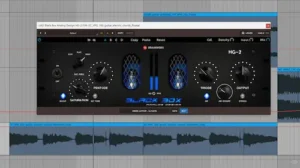 Saturation is easy to approve on the main monitors and harder to judge across playback systems. The HG-2 can make a mix feel denser and more continuous in a controlled room, where the relationship between added harmonics, softened peaks and the original low end is easy to hear. Smaller speakers often expose the trade-off more clearly: useful density remains intelligible, while excessive processing turns into midrange congestion.
Quiet monitoring after level matching is one of the fastest checks. As playback level drops, the mix should still preserve hierarchy. The lead vocal, snare and other focal elements need to remain distinct rather than merging into a constant band of harmonic activity. If the processed version only sounds better when played louder, the HG-2 setting is difficult to defend.
Mono is useful for a different reason. Added harmonic content can make a stereo mix feel larger without actually improving spatial depth. Collapsing the signal removes that impression and exposes whether the center has become overcrowded. If vocal presence, snare energy and dense instruments begin fighting for the same space, the processing has probably added more information than the arrangement can support.
Before a final limiter, the HG-2 can be useful when it changes the right peaks. Mild saturation may reduce isolated transient extremes while increasing average density, allowing the limiter to reach the same final level with less audible intervention. That benefit disappears when the source is already heavily clipped or saturated, where the relationship between loudness and clipping in mastering becomes more important than adding another color stage. In that case, another nonlinear processor can leave the limiter with a denser signal but no meaningful improvement in peak structure.
Codec translation should be tested rather than assumed. Lossy encoding can expose dense high-frequency material, stressed cymbals and aggressive vocal harmonics differently from the uncompressed master. The HG-2 is not inherently bad for streaming, but a setting approved only from the lossless source may behave differently after encoding. This is part of the broader problem of mastering for streaming platforms: processing decisions have to survive the delivered format, not just the lossless session. For critical releases, an encoded audition is more useful than assuming that analog-style saturation automatically improves translation.
Streaming normalization does not change that calculation. Platforms may adjust playback level, but they do not reverse harmonic processing, restore softened transients or recover depth lost earlier in the chain. The HG-2 therefore has no special advantage under normalization. Its value is determined before delivery: whether the tonal balance, density and peak structure are better after processing at a comparable playback level.
For mastering, that leads to a simple test. Do not ask whether the HG-2 helps the track become louder. Ask whether the same delivery level can be reached with better punch, clearer hierarchy and less audible work from the final limiter.
Verdict: Is the UAD Black Box HG-2 Worth It?
The UAD Black Box HG-2 is worth considering when a mix or master needs several related changes at once: more harmonic density, a different relationship between peaks and average level, and additional weight without the envelope behavior of another compressor. Its multi-stage architecture remains the reason to use it. This is more than a drive control wrapped in analog styling.
Its best applications are selective. A balanced mix that feels too lean, a drum bus with more attack than body, or a master relying too heavily on the final limiter can all give the HG-2 a clear job. Dense productions with extensive clipping, saturation and bus processing are less convincing candidates. Adding another nonlinear stage because a mastering chain is expected to contain one is not a reason to use it.
The buying decision is narrower than the sonic verdict. For existing Apollo and UAD-2 users, the plugin is a strong fit for mix buses, selected subgroups and mastering chains. Engineers who already own HG-2MS, need unrestricted native instances or want precise multiband control have less reason to choose this version.
The HG-2 remains relevant because its stages can distribute harmonic color and peak reshaping in ways that are difficult to reproduce with a single EQ, compressor or distortion stage. That advantage survives only when the processing is level-matched and used with restraint. If the plugin sounds better mainly because the mix became louder and thicker, it has not solved the problem.
Overall Rating
| Category | Rating |
|---|---|
| Sound Quality | 9.2/10 |
| Mixing and Mastering Workflow | 9.0/10 |
| Translation and Level-Matched Performance | 8.8/10 |
| DSP Efficiency | 6.5/10 |
| Saturation Flexibility | 8.7/10 |
| Value for Existing UAD Users | 9.0/10 |
| Overall | 8.5/10 |
The UAD Black Box HG-2 earns its rating through its combination of multi-stage saturation, transient shaping and practical mix-bus workflow. The score reflects both its strengths and limitations: excellent harmonic control and strong workflow value, balanced against DSP requirements and reduced flexibility compared with native alternatives.
Sound Quality — 9.2/10. The HG-2 can add weight and harmonic density without immediately turning a bus or master into an obvious distortion effect. Its strongest quality is the way several restrained stages can produce a more integrated result than one circuit driven hard. The deduction is deliberate: dense or already saturated material can lose separation quickly, and the plugin does not improve every source simply by being inserted.
Mixing and Mastering Workflow — 9.0/10. Pentode, Triode, parallel Saturation, Density, Air and Calibration provide enough control to shape the result without turning the plugin into a technical routing exercise. It is particularly effective on mix buses, drum buses and selected mastering chains. The workflow becomes less attractive when a session needs many instances or precise frequency-dependent processing.
Translation and Level-Matched Performance — 8.8/10. At conservative settings, the HG-2 can improve the relationship between transient peaks and the body of a mix in a way that survives matched comparison. It can also make a signal appear better simply because it becomes denser and perceptually louder. The score reflects both sides: the processing can translate extremely well, but only when output level, depth and transient definition are checked rather than assumed.
DSP Efficiency — 6.5/10. At roughly 36 percent of one UAD-2 SHARC processor at 44.1 kHz, the HG-2 is better suited to a few strategic buses than session-wide use. That is acceptable for a mastering processor but restrictive compared with native alternatives.
Saturation Flexibility — 8.7/10. The combination of serial tube stages and a separate parallel saturation path gives the HG-2 more range than a basic drive-and-tone processor. It can move from subtle density to obvious coloration, but it is not a substitute for multiband saturation, detailed Mid-Side processing or surgical peak control.
Value for Existing UAD Users — 9.0/10. Inside an established Apollo or UAD-2 workflow, the HG-2 is a focused and useful addition for engineers who want this specific multi-stage saturation architecture. The value drops sharply for anyone who needs native scalability, already owns HG-2MS or has another processor covering the same role.
UAD Black Box HG-2 FAQ
Does the UAD Black Box HG-2 run natively without Apollo or UAD-2 hardware?
No. This UAD version runs on compatible Apollo or UAD-2 DSP hardware. If native operation is a requirement, compare the available HG-2 software versions and other native saturation processors before buying.
How much UAD DSP does the Black Box HG-2 use?
Universal Audio’s DSP chart lists the HG-2 at roughly 36 percent of one UAD-2 SHARC processor at 44.1 kHz. That makes a few strategic instances more practical than session-wide use.
Does the HG-2 use more DSP at higher sample rates?
Yes. Higher sample rates reduce the number of plugin instances a UAD system can run. Engineers working at 88.2 or 96 kHz should account for the HG-2’s DSP demand before building it into multiple buses.
Should the HG-2 go before or after a bus compressor?
Put it before the compressor when the saturation should change the signal driving the detector. Place it after when the compressor should establish the dynamics first and the HG-2 should shape the controlled result. Neither order is universally better.
Can the Black Box HG-2 replace a clipper before a limiter?
Not directly. The HG-2 can reshape peaks while adding harmonics, but a dedicated clipper provides more predictable peak control. Use the HG-2 when the tonal change is part of the result, not when peak reduction is the only objective.
Is the standard HG-2 or HG-2MS better for mastering?
HG-2MS is the stronger choice when detailed Mid-Side and stereo control are required. The standard HG-2 is better suited to faster, broad processing when the master does not need separate treatment of the center and sides.
Can the HG-2 increase loudness before limiting?
It can reduce some transient extremes and increase perceived density, which may help a master reach its target with less audible limiter action. The result depends on the source; excessive drive can reduce punch and leave the limiter with a more congested signal.
Is the UAD Black Box HG-2 useful on individual tracks?
Yes, particularly on drums, bass, vocals and instruments that need more harmonic weight. Its DSP demand makes selective use more practical than treating it as an automatic insert across every channel.
What are the best alternatives to the UAD Black Box HG-2?
HG-2MS is the closest option for deeper stereo control. FabFilter Saturn 2 is better for multiband and frequency-specific saturation, Soundtoys Decapitator for more obvious character, and a dedicated clipper for direct peak management.
Is the UAD Black Box HG-2 worth buying if I already own another tube saturator?
Only if its serial Pentode and Triode stages, parallel saturation path and bus-oriented workflow fill a real gap. If the existing processor already produces the required density and peak behavior, another overlapping saturation plugin is unlikely to change the work.

Yurii Ariefiev is a mastering engineer and audio production editor whose work focuses on saturation, gain staging, peak control and translation across real playback systems. He evaluates audio plugins by how they affect transient structure, harmonic density and downstream limiting inside practical mixing and mastering workflows.
This UAD Black Box HG-2 review approaches the plugin as a working nonlinear processor rather than an analog-emulation feature list, with emphasis on level-matched decisions, mix-bus behavior and the point where added density begins to reduce punch or depth.