
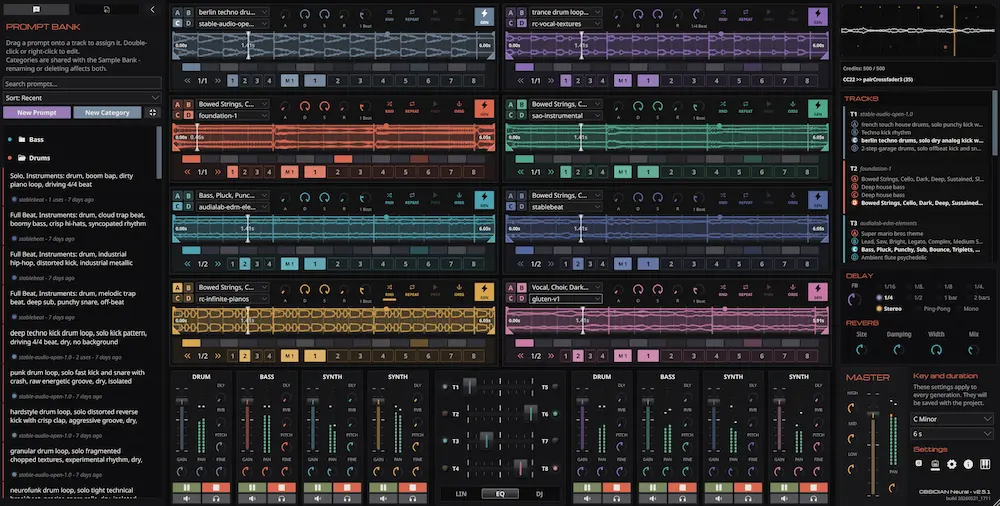
OBSIDIAN Neural Local Edition tackles a practical problem with generative audio: most AI tools still sit outside the production workflow. They generate a file, then leave the producer to download it, import it into a DAW, find the usable sections, and turn the result into something that can actually be arranged or performed. InnerMost47 takes a different approach. OBSIDIAN Neural is a VST3/AU instrument built around an eight-track sampler, while the Local Edition runs its generative model directly on the host CPU.
This is not a song generator in the Suno or Udio mold. OBSIDIAN Neural generates audio that remains part of an instrument workflow, with MIDI triggering, quantized page switching, live crossfading, multi-output routing, and onboard processing. The real test is not whether it can produce an impressive loop from a prompt. It is whether local AI generation becomes fast, controllable, and integrated enough to earn a place inside an actual production or performance setup.
OBSIDIAN Neural Local Edition: Key Specifications
| Feature | Details |
|---|---|
| Plugin formats | VST3 and AU, plus standalone operation |
| Operating systems | Windows, macOS on Apple Silicon, and Linux |
| Local AI model | Stable Audio 3 Medium |
| Processing | Runs on the host CPU; no dedicated GPU required |
| Offline use | Local generation works without an internet connection after setup |
| Instrument structure | Eight tracks with MIDI triggering and multiple pages for generated material |
| Performance controls | Quantized page switching, crossfading, MIDI mapping, and tempo synchronization |
| Studio routing | Multi-output operation for separate DAW processing |
| Server mode | Optional access to additional AI engines through cloud or self-hosted operation |
| Current availability | Local Edition beta |
Why Offline AI Audio Generation Matters Inside a DAW
 Generative audio has improved faster than its production workflow. A browser-based tool may produce a convincing passage, but the producer still has to export the file, import it into a DAW, isolate the useful section, check the timing, and decide whether the material can survive editing and processing. The generation may be fast; using the result often is not.
That workflow is acceptable for occasional ideation. It is a poor fit for an instrument, where the distance between an idea and a playable result needs to stay short.
Local inference changes that equation. OBSIDIAN Neural Local Edition runs Stable Audio 3 Medium on the host CPU instead of requiring a remote GPU service for every generation. After the initial setup, generation can run offline, with prompts and audio remaining on the local machine. For studio and live use, that removes several points of friction at once: network dependency, server availability, cloud credits, and the interruption of moving between a browser and the DAW.
InnerMost47 claims that a recent laptop CPU can generate usable loops in roughly 10 to 11 seconds. That is not a universal benchmark. Actual performance will depend on the processor, available system resources, and the load imposed by the rest of the session. More important, generation time alone does not reveal whether the DAW remains responsive while inference is running—a distinction that matters far more in a real project than an isolated speed figure.
Ten seconds is still not real-time synthesis. A conventional sampler or synthesizer responds immediately; OBSIDIAN Neural must generate material before that material becomes playable. But the delay is short enough to support a different working rhythm from cloud rendering: generate, audition, reject or keep, then continue building the session without leaving the production environment.
That is the real significance of the Local Edition. The question is no longer whether AI can generate audio—the market has already answered that. The harder test is whether generation can happen quickly and reliably enough to become part of the producer’s decision loop rather than a separate task outside it.
From AI Generation to a Playable Production Workflow
OBSIDIAN Neural is most convincing after the generation is finished. Instead of treating each result as an exported file, the plugin places generated material inside an eight-track environment built for triggering, organization, and performance. MIDI control, quantized page switching, crossfading, and onboard processing make it closer to a generative performance sampler than a conventional text-to-audio interface.
For producers, the immediate benefit is not automatic composition. It is a shorter path from generation to arrangement. A useful loop can remain inside the instrument, be assigned to a track, combined with other material, and triggered from the same session. That matters because the weak point in many AI workflows is not generating audio; it is turning disconnected results into sources that can be arranged and controlled.
The page system becomes more relevant in live and improvisational work. Material can be prepared in groups, then moved through with quantized switching and crossfades rather than launched as unrelated files. The model itself is not responding like a synthesizer or sampler—generation still takes time—but once the material exists, the performance layer gives it a structure that standalone text-to-audio tools generally lack.
Sound design may be an even stronger use case. A generated texture, percussion layer, transition, ambient bed, or harmonic fragment does not need to support an entire composition. It only needs to provide a useful source that would have taken longer to record, synthesize, or locate in a library. This is part of a broader shift toward generative instruments: our MotionTones review examines a very different approach, using physics-based motion rather than an AI model to produce evolving material. In both cases, unpredictability becomes useful when the producer is searching for sources rather than asking the system to finish the record.
The onboard filters, EQ, compression, distortion, delay, and reverb support that workflow, but they are not the decisive feature for studio use. Multi-output routing is. Sending parts to separate DAW channels allows generated material to be edited and mixed like any other set of sources, with independent EQ, dynamics, automation, bussing, sidechain processing, and spatial control.
That separation is critical once several generated layers begin interacting. A single stereo output limits decisions at exactly the stage where control matters most. With discrete routing, OBSIDIAN Neural can function as a source generator at the front of a conventional mixing workflow rather than as a closed AI system that delivers a finished result.
This is the plugin’s clearest distinction from standalone AI music services. The value is not simply that it can create more material. Production already has an abundance of material. The harder problem is getting useful ideas into a form that can be arranged, performed, revised, and mixed without rebuilding the workflow around the generator.
CPU-Only AI Generation Changes the Production Equation
 The important feature of OBSIDIAN Neural Local Edition is not generative AI by itself. It is the ability to run Stable Audio 3 Medium locally without requiring a dedicated GPU. That puts offline text-to-audio generation within reach of music systems that were built for DAW performance rather than machine-learning workloads.
That distinction matters in studios. A production computer is typically configured around low-latency audio, virtual instruments, plugin-heavy sessions, quiet operation, and driver stability. A high-end discrete GPU is not a standard requirement for most mixing or mastering work, and many Apple Silicon systems already handle demanding audio sessions without one. Removing the dedicated-GPU requirement makes local generation easier to add to an existing setup.
The trade-off is resource competition. OBSIDIAN Neural runs inference on the same processor the DAW may already be using for instruments, oversampling, convolution, look-ahead processing, metering, and the audio engine itself. The useful benchmark is therefore not generation time in isolation. It is how much CPU headroom remains available to the session while the model is working.
A roughly 10-second generation cycle is practical if the DAW stays responsive and playback remains stable. If inference competes heavily with the audio engine, the same figure becomes less meaningful. That is why standalone benchmarks reveal only part of the workflow: a light writing template, a large production session, and a near-finished mix place very different demands on the same processor.
For that reason, local generation is likely to fit most naturally earlier in production, during writing, arrangement, and sound selection, when sessions tend to have more available headroom and the generated material is still being evaluated. Once the arrangement is fixed, important parts can be committed to audio and the session can be prepared for mastering without keeping the generative model active through the final production stages.
This does not reduce the value of CPU-only generation. It clarifies the workflow. Local AI is most useful when it behaves like a temporary production resource: generate the material, keep what earns its place, print the sources that matter, and free the processor for the rest of the session.
Why AI-Generated Audio Still Has to Earn Its Place in the Mix
A generated loop can sound finished on first playback and still fail the moment the arrangement fills in. The real test is not whether a source sounds impressive in solo. It is whether the source leaves enough room for the rest of the record.
The failure points are familiar: transients that pull against the groove, low-frequency energy that competes with the bass or kick, baked-in ambience that limits depth control, and broad spectral density that occupies more space than the part deserves. None of these problems is unique to AI. Engineers encounter the same issues with commercial loops, resampled material, field recordings, and heavily processed sample libraries.
Generative tools do, however, change the rate at which those problems can accumulate. When another variation is only a short generation cycle away, adding material feels almost free. The cost appears later, when several individually convincing layers have to share the same frequency range, stereo field, and dynamic space. Additional nonlinear processing can increase that pressure; as our UAD Black Box HG-2 review shows, added harmonic density can make a source feel larger while reducing separation when the production is already crowded.
That makes selection more important than generation. In an eight-track environment, the strongest result is rarely the one with the most active layers. A sparse source that leaves room for the vocal, rhythm section, or lead element may be more useful than a spectacular standalone generation that dominates the arrangement. The practical discipline is simple: audition in context, define a role for each layer, and reject anything that requires excessive processing just to justify its presence.
Multi-output routing becomes valuable at this stage because each retained source can be treated on its own terms. Separate DAW channels allow independent control over timing, low-end weight, transient shape, depth, automation, and saturation. A stereo sum may be convenient for performance, but it gives away too much control once the material becomes part of a serious mix.
Commercial sessions also need a clear commitment point. Once a generated part becomes arrangement-critical, printing it to audio is safer than assuming the same source can always be recreated from a saved plugin state. Model updates, software revisions, and changes in generation behavior can complicate long-term recall; a rendered audio file preserves the exact source the mix was built around.
This is where OBSIDIAN Neural stops being an AI story and becomes a production tool. The model can supply material, but it cannot decide which layers deserve space, which ones should be removed, or when a source is stable enough to commit. Those decisions still determine whether the final mix translates.
Where OBSIDIAN Neural Works—and Where Conventional Tools Are Still Faster
OBSIDIAN Neural makes the most sense when the producer wants material that has not been fully specified in advance. Textures, rhythmic beds, transitions, atmospheric layers, and unexpected variations can benefit from a system that searches a wider range of outcomes than a conventional preset or sample browser.
The advantage disappears when the target is precise. If a track needs a kick with a specific envelope, a bass pattern locked to an exact rhythm, or a defined harmonic voicing, synthesis, sampling, or recording will often reach the result faster. Prompting is not automatically efficient; every generation introduces an audition and selection stage, and repeated attempts can take longer than building a known sound directly.
The same distinction applies to performance. InnerMost47 describes OBSIDIAN Neural as a real-time AI instrument, but local generation and real-time response are not the same thing. A reported 10-to-11-second generation cycle may be fast for CPU-based text-to-audio inference, yet a synthesizer or sampler responds at the moment of input. OBSIDIAN Neural generates first and becomes playable afterward. Its performance value comes from what can be done with the resulting material through MIDI triggering, page switching, and crossfading—not from instantaneous model response.
Predictability remains another trade-off. The variation that makes generative audio useful for discovery also makes it less suitable for exact direction and repeatable source design. A producer may receive something better than expected, something unusable, or something close enough to trigger another round of prompting. Whether that uncertainty is productive depends on the job.
Local operation also shifts the computational burden onto the production machine. That issue is manageable if generation happens during a dedicated writing or sound-design stage, but it becomes harder to ignore in sessions already close to their CPU limit. The Local Edition removes dependence on remote inference; it does not remove the processing cost of inference itself.
Beta status adds a more practical constraint. Professional adoption depends on session recall, host compatibility, installation behavior, update stability, and confidence that a project can be reopened months later. Free beta access makes OBSIDIAN Neural easy to test, but it does not yet establish the long-term reliability required for critical commercial sessions.
The useful dividing line is straightforward. OBSIDIAN Neural earns its place when uncertainty produces material faster than deliberate construction would. When the producer already knows exactly what the track needs, conventional tools are usually the shorter route.
OBSIDIAN Neural vs AI Song Generators, Samplers, and Loop Libraries
OBSIDIAN Neural has no exact one-to-one competitor because it overlaps several established workflows. It generates audio like a text-to-audio system, organizes material like a multi-track sampler, and adds controls intended for live triggering and transitions. Comparing it only with Suno or Udio ignores the instrument layer; comparing it only with a conventional sampler ignores the ability to create new source material from a prompt.
| Workflow | What It Does Best | Where the Audio Comes From | Control After Creation | Main Limitation |
|---|---|---|---|---|
| OBSIDIAN Neural Local Edition | Generating and performing new audio inside a plugin | Local AI generation on the host CPU | MIDI triggering, page switching, crossfading, processing, and multi-output routing | Generation delay, CPU demand, and less predictable results |
| Cloud AI song generators | Creating complete musical ideas from prompts | Remote model generation | Usually limited until the result is exported and edited elsewhere | Weak integration with conventional DAW workflows |
| Standalone text-to-audio tools | Creating custom textures, effects, and source material | Local or cloud generation, depending on the system | Typically begins after export | Generation and performance are separate stages |
| Conventional samplers | Precise playback, editing, and repeatable performance | User samples or installed libraries | Deep, deterministic control | Cannot generate genuinely new source material without external input |
| Loop libraries | Finding polished, ready-made material quickly | Pre-recorded and curated catalogs | Depends on how extensively the producer edits the source | Time spent searching and the possibility of widely used material |
The comparison makes OBSIDIAN Neural’s position clearer. Producers who want complete songs from prompts are better served by dedicated song generators. Detailed sample mapping, exact recall, and deterministic playback still favor a mature sampler, while precise sound design is usually faster in an instrument that exposes the parameters responsible for the result.
OBSIDIAN Neural is aimed at a narrower workflow: generating material and then performing with it inside the same environment. That can suit electronic producers building arrangements from evolving layers, live artists who want groups of related material under MIDI control, and experimental musicians who value variation more than exact repetition.
Composers and sound designers may also find it useful as a source generator, particularly when the target is broad enough to benefit from unexpected results. The less precisely the sound can be specified in advance, the stronger the case for generation. When the target is already known, synthesis, recording, or a well-organized sample library will usually be faster.
Mixing and mastering engineers should view OBSIDIAN Neural accordingly. It is not an AI mixing assistant, an automated mastering system, or a repair tool. It creates production material. Once that material enters an arrangement, its balance, dynamics, stereo behavior, and translation still have to be handled through conventional engineering decisions.
OBSIDIAN Neural Local Edition Rating
| Category | Rating |
|---|---|
| Generative Workflow | 9/10 |
| DAW Integration | 9/10 |
| Performance Design | 8.5/10 |
| Production Control | 8/10 |
| CPU Practicality | 7.5/10 |
| Professional Reliability | 6.5/10 |
| Beta Value | 9/10 |
| Overall | 8.2/10 |
Generative Workflow — 9/10. OBSIDIAN Neural solves a real problem in AI audio production: generated material does not have to leave the creative environment before it becomes usable. Moving from generation into triggering, arrangement, and performance inside the same instrument is a stronger workflow than exporting isolated results from a browser-based service.
DAW Integration — 9/10. VST3/AU operation, MIDI control, an eight-track structure, and especially multi-output routing give the plugin a credible place in a professional session. Separate outputs matter more than the onboard effects because they allow generated sources to enter a conventional mixing workflow without being locked into a single stereo sum.
Performance Design — 8.5/10. Quantized page switching, crossfading, and MIDI triggering give generated material a useful performance layer. The score stops short of 9 because generation itself is not instantaneous: the model creates material first, and the instrument becomes responsive after that material exists.
Production Control — 8/10. OBSIDIAN Neural offers far more control after generation than a standalone AI song generator, but probabilistic source creation remains less precise than synthesis, sampling, or recording. When a producer already knows the exact sound, rhythm, or articulation required, conventional tools are usually faster.
CPU Practicality — 7.5/10. Running Stable Audio 3 Medium without a dedicated GPU is a major accessibility advantage, but local inference competes with the same processor used by the DAW. Until performance is measured across a wider range of real sessions and hardware, CPU-only operation should be treated as a promising workflow advantage rather than proven efficiency.
Professional Reliability — 6.5/10. This is the category most constrained by beta status. Long-term session recall, update stability, host compatibility, and behavior across commercial projects still need time to establish. Free access makes experimentation easy; it does not make the software production-proven.
Beta Value — 9/10. Free beta access removes most of the financial risk of testing a genuinely unusual production workflow. The rating applies to the current beta period, not to future commercial pricing, which has not yet established the plugin’s long-term value proposition.
Overall — 8.2/10. OBSIDIAN Neural Local Edition is one of the more coherent attempts to bring generative audio into an actual production and performance workflow. Its strongest qualities are integration, routing, and the decision to treat AI output as playable source material rather than a finished song. The score is held back by beta-stage reliability, uncertain CPU behavior across demanding sessions, and the unavoidable loss of precision that comes with generative source creation.
From Generated Loops to a Mix That Actually Translates
 OBSIDIAN Neural may change where source material comes from, but it does not change what happens after that material enters an arrangement. A generated layer still has to coexist with the kick, bass, vocals, transients, ambience, and every other source competing for space in the mix.
The first problem is context. A loop that sounds large on studio monitors may owe much of that impression to deep low-frequency content, broad stereo information, or ambience already embedded in the source. Those qualities can be attractive in isolation and restrictive in a full arrangement. The mix still has to preserve the elements that matter when playback moves from nearfields to headphones, cars, phones, and smaller speakers.
Density becomes more consequential as generated layers accumulate. Several sources with sustained energy can leave little transient or spectral space before mastering begins. Pushing that mix harder into a limiter may increase level, but it cannot restore separation that was lost in the arrangement. This is one reason mastering can expose problems already built into the mix rather than solve them.
Fast generation also changes how material should be monitored. Newness can make an unusual source feel more important than it is, especially when it is auditioned louder or in solo. Level-matched comparison, mono checks, and repeated listening inside the arrangement are more useful than deciding from the first playback. Spectrum analysis can confirm a suspicion, but it should not replace the basic question: does this layer still contribute when the rest of the record is playing?
Delivery formats introduce no special exception for AI-generated audio. Dense high-frequency material, diffuse stereo content, and heavily layered ambience can become less stable under lossy encoding regardless of how the source was created. The same applies when mastering for streaming platforms: normalization does not rescue an over-limited mix, and the familiar trade-offs between loudness, punch, density, and distortion remain exactly where they were.
The practical workflow is to treat OBSIDIAN Neural as a source-generation stage rather than permanent session overhead. Generate and organize material while the arrangement is still fluid, route the parts that need individual control, then commit arrangement-critical sources to audio once their role is established. From that point forward, edit, mix, and master the track according to what is actually coming out of the speakers—not according to the technology that created the source.
That distinction matters. AI generation can accelerate the search for material, but it does not shorten the engineering chain after the material has been chosen. Translation is still won or lost through arrangement, monitoring, mixing decisions, and the quality of the final master.
Verdict: OBSIDIAN Neural Works Best as a Generative Instrument, Not an AI Songwriter
OBSIDIAN Neural Local Edition has a clearer purpose than most AI music tools. It generates source material, keeps that material inside a playable environment, and gives the producer enough control to move from prompting into arrangement and performance without rebuilding the workflow around a browser-based service.
The local CPU engine is the reason the concept matters. Offline generation removes routine dependence on remote servers, cloud credits, and an active internet connection, while the eight-track architecture gives the resulting audio a practical destination. MIDI triggering, page switching, crossfading, and multi-output routing are not secondary additions; they are what separate OBSIDIAN Neural from a text-to-audio generator that simply delivers another file.
The trade-offs are substantial. Generation is not instantaneous, inference competes for CPU resources, beta software still has to prove its reliability, and probabilistic output cannot match conventional instruments when a production requires exact control. A producer with a clearly defined target may reach it faster with synthesis, sampling, recording, or an existing library.
OBSIDIAN Neural is therefore best suited to electronic producers, live performers, sound designers, and experimental musicians who want variation before precision. It is a poor fit for anyone looking for complete songs from prompts, automated mixing or mastering, or a faster way to create a sound that has already been precisely defined.
The strongest case for the Local Edition is simple: generative audio is more useful when it enters the production chain as editable, playable source material rather than leaving it as a finished stereo export. OBSIDIAN Neural does not remove the work that follows generation, but it places the generated result where that work can actually begin.
OBSIDIAN Neural Local Edition Price and Beta Access
OBSIDIAN Neural Local Edition is currently available through the developer’s beta program. Unlike the server-based workflow, local generation runs on the user’s own CPU and does not consume cloud generation credits while operating offline.
That distinction matters when comparing it with cloud AI music services. Local operation moves the computational cost to the user’s own machine, while server mode remains available for producers who want access to the broader lineup of specialized AI engines. Before installing, users should verify the current beta terms, final pricing, and activation requirements directly with InnerMost47, since those details can change while the Local Edition is still being rolled out.
OBSIDIAN Neural Local Edition FAQ
Can OBSIDIAN Neural Local Edition run completely offline?
Yes. After the one-time setup, the Local Edition can generate audio without an internet connection. Prompts and generated material remain on the local machine rather than being sent to a remote inference server.
Does OBSIDIAN Neural Local Edition require a dedicated GPU?
No. The Local Edition runs Stable Audio 3 Medium on the host CPU. Actual generation speed will depend on the processor and the workload already being handled by the production system.
How fast does OBSIDIAN Neural generate audio on a CPU?
InnerMost47 reports generation times of roughly 10 to 11 seconds for usable loops on a recent laptop CPU. That is a developer figure, not a guaranteed benchmark for every computer or DAW session.
Which plugin formats and operating systems does OBSIDIAN Neural support?
The Local Edition is available for Windows, macOS on Apple Silicon, and Linux, with VST3 and AU support. Intel-based Mac users are not included in the stated Local Edition compatibility.
Can OBSIDIAN Neural Local Edition be activated on more than one computer?
Yes. The beta license allows activation on up to three machines, which is useful for producers working across separate studio, laptop, or performance systems.
Can OBSIDIAN Neural switch between local and cloud AI models?
Yes. The Local Edition can use the CPU-based local model offline and switch to server mode when additional model options are needed. Server mode can provide access to a broader lineup of specialized AI engines through a cloud subscription or self-hosted server.
Should OBSIDIAN Neural parts be bounced to audio before mixing?
For arrangement-critical material, committing the final source to audio is the safer production workflow. It reduces CPU demand, simplifies editing and project transfer, and preserves the exact sound used to build the mix.
Does AI-generated audio require special mastering?
No. Mastering decisions should be based on the finished mix, not on whether a source was generated by AI. Stereo balance, low-frequency control, transient integrity, distortion, and overall density still have to be evaluated from the audio itself.
Is OBSIDIAN Neural an alternative to Suno or Udio?
Not in the direct sense. Suno and Udio are designed around generating larger musical outputs from prompts. OBSIDIAN Neural generates material for triggering, layering, processing, and performance inside a plugin-based production workflow.
Is OBSIDIAN Neural Local Edition free?
The Local Edition is free during the beta period. The beta does not establish what the product will cost afterward, so long-term value cannot be judged until post-beta pricing and license terms are confirmed.

Yurii Ariefiev is a mastering engineer and audio production editor focused on how modern production tools behave beyond the feature list—inside real DAW sessions, dense mixes and finished masters. His work examines source quality, routing, CPU demands, stereo behavior and translation across playback systems.
For this article, OBSIDIAN Neural Local Edition is evaluated as a generative audio instrument rather than an AI novelty: how locally generated material enters an arrangement, competes for mix space, moves through a professional production workflow and affects the decisions made before mastering.

