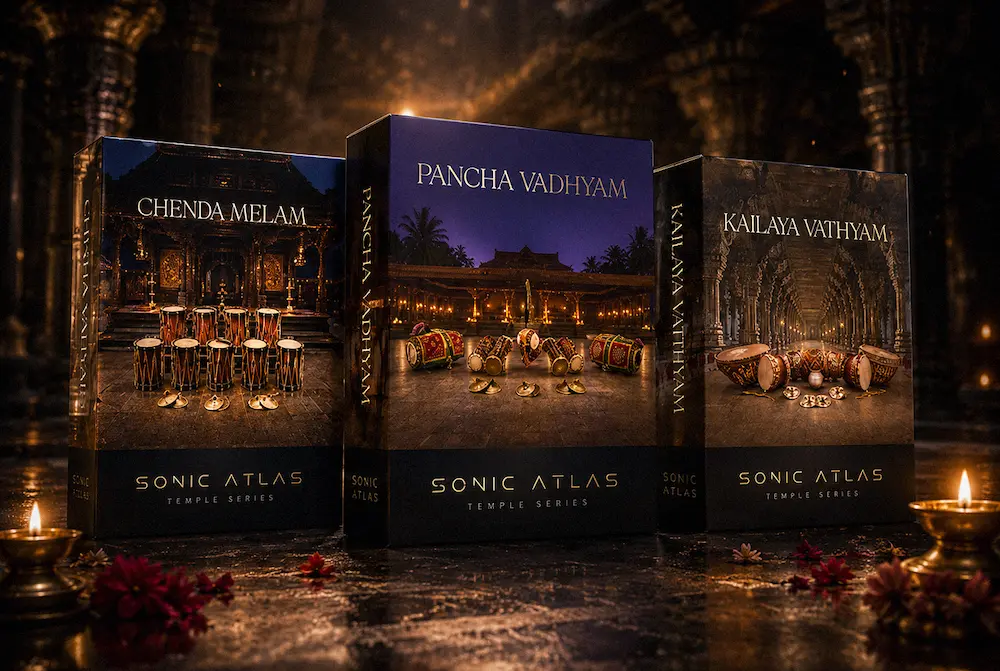
Pitch Innovations Temple Drums of India is a three-kit percussion collection for the free Sonic Atlas sampler, covering Pancha Vadhyam, Chenda Melam, and Kailaya Vathiyam. The library is built around recorded South Indian temple ensembles rather than a conventional set of isolated drum instruments, so the main attraction is the performance itself: multiple players moving together through changing rhythmic density, tempo, and ensemble configurations.
That changes how the library works in a production. Instead of programming every interaction between individual percussion instruments, you can start with a recorded ensemble performance and move between solo, duo, and full-group material as the arrangement develops. The result is particularly useful for film scoring, trailer work, hybrid orchestral production, electronic music, and other situations where the percussion needs to sound like a real group rather than a stack of perfectly aligned samples.
I approached Temple Drums primarily as a production source rather than as another sampler feature set. The important questions are therefore practical: how convincing the ensemble interaction feels, how easily the material can be arranged, where the recordings become difficult to control in a dense mix, and whether the three kits justify their $99 bundle price.
Quick Verdict
Temple Drums of India is a strong specialist percussion library for producers who need authentic South Indian ensemble performance rather than another collection of generic cinematic drum samples. Its biggest strengths are ensemble realism, recorded player interaction, and a workflow that reduces the amount of MIDI programming required to create convincing rhythmic parts. The main limitations are its specialized scope and the transient, room, and low-frequency management required when large ensembles are layered into dense productions. At $99 for all three kits, it offers strong value when South Indian percussion is a recurring part of your workflow.
Hands-On Testing
I tested Temple Drums of India as a production instrument rather than judging it from the feature list alone. I compared the ensemble material at different densities and listened specifically for the points that usually become problematic once percussion is placed inside a finished arrangement: transient buildup, low-frequency accumulation, room information, and the amount of separation between individual players.
The most useful behavior appears when the ensemble is allowed to remain the main rhythmic event. Chenda Melam, in particular, can generate enough simultaneous transient information that adding another large cinematic percussion layer quickly becomes counterproductive. Kailaya Vathiyam behaves differently: its deeper resonance makes the relationship with kick and bass more important than simply adding EQ to make the drum “fit.” These are production decisions I would not make from the sample count or feature list alone.
Independent review: This review evaluates Temple Drums of India from a production and mixing-engineering perspective rather than simply reproducing the manufacturer’s feature list. The assessment focuses on ensemble realism, source quality, arrangement workflow, transient density, low-frequency interaction, spatial behavior, mix integration, and whether the library provides a practical advantage over building similar percussion parts from individual samples.
Temple Drums of India: Pros and Cons
Pros:
- Authentic South Indian ensemble performances recorded with 40 musicians.
- Full ensemble, duo, solo, and individual instrument material reduces the need for manual ensemble programming.
- Strong rhythmic realism from real player interaction rather than isolated sample construction.
- Close and ambient microphone perspectives provide useful control over depth and room energy.
- Excellent fit for film scoring, hybrid orchestral production, cinematic electronic music, and culturally specific percussion.
- Three specialized kits cover different production roles without requiring a large general-purpose percussion library.
- $99 bundle pricing offers strong value for producers who regularly need South Indian percussion.
Cons:
- The library is highly specialized and is not a replacement for a broad Indian percussion collection.
- Dense ensemble performances can create transient buildup and low-frequency overlap in busy mixes.
- Ambient microphone material can compete with existing reverbs and orchestral room sound.
- The sampler technology itself is evolutionary rather than a major DSP innovation.
- There is not enough independent benchmark data to make reliable CPU or memory performance claims.
- The $99 bundle is harder to justify if South Indian percussion is only an occasional production requirement.
In This Review
Why South Indian Ensemble Percussion Is Hard to Recreate With Samples
 Most percussion libraries are built around individual instruments: capture the hits, add velocity layers and round robins, then let the producer assemble the rhythm. That works well when each instrument needs to function independently. It is a different problem when the character of the performance comes from the interaction between multiple players.
Temple Drums of India is built around that interaction. Pancha Vadhyam contains 1,321 samples recorded with 12 musicians, Chenda Melam contains 1,471 samples from a 15-player ensemble, and Kailaya Vathiyam contains 1,159 samples from 13 musicians. Across the three kits, Temple Drums of India contains 3,951 samples: 3,168 one-shots and 783 loops, with solo, duo, full-ensemble, and individual instrument material alongside the recorded ensemble performances.
The practical advantage is timing. With isolated percussion samples, the producer has to create the relationship between the players manually—attack placement, velocity changes, density, accents, and the movement from one rhythmic stage to the next. Temple Drums captures much of that relationship in the performance itself.
That does not make every loop automatically more useful. It means the library is particularly efficient when the required part already resembles the way the ensemble was recorded. In those situations, the producer is selecting and arranging a performance instead of reconstructing one.
That makes Temple Drums of India better understood as a playable ensemble-performance library than as a conventional Indian percussion sample pack.
How Temple Drums of India Changes the Production Workflow
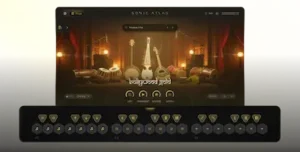
Sonic Atlas is the free sampler platform that hosts Temple Drums of India. Temple Drums of India is not a standalone percussion plugin; the three kits are expansion packs that run inside Sonic Atlas as AU, VST3, and AAX plug-ins on macOS and Windows, as well as through the standalone application. You are paying for the recorded percussion content; Sonic Atlas itself is the free playback platform.
The useful part of the library is the combination of loops, fills, one-shots, velocity layers, round robins, and close/ambient perspectives. Tempo-synced performances can be reshaped with Reverse, Half-Time, Double-Time, and Stutter controls without leaving the instrument. None of this represents a major DSP breakthrough—these are established sampler functions—but they become more valuable when applied to recorded ensemble performances rather than generic one-shot material.
The workflow advantage becomes clear during arrangement. A composer can establish a section with a full ensemble performance, reduce the density with a duo or solo part, introduce a fill at a transition, and return to the larger ensemble for the next section. Recreating the same progression from individual percussion samples would require considerably more MIDI programming, timing work, velocity editing, and variation.
This is the practical reason to use Temple Drums: it reduces arrangement and programming work by delivering musical ensemble behavior at the source. The same source-first principle can solve a very different problem in electronic production, where our Emergence Audio Envoy review examines an instrument built around evolving synthetic percussion and controlled rhythmic variation rather than recorded ensemble realism. Temple Drums takes the opposite route—preserving the interaction of real players—but both approaches move more of the rhythmic decision-making upstream, before the material reaches the mix. Its built-in effects should still be viewed as production conveniences rather than replacements for dedicated processing.
How the Three Temple Drums Kits Behave in a Production
Pancha Vadhyam: Flexible Ensemble Texture
Pancha Vadhyam is the most flexible of the three kits for arrangement work. It brings together Thimila, Maddalam, Idakka, Ilathalam, and Kombu in a five-instrument Kerala temple ensemble, with 265 loops and fills and 1,056 one-shots. Individual instruments are available alongside solo, duo, and full-ensemble configurations.
Its strength is variation. The material can move between individual voices and increasingly dense ensemble passages without forcing the producer to build every rhythmic layer from scratch. The Idakka also gives the kit a more pitched, expressive character than a conventional collection of drum loops, making it useful when percussion needs to contribute melodic or textural movement.
That makes Pancha Vadhyam particularly effective in cinematic arrangements, hybrid orchestration, atmospheric electronic production, and transitions where the percussion needs to develop with the arrangement rather than simply repeat beneath it.
Chenda Melam: Density, Momentum, and Impact
Chenda Melam is the largest of the three kits, with 307 loops and fills and 1,164 one-shots across 1,471 samples. The 15-player ensemble includes Ilathalam, Kombu, and Kuzhal layers, giving the material a broader rhythmic and tonal footprint.
It is also the most immediately suited to cinematic production. The performances move from relatively restrained passages toward higher rhythmic density, making them useful for builds, action cues, drops, transitions, and climactic sections.
The same density creates a mixing consideration. A large ensemble can generate enough simultaneous transient energy to push a compressor or limiter harder than expected, particularly when layered with cinematic impacts, electronic drums, or orchestral percussion. The solution is not necessarily more processing; often the better move is to reduce the number of competing layers and let the ensemble carry the rhythmic event on its own.
Kailaya Vathiyam: Low-End Weight and Ceremonial Scale
Kailaya Vathiyam is the most specialized kit in the collection. It contains 211 loops and fills and 948 one-shots from a 13-player ensemble, with a strong emphasis on deep ceremonial drums and call-and-response performance.
Its defining characteristic is also its main mixing challenge: low-frequency physical weight. The deeper drum resonance can give a cue immediate scale, but it can also compete with kick drums, bass, low orchestral percussion, and sustained low-mid material.
That makes Kailaya Vathiyam less of a plug-and-play “big drum” solution and more of an arrangement-dependent source. In a sparse cue, the natural low end may require little intervention. In a dense production, controlling the overlap between the ensemble and the existing low-frequency foundation becomes part of the mix design.
Which Temple Drums of India Kit Should You Buy?
Buy Pancha Vadhyam if you want the most versatile of the three ensembles. Its combination of Thimila, Maddalam, Idakka, Ilathalam, and Kombu gives it the widest range of rhythmic and tonal roles. The Idakka is particularly useful when the percussion needs some pitch and movement rather than functioning purely as a drum layer.
Buy Chenda Melam if impact is the priority. It is the obvious choice for trailer builds, action cues, climaxes, and sections where the percussion needs to create a large rhythmic event. The trade-off is mix density: this is the kit most likely to compete with other cinematic percussion if several large layers are playing simultaneously.
Buy Kailaya Vathiyam if you specifically want deeper ceremonial weight. It is the most specialized option and therefore the hardest to replace with a generic percussion library. It is also the kit I would approach most carefully around kick, bass, and low orchestral material.
Buy the $99 bundle when you can identify a recurring role for at least two kits. If you only need one of these sounds, the $49 individual expansion is the more rational purchase. The bundle is cheap enough to be attractive, but buying all three simply because the discount is large does not create additional production value if two kits will remain unused.
Temple Drums of India Sound Quality and Real-World Mix Performance
The strongest argument for Temple Drums of India is not its sampler technology but the quality and behavior of the recorded source material. The ensembles retain the timing interaction, transient variation, room response, and changing rhythmic density of real players, which gives the performances a different character from percussion assembled from isolated one-shots.
Pancha Vadhyam is the most texturally flexible of the three kits. The combination of hand drums, cymbal layers, Kombu, and the pitched character of the Idakka gives it more movement than a conventional collection of rhythm loops. It can function as a rhythmic layer while still contributing tonal and spatial information to the arrangement.
Chenda Melam has the greatest sense of collective impact. The dense ensemble attacks can create substantial transient energy, but that is also what makes the kit useful for climaxes, builds, trailer cues, and large-scale rhythmic passages. It sounds most convincing when the arrangement leaves enough space for the ensemble to remain the dominant percussion event.
Kailaya Vathiyam is the most physically weighted of the three. Its deeper resonance can add scale without relying on synthetic low-end enhancement, but it also demands more attention to the relationship between percussion, kick, bass, and low orchestral material.
From a mixing-engineering perspective, these recordings do not need heavy processing to sound convincing. The engineering job is mostly to control how much of their existing transient, low-frequency, and room energy enters the mix.
What Temple Drums of India Delivers—and Where It Falls Short
 The fact that these are relatively uncommon sampled traditions is interesting, but it is not enough to justify the purchase. A percussion library becomes useful when its source material solves a problem that would otherwise require more programming, more layering, or access to musicians and recording space.
That is the stronger case for Temple Drums. The value comes from having playable recordings of complete South Indian ensembles and their individual components inside a DAW-ready instrument.
Temple Drums is strongest when the arrangement actually calls for the sound and behavior of a South Indian ensemble. In that context, the recorded group interaction and ready-to-play performances solve a real programming problem.
If the brief is simply “add some world percussion,” the case is much weaker. A broader library may offer more instruments, articulations, and general-purpose material for the same production budget.
That is where the comparison with established Indian and regional percussion libraries becomes relevant. Native Instruments’ India collection covers a broader range of Indian instruments and production material, while Soundiron has more deeply sampled individual instruments such as tabla and dhol. A different approach can be seen in our Best Service Arabic Oud review, where the value of a specialist instrument comes from regional character and performance-specific sampling rather than sheer library breadth. Temple Drums follows a similar principle, but applies it to South Indian ensemble percussion rather than a solo melodic instrument.
Its stronger proposition is narrower: focused South Indian ensemble performances, delivered through a playable workflow that reduces the amount of manual programming required to make those ensembles work in a modern arrangement.
That is the part worth evaluating—and the part that gives Temple Drums a legitimate place alongside broader Indian percussion libraries rather than making it a direct replacement for them.
Temple Drums of India vs. Broader Indian Percussion Libraries
| Library / approach | Primary strength | Ensemble realism | Instrument breadth | Best use |
|---|---|---|---|---|
| Temple Drums of India | Recorded South Indian ensembles | Very high | Focused | Film scoring, hybrid production, cinematic and electronic percussion |
| Broad Indian percussion libraries | Instrument variety | Variable | High | General Indian production |
| Deep-sampled individual instruments | Detailed instrument control | Lower at ensemble level | Focused | Detailed MIDI programming |
| Generic cinematic percussion | Production versatility | Variable | Broad | Trailers, action cues, hybrid scoring |
Sample count tells you very little here. The useful question is how much of the ensemble performance is already contained in the source. Temple Drums gives up breadth in exchange for authentic South Indian ensemble behavior, which can save substantial programming time when that specific sound is required.
Mixing Temple Drums of India in a Dense Production
Temple Drums does not need much processing simply because it is a large percussion library. The real issue is how a recorded ensemble interacts with everything else in the arrangement. In a dense production, the main constraints are transient density, room energy, and low-frequency overlap.
Transient density is the first thing to watch. A full Chenda Melam performance can contain enough simultaneous attacks to create substantial peak energy. Layer that with a drum kit, orchestral percussion, or low-frequency impacts and the mix bus may react aggressively even when the percussion channel itself is not particularly loud. In that situation, reducing competing layers or controlling the arrangement can be more effective than simply turning down the ensemble or compressing it harder.
Room energy becomes the next variable. The close and ambient perspectives give the producer control over how much of the recording’s acoustic space enters the mix. That matters when the production already contains orchestral halls, synth reverbs, or vocal ambience. An ambient percussion layer can sound impressive in isolation while filling exactly the same spatial range that another part of the arrangement needs.
Low-frequency overlap is particularly relevant to Kailaya Vathiyam. Its deep drum resonance can supply physical weight and scale, but that energy can compete directly with kick, bass, low orchestral percussion, and sustained low-mid material. An aggressive high-pass filter is not automatically the answer. Removing the lowest information indiscriminately can also remove the physical character that makes the recording useful.
The better approach is to find the actual conflict first. Depending on the arrangement, the fix may be less layering, a level change, targeted EQ, dynamic control, or a different microphone perspective. Those decisions matter before the mix reaches the final mastering stage, where accumulated peaks, low-end overlap, and excessive spatial density are much harder to correct without affecting the rest of the track. Treating the ensemble as a musical source rather than a problem to be “cleaned up” usually preserves more of what makes these recordings distinctive.
Close vs. Ambient: A Real Mixing Advantage
Close and ambient microphone perspectives are easy to overlook in a feature list, but they have a direct impact on how an ensemble sits in a mix. A pre-mixed stereo loop fixes the balance between direct sound and room energy. Temple Drums gives the producer some control over that relationship before the signal reaches the rest of the mix chain.
The close perspective is useful when articulation needs to remain defined against dense instrumentation. The ambient perspective can supply scale and depth without relying entirely on an additional reverb. That becomes particularly useful with cinematic percussion, where the acoustic environment is part of the perceived size of the performance.
The trade-off is straightforward. More ambient information also means more room energy competing with orchestral halls, synth reverbs, vocals, and other spatial elements. In a sparse arrangement that extra space can be an advantage; in a dense mix it may be the first thing that needs to be controlled.
This is a meaningful production feature, but it should be described accurately: the advantage comes from the recording and microphone perspective design, not from novel plugin DSP.
The Engineering Verdict: Where Temple Drums Works Best in a Mix
From a mixing-engineering perspective, Temple Drums is most convincing when treated as a primary rhythmic source rather than another layer in an already crowded percussion arrangement. Its ensemble performances contain enough internal variation that adding several additional cinematic percussion layers can reduce the very realism that makes the library valuable.
The most important decision is therefore often arrangement rather than processing. If Chenda Melam already supplies the rhythmic impact required for a section, adding another large drum layer may create unnecessary transient buildup. Likewise, Kailaya Vathiyam can provide enough low-frequency weight that the kick and bass relationship may need to be reconsidered before reaching for aggressive EQ.
This is one of the library’s strongest production advantages: the source material can replace multiple programmed layers instead of simply being added on top of them. Used that way, Temple Drums can actually simplify a mix rather than make it more complicated.
How I Would Actually Use Temple Drums in a Production
I would not treat Temple Drums as a percussion layer that automatically sits underneath a full drum arrangement. That wastes much of what makes the library distinctive.
For a trailer or cinematic cue, I would start with the ensemble performance as the main rhythmic statement and build the rest of the percussion around it. If Chenda Melam already provides the required impact, I would remove competing cinematic drum layers rather than stacking more percussion on top.
For electronic production, the more interesting approach is to use the ensemble as a contrast to programmed drums. A rigid electronic pattern underneath a changing acoustic performance creates a different rhythmic relationship from simply adding another loop. Pancha Vadhyam is particularly suited to this because its material can move between rhythmic and tonal roles.
Kailaya Vathiyam requires a different approach. I would decide where its low-frequency weight belongs in the arrangement before processing it. If the kick and bass already occupy the same register, the solution may be an arrangement change or level decision rather than a large EQ cut.
That is where the library makes the most sense to me: use the recorded ensemble to replace decisions you would otherwise have to program or layer manually.
CPU, Latency, and Large-Session Performance
There is not enough independent testing to make precise performance claims about Temple Drums of India. I could not find controlled third-party measurements covering CPU load, RAM usage, latency, loading times, or large-session behavior for the Temple Drums libraries specifically.
That makes claims such as “extremely low CPU usage” or “zero-latency performance” difficult to substantiate. Sample count is not a useful proxy for CPU or memory requirements either; streaming architecture, preload settings, disk performance, and the number of simultaneously active voices matter more.
For normal DAW work, compatibility is less of a concern. Sonic Atlas supports AU, VST3, and AAX on macOS and Windows, covering the main plugin formats used in professional music production.
Large scoring templates are a different case. Treat Temple Drums like any other sample-based instrument: load it into the actual template, watch memory and voice activity, and freeze or print parts when the session calls for it. There is no reason to assume that nearly 4,000 samples will automatically create a heavy session, just as there is no reason to assume the opposite without measurement.
Is Temple Drums Useful for Mixing and Mastering?
For mixing, yes—but primarily as a source instrument. Its dense ensemble performances can introduce real engineering considerations around transient buildup, low-frequency masking, room energy, stereo density, and dynamic interaction with the rest of the arrangement. Those issues are particularly relevant in cinematic, hybrid, and world-influenced productions.
For mastering, the direct value is minimal. Temple Drums does not perform any mastering function, and owning it provides no meaningful advantage for a conventional mastering workflow.
Its relevance to mastering is indirect: a well-programmed percussion part gives the mix engineer more control over peaks, low-end balance, and spatial density before the stereo bus reaches the mastering stage. If those elements are already under control, the mastering engineer has fewer problems to correct later.
That distinction matters: Temple Drums can contribute to a better mix, but it is not a mastering tool.
Where Temple Drums of India Makes the Most Sense
Temple Drums is most valuable when the percussion needs to carry rhythmic identity, scale, or movement rather than simply fill a drum track. Its strongest applications are scoring and production workflows where a convincing ensemble performance would otherwise require substantial programming.
- Film scoring and trailers: One of the strongest use cases. The ensemble performances work naturally for ceremonial passages, builds, action cues, transitions, and climactic sections. For finished film-score material, the final mastering stage also has to preserve depth and dynamic contrast rather than treating the cue like a conventional loudness-driven music release; see our guide to film score mastering.
- Hybrid orchestral production: Useful when acoustic ensemble percussion needs to add rhythmic and cultural character without relying on another generic cinematic drum layer.
- Electronic music: Effective for rhythmic beds, drops, transitions, and textural layers, particularly when processed or combined with conventional electronic drums.
- Hip-hop: Best used as a secondary rhythmic element or sampled layer rather than as a replacement for a conventional drum kit.
- Pop and rock: More situational. The material is most useful for intros, bridges, transitions, and sections that need a clear change in rhythmic character.
- Game audio: A good source for cinematic and culturally specific cues, although interactive variation and implementation still need to be handled in the game-audio workflow.
It has little direct value for podcast, voice, broadcast, or mastering work. Those workflows do not benefit from a specialist South Indian percussion instrument.
Temple Drums of India Pricing and Value
At the time of this review, Temple Drums of India is available for $99 as a three-kit bundle, reduced from the listed $237 regular price. Individual Pancha Vadhyam, Chenda Melam, and Kailaya Vathiyam kits are $49 each versus their listed $79 regular price. The current bundle pricing makes the collection substantially more attractive when more than one ensemble fits your production workflow.
At $99, the collection is reasonably priced for a specialist library containing 3,951 samples recorded with 40 musicians across three South Indian ensemble traditions. But sample count and discount percentage are secondary considerations. The real question is how often the material will solve a production requirement that your existing libraries do not.
For composers and producers who regularly need South Indian percussion, the bundle offers strong ROI. For a producer who only occasionally wants “world percussion,” a broader library will usually provide more usable material for the same budget.
Why Sonic Atlas Matters to the Long-Term Value of Temple Drums
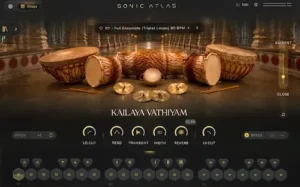 Temple Drums is easier to evaluate as part of the Sonic Atlas ecosystem than as an isolated sample library. The underlying sampler is free, while the paid expansions add increasingly specialized performance content. That separates the cost of the playback engine from the cost of the recordings themselves.
Sonic Atlas already includes collections such as Song Starter, Streets, and Tapes, alongside the Rare Kits line that includes Temple Drums. The broader strategy is clear: build a sampler around focused performance libraries rather than compete directly with general-purpose platforms on sheer instrument count.
That approach could give Sonic Atlas useful long-term value for producers who regularly work with world and regional percussion. The important variable is future content. If Pitch Innovations continues adding recordings with the same level of specificity, buying into the platform becomes more defensible because each expansion increases the usefulness of the existing instrument.
There is still a clear ceiling to the concept. Sonic Atlas is not a replacement for Kontakt, dedicated orchestral platforms, or comprehensive percussion workstations. Its advantage is specialization and speed, not breadth.
Overall Rating
| Category | Rating |
|---|---|
| Ensemble Realism | 9.5/10 |
| Sound Quality | 9/10 |
| Production Workflow | 9.5/10 |
| Mix Integration | 8.5/10 |
| Arrangement Utility | 9/10 |
| Value for Money | 9/10 |
| Overall | 9.0/10 |
Ensemble Realism — 9.5/10: This is the strongest part of Temple Drums. The interaction between multiple players, changing rhythmic density, and recorded ensemble dynamics gives the library a level of performance realism that would require substantially more programming with isolated percussion samples.
Sound Quality — 9/10: The recorded instruments have enough character and physical weight to work as foreground musical elements rather than generic percussion layers. The close and ambient perspectives also provide useful control over articulation and room presence.
Production Workflow — 9.5/10: Solo, duo, and full-ensemble material, combined with loops, fills, one-shots, velocity layers, and tempo-based transformations, removes a significant amount of repetitive MIDI programming. The workflow is one of the main reasons to choose this library.
Mix Integration — 8.5/10: Temple Drums can sit convincingly in a mix, but large ensembles introduce real engineering challenges. Transient density, room energy, stereo information, and the low-end weight of Kailaya Vathiyam can compete with drums, bass, orchestral percussion, and other spatial elements.
Arrangement Utility — 9/10: The three kits cover different production roles, while solo, duo, ensemble, loop, fill, and one-shot material allows the producer to move between rhythmic density and arrangement scale without rebuilding the entire percussion part manually. The limitation is intentional specialization rather than lack of usable material.
Value for Money — 9/10: At $99 for all three kits, the bundle offers strong value when South Indian ensemble percussion is a recurring production requirement. For occasional “world percussion” use, a broader library may deliver a better return on the same budget.
At 9.0/10, Temple Drums is easy to recommend when South Indian ensemble percussion is something you will actually use. The recordings are the reason to buy it; the Sonic Atlas workflow makes those recordings practical inside a modern DAW. I would mark it down mainly for specialization and for the amount of mix space the larger ensembles can consume.
From a mixing-engineering perspective, the library is most valuable when its performances are allowed to replace unnecessary percussion layers rather than simply being stacked on top of them. Used that way, Temple Drums can provide more character while actually reducing programming and mix complexity.
Is Temple Drums of India Worth Buying?
Yes, if South Indian percussion is a recurring requirement in your work.
Temple Drums’ specialization is its main advantage. Rather than trying to cover every Indian percussion style, it concentrates on three specific ensemble traditions and presents them in a workflow designed for modern production. That makes it more useful for a composer who needs this particular sound than for a producer looking for another general-purpose percussion library.
The strongest part of the product is the recorded ensemble material and the way it is organized for performance. The weaker case is technological innovation. Velocity layers, round robins, time manipulation, and creative effects are established sampler features; they improve usability, but they do not justify calling the instrument a major DSP advance.
The more accurate assessment is straightforward: Temple Drums is a well-designed specialist production instrument whose value comes from its ensemble performances and efficient programming workflow, not from novel DSP.
For composers, trailer producers, electronic artists, and producers who want a more distinctive alternative to generic cinematic percussion, it is a strong specialist purchase. For mastering engineers, general-purpose pop producers, or anyone who already owns more Indian percussion than they regularly use, there is little reason to add another library. Once the production is finished, the same concerns around transient density, low-end balance, and dynamic range become part of the final release workflow across streaming services; our guide to mastering for streaming platforms covers that stage in more detail.
Hear How Your Percussion Mix Translates at the Mastering Stage
Percussion with dense transients, heavy low-end, and strong room information can sound impressive in the production while still creating problems for the final master. The difference becomes obvious when the track is evaluated as a finished mix rather than as an isolated instrument.
Upload up to 35 seconds of your mix and hear a free mastering demo focused on dynamics, low-end balance, stereo depth, and translation. Compare the original and mastered versions before deciding whether the track needs further mastering work.
Get your free mastering demo →
Temple Drums of India FAQ
Is Temple Drums of India a Kontakt library?
No. Temple Drums of India is not a Kontakt instrument. The three percussion kits are expansion packs for the free Sonic Atlas sampler, which runs as AU, VST3, and AAX plug-ins as well as a standalone application on supported macOS and Windows systems.
Is Sonic Atlas a replacement for Kontakt?
No. Sonic Atlas is better understood as a focused sampler platform for specialized world-music and rhythm libraries. Kontakt remains the broader platform for large-scale instrument collections, orchestral libraries, and extensive third-party content. Temple Drums’ advantage is the specificity of its recorded ensemble performances and the speed of its dedicated workflow, not the breadth of its sampler ecosystem.
Is Temple Drums of India the best Indian percussion VST?
It is not the broadest Indian percussion option. Its advantage is narrower: Temple Drums focuses on three South Indian ensemble traditions and provides recorded group performances that are difficult to reproduce by programming isolated samples. If breadth is the priority, a larger Indian percussion collection is the better choice.
Can Temple Drums of India be used for film scoring?
Yes. The ensemble performances, fills, rhythmic builds, and close/ambient perspectives make it well suited to film, trailer, hybrid orchestral, and cinematic electronic work.
Does Temple Drums of India work for electronic music?
Yes. Tempo-synced performances and controls such as Reverse, Half-Time, Double-Time, and Stutter make the acoustic material useful for rhythmic layers, transitions, drops, and sound-design work.
Does Temple Drums of India work in Ableton, Logic Pro, and Pro Tools?
Yes. Sonic Atlas supports AU, VST3, and AAX formats on macOS and Windows, covering the main plugin formats used by Ableton Live, Logic Pro, Pro Tools, and other professional DAWs.
Is Temple Drums of India useful for mixing engineers?
As a source instrument, yes. It is not a mixing processor, but its large ensembles can create transient buildup, low-frequency overlap, room-energy, and stereo-density issues that require conventional mix-engineering decisions.
Does Temple Drums of India have high CPU usage?
There is not enough independent benchmark data to assign a reliable CPU figure. In large sessions, evaluate it in the actual DAW template and monitor memory and voice activity rather than using sample count as a performance estimate.
How does Temple Drums compare with broader Indian percussion libraries?
Temple Drums trades breadth for specialization. Broader libraries cover more instruments, while Temple Drums focuses on three South Indian ensemble traditions and provides pre-recorded group performances that reduce the amount of manual ensemble programming.
Is Temple Drums of India useful for mastering?
Not directly. It is a production instrument. Its connection to mastering is indirect: the density, low end, and transient behavior of percussion in the mix can affect headroom and dynamics before the mastering stage.
Should you buy the Temple Drums bundle or an individual kit?
Choose the bundle if several of the ensembles fit your work. An individual kit makes more sense when you have a recurring need for a specific sound, such as the large ensemble impact of Chenda Melam or the deeper drum character of Kailaya Vathiyam.
Is Temple Drums of India worth $99?
At $99 for all three kits, the bundle is good value for composers and producers who regularly need South Indian ensemble percussion. The price is harder to justify if you only need occasional world percussion or already own a broad Indian percussion collection. The individual $49 kits are the more efficient option when you only need one specific ensemble.

Yurii Ariefiev evaluates virtual instruments from a production and mixing-engineering perspective, with particular attention to sampled performance, rhythmic realism, arrangement workflow, and how source material behaves once it enters a dense mix. His reviews focus on whether a library delivers usable musical results rather than simply a long feature list.
At AREFYEV STUDIO, instrument reviews are judged by what happens beyond the plugin interface: transient density, low-end interaction, spatial balance, mix translation, and the decisions that remain before mastering. For percussion libraries, the quality of the recorded ensemble and the amount of programming they eliminate can matter more than the underlying sampler technology.
☕ Buy me a coffee