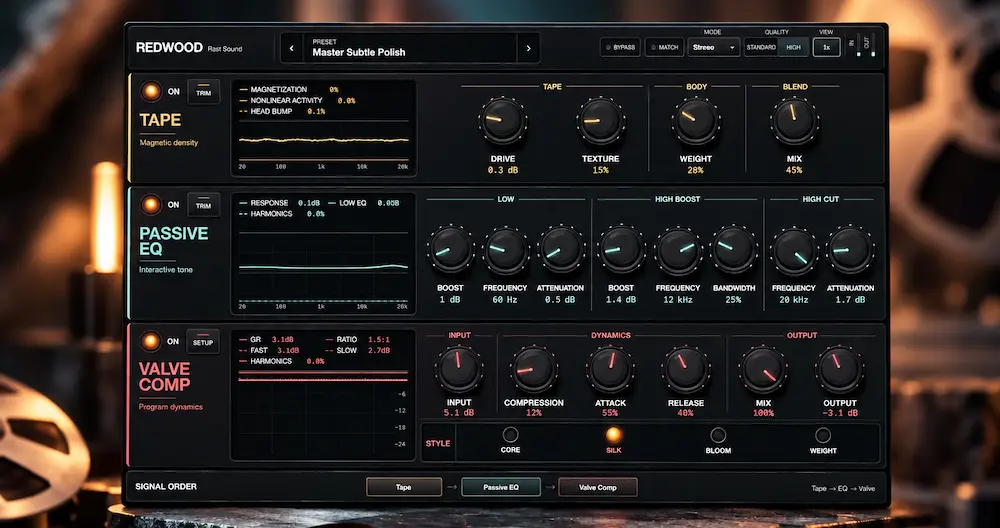
Rast Sound Redwood is a multi-effect mixing plugin that combines magnetic tape processing, a passive-style EQ and tube compression in one signal chain. The concept is straightforward: instead of building an analog-style chain from three separate processors, Redwood puts the three stages into a single production-oriented workflow.
That makes Redwood more interesting as a mixing workflow tool than as a fundamentally new type of saturation, EQ or compression. Its value depends on how useful the combined processing is on real production sources and whether the convenience outweighs the reduced control of dedicated processors.
In this review, I assess Redwood from a mixing and mastering perspective, focusing on where the integrated chain makes sense, where specialist plugins remain preferable, and which conclusions can reasonably be drawn from the available product information without independent measurements.
Rast Sound Redwood: Quick Specs
| Type | Multi-effect mixing plugin |
| Processing | Magnetic tape modeling • Passive-style EQ • Tube compression |
| Compressor Characters | 4 |
| Presets | 45 |
| Formats | VST3 • AU • AAX |
| Platforms | macOS • Windows |
| Price | €79 introductory price • €129 regular price |
Why Redwood’s Integrated Processing Chain Makes Sense in a Mix
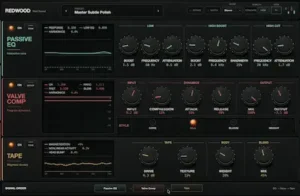 A tape stage, broad EQ, and gentle tube compression are often used together for the same reason: they change the character and density of a source without requiring surgical intervention. Tape can add harmonic content and alter peak behavior; broad EQ reshapes the tonal balance; compression controls dynamics and can add further density. Because the stages interact, changes to one part of the chain can affect how the overall processing is perceived.
That relationship is easy to manage with separate plugins, but it also creates more opportunities for unnecessary tweaking. An engineer may spend more time choosing processors and balancing their interaction than deciding whether the chain actually improves the source. Redwood condenses that workflow into a single processing environment, which makes it faster to audition the complete effect rather than building it one stage at a time.
This is particularly relevant on vocals, drum buses, bass, synths, and instrument groups. These sources often need broad tonal and dynamic shaping rather than corrective EQ or highly specific compression. A compact analog-style chain can therefore be more useful than a collection of processors with dozens of controls that ultimately produce the same general move.
The limitation is that integration comes at the expense of specialization. A dedicated tape emulator can offer more control over the saturation behavior, a dedicated EQ can handle corrective or highly specific tonal work, and a dedicated compressor can provide much finer control over dynamics. Redwood is not trying to win those individual battles. Its advantage is getting three related processes into the mix quickly and keeping them under one roof.
What Redwood’s Tape, EQ and Tube Compression Stages Do to a Mix
Redwood is built around three familiar processes, but its main distinction is how they are combined inside one plugin. Tape processing provides harmonic coloration, the passive-style EQ handles broad tonal shaping, and the tube compressor controls dynamics and adds density. The appeal is not any one stage in isolation. It is the ability to access all three forms of processing as part of a single, repeatable workflow.
Tape Saturation: Adding Density Without Chasing Distortion
The tape stage is most useful when a source is technically clean but lacks density or character. Driven moderately, tape-style saturation can add harmonic content, soften peak transients, and change the perceived relationship between peak level and average level. On a vocal, that can make the signal feel more present without simply adding top-end; on drums, it can take some of the edge off sharp transients while increasing perceived weight.
That makes the stage relevant to vocals, drums, bass, synths, guitars, and buses. The useful setting is rarely the one that announces itself as distortion. In a mix, the better result is usually the setting where the source becomes easier to place without immediately sounding processed.
There is also a practical limit. Saturation can increase apparent loudness and harmonic density, which makes the processed signal easy to mistake for an improvement during an unlevelled A/B comparison. It can also reduce separation when several already-dense elements are being processed in the same mix. Bass and kick relationships deserve particular attention because additional harmonics and dynamic softening can change how the low end reads on different playback systems.
For that reason, the tape stage should be evaluated with the output level matched closely to bypass. If the processed version only wins because it is louder or denser, the setting is not doing useful mix work.
Passive-Style EQ: Broad Tonal Decisions, Not Surgical Repair
The EQ section occupies a different role. A passive-style design is better suited to broad tonal moves than corrective work: changing the apparent weight of a source, opening the upper range, or shifting the overall tonal balance of a bus.
That fits the rest of Redwood’s architecture. Saturation, EQ and compression can all influence the perceived balance and density of the source, so changing one stage can alter how the combined processing is perceived. Keeping that interaction inside one plugin is more useful than simply having an EQ built into the interface.
The distinction becomes important when the problem is specific. A narrow resonance, harsh cymbal frequency, room-mode buildup, or precise mastering correction calls for a dedicated EQ with more surgical control. Redwood is better treated as a tone-shaping stage than as the EQ you reach for when the mix needs technical repair.
Variable Tube Compression: Finishing the Envelope
The compression stage adds dynamic control and can further shape the density created by the combined processing. Because saturation, EQ and compression interact, the audible result depends on how the three stages are balanced rather than on any single processor in isolation.
Vocals are an obvious application. A moderate amount of coloration followed by controlled compression can produce a denser, more finished signal without requiring a long chain. Drum buses and instrument groups are another strong use case, particularly when the goal is cohesion rather than aggressive transient control.
The same limitation applies here as with the EQ. A dedicated compressor remains preferable when the job requires highly specific attack and release behavior, detailed sidechain filtering, precise stereo-linking, or a particular compressor topology. Redwood’s compressor is valuable when the desired result is broad musical control within the integrated chain, not when the compressor itself is the centerpiece of the processing decision.
That distinction defines Redwood’s position in a professional mixing workflow: it is a fast way to make three related processing decisions, not a reason to stop using specialist processors when the mix demands them.
Hear What Your Mix Needs Before Mastering
Analog-style processing can add density and character, but the final mix still has to maintain balance, punch, detail and reliable translation across playback systems. If you want to hear how your mix holds together before committing to a full master, you can send up to 40 seconds for a free mastering demo. Submit your mix for a free mastering demo →
What You Actually Get Inside Redwood
Redwood is built around three processing stages, but the practical range of the plugin comes from how those stages are packaged together. The signal path combines magnetic tape processing, a passive-style EQ and tube compression, while the compressor section provides four different characters for different degrees of cohesion, energy and density.
The plugin also includes 45 presets, which makes the preset library useful as a starting point for common production tasks rather than simply as a collection of factory sounds. The more important point, however, is that Redwood is designed around a repeatable processing workflow: establish harmonic character, shape the tonal balance, then control dynamics without opening three separate processors.
Where Redwood Actually Speeds Up a Mixing Workflow
Redwood’s main workflow advantage is not reducing the amount of processing. It reduces the number of decisions and setup steps needed to audition a familiar processing chain.
Take a vocal that needs more density, a broad tonal adjustment, and gentle compression. With separate processors, the engineer has to select and configure three stages, manage their gain relationships, and repeatedly bypass individual processors to understand what each one is contributing to the finished signal. None of that is difficult, but it adds friction when the goal is simply to find out whether this type of processing belongs on the track.
Redwood makes that decision faster. The entire chain can be adjusted and bypassed from a single insert, so the engineer can move from a clean vocal to a colored, shaped, and controlled version without building the processing chain first. That is particularly useful during the early stages of a mix, when processing choices are still being evaluated rather than finalized.
Drum buses provide an even clearer example. A mix engineer may want a little tape density, a broad tonal shift, and enough compression to make the kit feel more cohesive. Redwood allows that combination to be auditioned immediately. If the result works, the chain is already in place; if it does not, the engineer has spent less time constructing a chain that ultimately gets discarded.
The same principle applies to synths, basses, guitars, and instrument groups. Redwood can function as a fast first-pass channel for sources that need character and cohesion rather than detailed corrective processing.
There is a hard limit, though. Integration only saves time while the three stages are doing what the source requires. If the EQ needs to become surgical, the compressor needs a very specific envelope response, or the tape stage needs more specialized control, a dedicated processor has to take over. At that point, Redwood has not eliminated the processing chain; it has simply provided a starting point.
That makes the plugin’s workflow advantage quite specific: Redwood is most efficient when the desired result is broad, musical processing and the engineer wants to reach that result quickly. It is considerably less compelling when precision is the priority.
Where Redwood Fits Best in a Professional Production Workflow
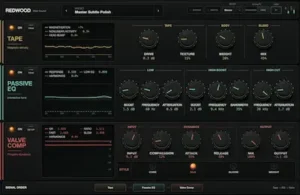 Redwood makes the most sense on sources that need several broad processing moves at once. Its combination of saturation, tonal shaping, and compression is more useful when the goal is to change the character and density of a sound than when the engineer is trying to correct a specific technical problem.
Vocals are one of the clearest applications. A clean vocal can sometimes need more density and cohesion without another corrective EQ or a heavily controlled compressor. Redwood can handle those jobs as a single chain, making it useful during vocal production as well as mixing. The important test is whether the added harmonic content helps the vocal stay present in the arrangement without forcing more top-end or level into the mix.
Drum buses and instrument groups are another strong fit. Moderate saturation followed by broad tonal shaping and compression can make separately recorded elements feel more unified. This is where Redwood’s integrated architecture has a practical advantage: the engineer can evaluate the complete treatment rather than optimizing three processors independently. The risk is cumulative transient reduction, particularly when the drums have already passed through compression or clipping elsewhere in the chain.
Bass benefits for a different reason. Added harmonics can make a bass part easier to perceive on small speakers and headphones without relying entirely on sub-bass energy. But the processed signal has to be evaluated against the kick and the rest of the low end. More apparent bass weight is not necessarily better low-end translation, and saturation followed by compression can change the envelope enough to alter the groove.
Synths, samples, guitars, and electronic-production elements are natural candidates for Redwood. These sources often benefit from broad coloration more than from another corrective processor. Pads can gain density, synth leads can become less sterile, drum machines can acquire additional harmonic texture, and layered guitars can be pushed toward a more cohesive tonal center. For synth-based production, that processing can follow the sound-design stage itself; a specialized instrument such as Martinic Prodigy, for example, establishes the oscillator and filter character first, while Redwood can then be used to shape the resulting signal. In these situations, the speed of the integrated chain is arguably more important than having maximum control over any individual stage. When a synth or guitar part also needs controlled stereo movement, a dedicated modulation processor such as UVI Thorus XT addresses a different part of the production problem without replacing Redwood’s role in tonal shaping and dynamics.
Mix-bus use is possible, but it requires a much lighter touch. Putting tape saturation, EQ, and tube compression across an entire mix means every stage affects material that may already be close to its intended balance. The cumulative effect can be attractive at first listen while reducing transient definition or low-end separation. Level-matched bypass comparisons are essential here, particularly when the processed signal becomes denser or louder.
Mastering is the least compelling application. A mastering engineer generally needs to make independent decisions about tonal balance, dynamics, stereo behavior, and harmonic coloration. An integrated chain can be convenient, but convenience is less valuable when each stage needs to be evaluated with precision. Redwood can have a place as an optional color processor, but I would not treat it as a substitute for dedicated mastering EQ, compression, or tape processing.
In practical terms, Redwood makes the most sense when the processing goal is character, tonal shaping and controlled density in one chain. It becomes less attractive when the source requires surgical EQ, highly specific compression timing, detailed transient control or independent optimization of each processing stage.
Where Redwood’s Analog Claims Still Need Independent Testing
Redwood is clearly positioned as an analog-inspired processing tool, but that positioning should not automatically be interpreted as proof of hardware-level accuracy. Tape modeling, passive EQ behavior and tube compression can all be approached in different ways, and the product description alone does not establish how closely the plugin matches any specific hardware reference.
There is currently no independent measurement available here for Redwood’s nonlinear distortion profile, aliasing behavior, phase response, latency, oversampling implementation or CPU performance. The same applies to any claim that its tape stage reproduces a particular machine or that its compressor characters behave identically to specific vintage hardware.
For a mixing engineer, the more useful question is therefore not whether Redwood is a mathematically exact hardware clone, but whether its saturation, tonal shaping and dynamic behavior produce a useful result in context.
That distinction matters because analog-style processing and accurate hardware emulation are not necessarily the same thing. A plugin can be musically effective without being a strict circuit-modeling recreation, while a technically sophisticated emulation may still be the wrong tool for a particular mix.
Rast Sound Redwood vs. Dedicated Analog-Style Plugins
Redwood is best understood as an integrated analog-style channel rather than as a direct replacement for every specialist processor. The main trade-off is between speed and control.
| Approach | Main Advantage | Main Limitation | Best Use |
|---|---|---|---|
| Rast Sound Redwood | Three analog-style stages in one workflow | Less specialist control | Fast tone, density and cohesion |
| Dedicated tape plugin | More tape-specific control | Requires additional processors for EQ and dynamics | Detailed tape coloration |
| Dedicated passive EQ | More precise tonal decisions | No integrated saturation or compression workflow | Broad musical EQ shaping |
| Dedicated tube / vari-mu compressor | More detailed dynamic control | Does not provide the complete Redwood chain | Detailed compression and envelope shaping |
| Separate tape + EQ + compressor chain | Maximum flexibility | More setup and decision-making | Precision mixing and complex signal shaping |
For a fast production workflow, Redwood has a clear advantage. For corrective or highly surgical processing, separate processors remain the more flexible option.
Redwood, Translation, and the Problem With “Sounds Better”
 Analog-style processing can create an immediate impression of improvement because it changes harmonic density, transient shape, and perceived loudness. Those changes may be musically useful, but they also make quick A/B comparisons easy to misread. A denser or slightly louder signal will often sound more impressive even when it does not improve the mix.
Redwood should therefore be judged at matched output levels and under the same monitoring conditions used for the rest of the production. The relevant question is not whether the processed signal sounds bigger in isolation, but whether it occupies its intended place in the arrangement more effectively.
Low-frequency translation deserves particular attention. Tape saturation and tube-style compression can increase the perceived weight of bass while also changing transient definition and separation between kick, bass, and low-frequency synths. What sounds fuller on nearfield monitors can become congested on headphones or smaller playback systems.
That makes cross-system checking an important part of the evaluation. Nearfields, headphones, and consumer-oriented speakers can reveal different problems in the same setting, particularly when harmonic saturation has altered the balance between fundamental frequencies and upper harmonics. The same principle applies when a mix changes character after final processing, which is why it is useful to distinguish a genuinely improved master from one that has simply become louder, denser, or more aggressive; our guide to common mastering problems covers that distinction in more detail.
The final criterion is whether the processing survives outside the studio. Streaming playback, codec processing, consumer speakers, and reduced-volume listening can expose excessive density or low-end buildup that was easy to overlook during production.
A successful Redwood setting should therefore improve the relationship between elements, not simply make a source louder, thicker, or more exciting in solo. If the processing stops working when the level is matched or the monitoring system changes, the apparent improvement was probably more about presentation than mix translation.
Who Gets the Most Value From Rast Sound Redwood?
- Producers and mix engineers: the strongest fit when tape-style coloration, broad EQ shaping and tube compression are recurring processing needs.
- Professional studios: useful as a fast character processor, but unlikely to replace specialist processors already available in a mature toolkit.
- Mastering engineers: a secondary use case because independent control of each processing stage is usually more important at the mastering stage.
Redwood is therefore best suited to engineers who value a compact analog-style processing chain over maximum control of each individual processor.
Price and Value: Is Rast Sound Redwood Worth €79?
At the €79 introductory price, Redwood is positioned as a relatively accessible way to combine tape-style coloration, passive-style EQ and tube compression in one plugin. The regular price is €129.
The value proposition is strongest when the integrated workflow replaces several recurring processing decisions in a session. If you already own dedicated tape, EQ and tube or vari-mu compression plugins that cover the same territory, Redwood becomes a convenience purchase rather than an essential addition.
The key question is therefore not whether €79 is cheap for an analog-style processor, but whether Redwood’s integrated workflow is useful enough in your sessions to justify another plugin.
Overall Rating
Editorial assessment: This rating evaluates Redwood’s processing architecture, feature set, workflow design and stated production use cases. It should not be interpreted as a substitute for level-matched listening tests or independent measurements of the plugin’s analog modeling.
| Category | Rating |
|---|---|
| Chain Integration | 9.0/10 |
| Feature Scope | 8.2/10 |
| Tonal Processing Utility | 8.0/10 |
| Workflow Utility | 8.7/10 |
| Processing Flexibility | 7.0/10 |
| Production Utility | 8.7/10 |
| Overall | 8.1/10 |
Redwood’s strongest qualities are its integrated processing architecture, broad production utility, and the way it combines three established analog-style processes into one workflow. The lower flexibility score reflects the trade-off: an integrated processor cannot provide the same specialist control as separate tape, EQ and compression plugins. The rating evaluates the product’s architecture and stated production utility rather than claiming independently verified sonic superiority.
Overall Comment: Redwood’s main strength is workflow integration rather than a new processing concept. It offers a practical combination of tape processing, passive-style EQ and tube compression, with the main compromise being reduced specialist control. Its strongest value is therefore as a fast production processor rather than as a replacement for dedicated analog-style tools.
The Professional Verdict on Rast Sound Redwood
Rast Sound Redwood makes the most sense as a compact three-stage processing chain, not as a replacement for specialist processors. Its practical advantage is having tape processing, passive-style EQ and tube compression available in one repeatable setup.
The combination makes the most sense on vocals, drum buses, bass, synths, guitars and instrument groups where broad tonal shaping, harmonic density and controlled dynamics are more important than surgical precision.
The trade-off is equally clear. Dedicated processors provide more control over individual stages, and there is currently no independent technical evidence here demonstrating that Redwood’s analog modeling is more accurate than competing solutions.
The €79 introductory price makes the workflow proposition easier to justify; at €129, the purchase becomes more dependent on whether the integrated chain offers a useful alternative to processors already in the toolkit.
Bottom line: Redwood is best for producers and mix engineers who want broad analog-style coloration and dynamics without assembling the chain from separate plugins. Its limitation is equally clear: when precision matters more than speed, dedicated processors remain the better choice.
Before Adding More Processing, Check What the Mix Already Does
Not every mix problem calls for another processor. Once saturation, tonal shaping and compression have changed density and dynamics, the more useful question is whether the finished balance, punch, detail and low-end translation still hold together outside the session. Upload up to 40 seconds of your mix and receive a free mastering demo prepared by a real mastering engineer, giving you a direct before-and-after reference for what further mastering processing may or may not contribute. Upload up to 40 seconds and get your free mastering demo →
Rast Sound Redwood FAQ
What is Rast Sound Redwood?
Redwood is a multi-effect mixing plugin that combines magnetic tape processing, passive-style EQ and tube compression in one integrated processing environment.
How many compressor characters does Redwood have?
Redwood includes four compressor characters designed for different approaches to cohesion, energy and density.
How many presets are included with Redwood?
The plugin includes 45 presets that provide starting points for different mixing and production situations.
What formats does Rast Sound Redwood support?
Redwood is available in VST3, AU and AAX formats for macOS and Windows.
Can Redwood replace dedicated tape, EQ and compression plugins?
It can replace a separate chain when the goal is broad coloration, tonal shaping and dynamic control. Dedicated processors remain preferable when individual stages require more specialized control.
Is Rast Sound Redwood worth €79?
At the €79 introductory price, Redwood is most compelling for producers and mix engineers who regularly need this type of combined processing. At the €129 regular price, its value depends more heavily on whether the integrated workflow adds something that existing plugins do not.

Yurii Ariefiev evaluates audio plugins from an engineering perspective, focusing on how processing choices affect harmonic coloration, transient response, tonal balance, and the way a signal holds together in a production. For multi-effect processors such as Rast Sound Redwood, the important question is how convincingly the combined stages serve a practical sonic purpose without obscuring the individual processing decisions.
Enjoyed this review? If you found it useful, you can support independent audio research with a coffee.
☕ Buy me a coffee