Eventide Fixate:Midrange Review: Psychoacoustic Dynamic EQ for Modern Mixing and Mastering
Most mix translation problems are midrange problems. Low-mid buildup, vocal nasalness, upper-mid glare, guitar congestion, transient masking — these are the issues that collapse mixes on earbuds, phones, laptops, cars, and streaming platforms long before sub-bass or stereo width become relevant.
The difficulty is that midrange problems rarely stay static. Resonances shift with arrangement density, vocal intensity, saturation, compression, and playback level. A fixed EQ cut may solve one phrase while damaging another. Traditional dynamic EQ improves that workflow, but most processors still react to isolated frequency spikes rather than perceptual balance.
Eventide Audio and Newfangled Audio are positioning Fixate:Midrange as a different approach. Instead of conventional spectrum analysis, the plugin uses psychoacoustic critical-band detection to identify perceptual midrange problems in real time, then applies dynamic correction only when those conditions appear.
That distinction matters because the ear does not interpret frequency content linearly. Harshness, honk, mud, and spectral imbalance are usually the result of competing energy relationships across multiple bands, not a single resonant peak. Fixate:Midrange attempts to process those interactions dynamically instead of forcing the user into constant manual EQ automation.
The plugin is clearly aimed at engineers working on dense modern productions where midrange instability changes from section to section. The real question is not whether the detection works. The real question is whether psychoacoustic correction can improve translation and control without stripping aggression, movement, or tonal identity out of the mix.
Article Navigation
- Why Midrange Control Has Become a Bigger Problem
- How Fixate:Midrange Works in Real Mixing Scenarios
- Why the HINTMAP System Matters
- Professional Mixing and Mastering Workflows
- The Limits of Psychoacoustic Correction
- Comparison With Soothe2, Gullfoss, and smart:EQ
- Adaptive EQ Comparison Table
- CPU Usage and Workflow Integration
- Who Should Actually Use Fixate:Midrange?
- Final Verdict
- FAQ
Why Midrange Control Has Become a Bigger Problem in Modern Mixing
Modern mixes carry far more midrange density than they did even five or ten years ago. Saturation stacking, clipped buses, layered synths, parallel distortion, upward compression, vocal layering, and sample-heavy production workflows have pushed spectral congestion into nearly every commercial genre — not just amateur mixes.
The problem is compounded by modern playback environments. Earbuds, phones, Bluetooth speakers, laptops, car systems, and streaming codecs all exaggerate instability in the midrange. A mix that feels controlled inside the studio can become harsh, cloudy, narrow, or fatiguing after AAC conversion or low-volume playback.
Streaming normalization changed the loudness war technically, but not psychologically. Engineers are no longer chasing raw peak level in the same way, yet clients still expect mixes to feel dense, loud, and forward at normalized playback levels. That pressure shifted production toward harmonic saturation and spectral filling instead of simple limiter abuse.
The result is a different type of fatigue problem. Many modern mixes are not obviously distorted, but they are constantly overloaded in the upper mids and low mids. After long listening sessions, the ear perceives those imbalances as tension, glare, congestion, or lack of depth — even when traditional meters appear relatively controlled.
Static EQ workflows are poorly suited for that behavior because most problematic resonances are transient and arrangement-dependent. A buildup around 2.5 kHz may only emerge when vocals, cymbals, guitars, and synth harmonics collide during the chorus. A low-mid masking problem may appear only when parallel compression engages on dense drum sections.
Traditional dynamic EQ improved this workflow, but most processors still react to isolated frequency thresholds rather than perceptual interaction between bands. Human hearing does not process frequencies independently. Perception shifts according to equal-loudness behavior, playback level, and how energy accumulates across critical bands rather than isolated frequencies alone. The ear groups information into critical bands, meaning a region can feel harsh or muddy even when no single frequency spike appears extreme on a conventional analyzer.
That psychoacoustic behavior is the foundation behind Fixate:Midrange. Instead of treating resonance control as a purely technical frequency problem, the plugin attempts to identify perceptual imbalance the way listeners actually experience it during real playback conditions.
How Fixate:Midrange Works in Real Mixing Scenarios
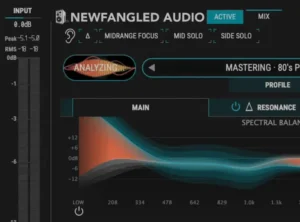 The core of Fixate:Midrange is a psychoacoustic detection engine based on critical-band analysis. Instead of reacting strictly to isolated frequency spikes, the plugin evaluates how energy is distributed across perceptual regions of the midrange — closer to how the ear interprets tonal balance during playback.
That approach matters because many mix problems are relational rather than absolute. A vocal may feel harsh without any extreme resonance visible on an analyzer. Guitars may sound hollow even when the spectrum looks balanced numerically. Traditional EQ tools measure frequency amplitude. Psychoacoustic systems attempt to measure perceptual dominance.
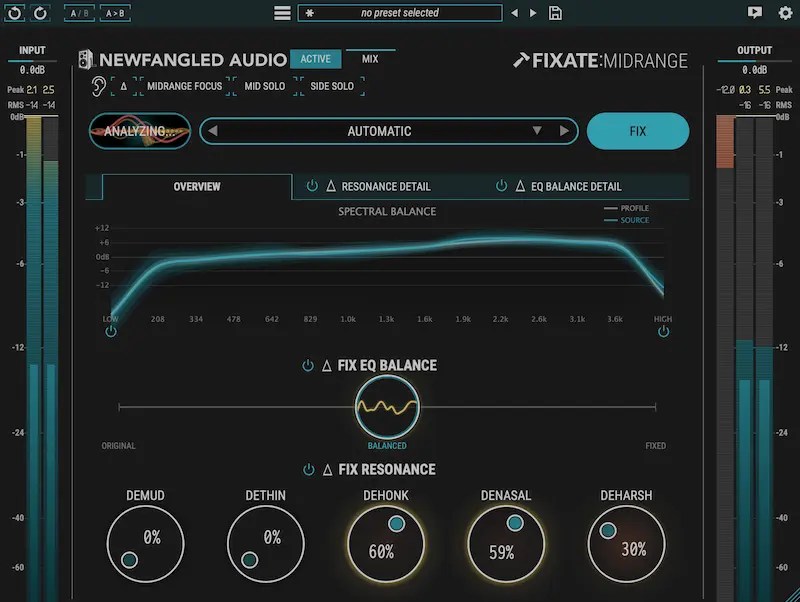
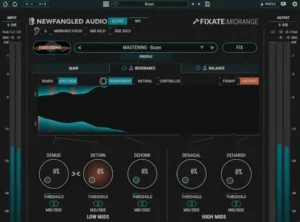
Fixate:Midrange divides correction into six dynamic processing zones:
- Mud
- Thinness
- Honk
- Nasalness
- Harshness
- Spectral Imbalance
Each processor activates independently and only when the plugin detects the corresponding condition in real time. That behavior is critical because static correction across an entire mix would quickly flatten depth, reduce transient contrast, and weaken tonal movement between sections.
The workflow itself is intentionally minimal:
- Insert the plugin
- Run Analyze
- Allow the detection engine to map problem areas
- Refine intensity and processing behavior manually
The Analyze stage behaves more like adaptive diagnostics than automatic mixing. The plugin listens to incoming material, evaluates spectral relationships, and configures its dynamic processors around likely perceptual issues. It does not make creative decisions for the engineer. It simply reduces the time spent manually chasing unstable midrange buildup.
That distinction separates Fixate:Midrange from many AI-assisted EQ tools currently entering the market. Most automated balancing plugins attempt to push the signal toward a generalized tonal target. Fixate:Midrange is more focused on conditional correction — identifying when the midrange becomes perceptually unstable and reacting only during those moments.
In practice, the speed advantage becomes obvious on dense productions. Vocal-heavy pop, modern metal, trap, EDM, and cinematic hybrid sessions often contain moving resonance problems that shift every few seconds depending on arrangement density, saturation, and bus compression behavior.
Manually automating those corrections across an entire session is possible, but it is slow. Fixate:Midrange is clearly designed to compress that workflow into a faster decision-making process without forcing permanent tonal reshaping onto the material.
Why the HINTMAP System Matters More Than the Automatic Processing
The most valuable part of Fixate:Midrange may not be the correction engine itself. It may be the monitoring perspective the plugin introduces during critical listening.
The HINTMAP display continuously visualizes where the plugin detects perceptual instability across the midrange. Unlike conventional spectrum analyzers that only display amplitude distribution, HINTMAP attempts to identify where the ear is most likely to perceive harshness, congestion, masking, hollowness, or tonal imbalance.
In practice, that changes how engineers actually use the plugin during long sessions. For experienced engineers, HINTMAP is less useful as an automated decision-maker and more useful as a secondary psychoacoustic reference during long sessions.
This becomes important because midrange judgment is highly dependent on monitoring conditions. Room nulls, aggressive tweeters, headphone resonances, playback volume, and fatigue can all distort perception in the upper mids and low mids. After several hours of mixing, engineers often begin compensating for monitoring bias without realizing it.
HINTMAP helps expose those moments faster.
For example, a mix may appear balanced visually on a standard analyzer while still feeling aggressively forward around 2–4 kHz during playback. Conversely, a dense low-mid buildup may not look excessive numerically but can still collapse perceived depth and separation once multiple buses begin interacting under compression.
The plugin’s psychoacoustic mapping gives engineers another way to cross-check those decisions before the problems become obvious on consumer playback systems.
The Midrange Focus monitoring mode extends that workflow further by isolating perceptual midrange content directly. Instead of listening to the full-range presentation, engineers can temporarily evaluate only the area where translation problems usually accumulate.
That feature is particularly relevant in mastering sessions. A mastering engineer cannot rebuild arrangement spacing or rebalance individual stems. The job becomes damage control, translation management, and spectral stabilization with minimal collateral impact on punch, width, and tonal identity.
In that context, HINTMAP is arguably more valuable than the automatic correction itself because it accelerates detection without forcing the engineer into permanent tonal reshaping.
Where Fixate:Midrange Actually Fits in Professional Production Workflows
The strongest argument for Fixate:Midrange is not automatic correction. It is workflow efficiency in situations where midrange instability changes too quickly for static processing to remain transparent.
The plugin is not universally useful across every genre or session type. Its value becomes obvious in specific production environments where perceptual buildup shifts dynamically throughout the arrangement.
1. Vocal-Heavy Modern Productions
Modern vocal chains are far more spectrally aggressive than they used to be. Bright condenser microphones, serial compression, saturation stacking, parallel distortion, pitch correction artifacts, multiband upward compression, and exciters all compete in the same upper-mid regions responsible for intelligibility.
That combination creates unstable resonance behavior that changes phrase by phrase depending on vocal intensity and arrangement density. Static EQ cuts rarely solve the problem cleanly because the harshness is not constant.
This is where Fixate:Midrange performs well when used with restraint. The Harshness and Nasalness modules can stabilize moving upper-mid buildup without permanently darkening the vocal or collapsing articulation.
The restraint part matters.
Heavy processing quickly pushes vocals toward over-smoothed commercial polish. Aggressive genres often rely on controlled edge, forwardness, and harmonic tension to maintain emotional impact. If the plugin is allowed to over-correct, vocals begin losing urgency and personality.
2. Dense Arrangement and Bus Processing
Layered guitars, stacked synths, cinematic percussion, orchestral hybrids, and parallel bus chains frequently generate temporary congestion in overlapping midrange zones. The problem is not always a single resonant source. Often it is cumulative masking created by multiple elements interacting under compression.
Traditional EQ carving becomes inefficient once those relationships shift dynamically between verses, choruses, drops, and transitional sections.
Fixate:Midrange works better in these situations on buses rather than individual channels. Instead of permanently hollowing instruments to create separation, the plugin can dynamically reduce buildup only during moments where perceptual masking becomes excessive.
That distinction helps preserve tonal density while still improving separation and translation.
3. Corrective Mastering for Inconsistent Mixes
This is probably the plugin’s most practical high-level use case.
Mastering engineers regularly receive mixes with unstable upper mids, shifting vocal projection, harsh cymbal interaction, or low-mid accumulation that only appears during dense sections. Correcting those issues manually at the mastering stage is possible, but the margin for error becomes extremely small once broadband compression and limiting enter the chain.
Fixate:Midrange can function as an adaptive stabilizer before final loudness processing. Instead of applying permanent tonal reshaping, the plugin reacts only when problematic buildup appears. In practical mastering chains, that usually places it before broadband compression, clipping, or final limiting stages — a workflow explored further in our mastering chain explained breakdown.
That reduces the need for aggressive broadband EQ compensation later in the chain.
Importantly, it does not replace mastering judgment. Engineers still need to determine whether the plugin is improving translation or simply making the material smoother and less confrontational.
4. Streaming Translation and Codec Stability
Modern streaming platforms expose midrange problems brutally. AAC and Ogg encoding tend to exaggerate upper-mid harshness, transient smear, brittle vocal edges, and spectral masking in already dense productions. We explored that behavior in much greater depth in our guide to fixing harsh highs in mastering, particularly how aggressive upper-mid energy changes after codec conversion and loudness processing.
A mix that feels balanced inside a treated studio can become sharp, cloudy, or fatiguing after transcoding and low-volume consumer playback.
Because Fixate:Midrange analyzes perceptual relationships instead of isolated frequency spikes, it can improve codec stability in some situations — particularly on loud modern pop, EDM, trap, and hybrid productions operating close to commercial loudness ceilings.
Still, the plugin cannot compensate for poor arrangement decisions, excessive clipping, or structurally overcrowded mixes. If the production itself is fighting for the same spectral space, psychoacoustic correction only reduces symptoms. It does not solve the underlying arrangement problem.
The Core Limitation: Psychoacoustic Correction Is Still Not Creative Decision-Making
 This is where most “intelligent mixing” marketing starts separating from real engineering practice.
Perceptual balance is not universally correct. Many iconic records contain midrange behavior that would technically qualify as excessive, unstable, or harsh under psychoacoustic analysis.
Forward snare transients, abrasive synths, nasal indie vocals, overloaded guitars, lo-fi saturation, clipped upper mids, and aggressive vocal presence are often deliberate production choices rather than spectral mistakes.
Fixate:Midrange does not understand intent. It identifies perceptual imbalance according to generalized psychoacoustic assumptions about what humans typically interpret as harshness, congestion, hollowness, or tonal fatigue.
Those assumptions are often useful. They are not artistic judgment.
That distinction becomes critical in genres where controlled aggression is part of the identity. Modern metal, industrial music, hyperpop, punk, underground hip-hop, experimental electronic production, and heavily saturated pop frequently rely on unstable midrange behavior to maintain energy and emotional pressure.
A plugin designed to smooth perceptual tension can easily remove the exact thing making the mix feel alive.
This creates a legitimate workflow risk, particularly for less experienced producers. Because psychoacoustic correction often sounds immediately “cleaner,” users may continue reducing harshness and congestion long after the mix has already lost impact, depth, and attitude.
The danger increases further during mastering.
At the mastering stage, subtle tonal identity differences matter more than broad smoothness. Excessive adaptive correction can narrow the emotional contrast between sections, soften transient aggression, and reduce the sense of forward motion that gives a mix urgency on consumer playback systems.
That does not make the plugin ineffective. It simply defines the role more clearly.
Fixate:Midrange performs best when treated as:
- a diagnostic layer
- a dynamic cleanup processor
- a translation control tool
- a way to reduce unstable spectral buildup quickly
It performs worse when treated as an autonomous tonal authority capable of deciding how a mix should feel emotionally.
The engineers most likely to get strong results from the plugin are probably the ones least willing to trust it blindly.
How Fixate:Midrange Compares to Soothe2, Gullfoss, smart:EQ, and Other Adaptive EQ Tools
Fixate:Midrange enters a category that is already crowded with adaptive EQ, resonance suppression, and spectral balancing plugins. The difference is that most competing tools approach the problem from either a resonance-management perspective or a tonal-balancing perspective. Fixate:Midrange sits somewhere between those two philosophies.
- oeksound Soothe2
- Soundtheory Gullfoss
- iZotope Ozone Stabilizer
- Sonible smart:EQ
- FabFilter Pro-Q dynamic EQ workflows
- TEOTE
Its closest conceptual competitor is probably Gullfoss, but the processing behavior feels noticeably different in practice.
Gullfoss continuously reshapes spectral balance across the entire signal, often producing an immediately polished and open presentation. The tradeoff is that aggressive settings can reduce transient density, soften impact, or flatten mix aggression. Many engineers use Gullfoss almost like adaptive mastering polish.
Fixate:Midrange is narrower in scope and more conditional in behavior. Instead of globally rebalancing the spectrum, it focuses on perceptual instability inside the midrange and reacts primarily when problematic conditions emerge.
In practice, the processing feels less like automatic polish and more like controlled midrange intervention when specific problems emerge.
Compared to Soothe2, the workflow philosophy changes again. Soothe2 remains one of the most precise resonance suppression tools available because it allows extremely detailed control over detection sensitivity, attack behavior, selectivity, and spectral shaping. That same psychoacoustic cleanup territory was recently explored from a different angle in our Three-Body Technology Unmask review, though Unmask is far more focused on source separation and masking control than broad perceptual midrange management.
The downside is complexity. Soothe2 often requires careful tuning to avoid over-smoothing transients or pulling life out of vocals and instruments.
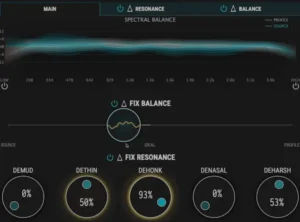
Fixate:Midrange trades some of that surgical flexibility for speed and categorization. Instead of building highly customized resonance behavior manually, the plugin organizes processing around perceptual problem types like Harshness, Nasalness, Mud, and Honk.
That makes the workflow faster, especially during dense sessions where engineers need broad corrective control without spending excessive time fine-tuning multiple dynamic nodes.
Against tools like smart:EQ or Ozone Stabilizer, the difference becomes even clearer. Those processors lean heavily toward target-curve normalization and AI-assisted tonal balancing. Their goal is often to guide material toward a statistically balanced spectral profile.
Fixate:Midrange feels less interested in imposing tonal targets and more interested in reducing perceptual instability dynamically as the arrangement evolves.
That will likely appeal more to experienced mixers and mastering engineers who dislike automated tonal normalization but still want faster ways to control moving midrange problems.
It also explains why the plugin can sound more transparent than some AI-driven balancing systems when used conservatively. Because the processing is event-dependent rather than constantly corrective, the mix retains more natural movement and spectral variation between sections.
The tradeoff is that Fixate:Midrange is not a complete spectral balancing solution. Engineers expecting automatic “finished mix” enhancement similar to smart mastering tools may find the results more subtle than expected.
Fixate:Midrange vs Other Adaptive EQ and Resonance Plugins
| Plugin | Primary Focus | Workflow Style | Strengths | Limitations |
|---|---|---|---|---|
| Fixate:Midrange | Psychoacoustic midrange stabilization | Fast adaptive correction | Excellent for dynamic midrange buildup and translation control | Can over-smooth aggressive mixes if pushed too far |
| Soothe2 | Precision resonance suppression | Deep manual control | Extremely surgical and flexible | Requires more tuning and workflow time |
| Gullfoss | Global spectral balancing | Continuous automatic processing | Fast overall polish and clarity enhancement | Can reduce punch and tonal aggression |
| smart:EQ | AI-assisted tonal balancing | Target-curve workflow | Efficient for quick balance correction | Can normalize tonal character too aggressively |
| FabFilter Pro-Q | Manual dynamic EQ | Fully engineer-driven | Maximum flexibility and transparency | Slower workflow on complex moving resonances |
CPU Load, Session Integration, and Real-World Workflow Impact
 A plugin performing continuous psychoacoustic analysis alongside multiple layers of dynamic processing is inevitably going to consume noticeable CPU resources. Fixate:Midrange is efficient enough for modern production systems, but it is not the type of processor most engineers will scatter across an entire large-format mix session.
The interface also encourages aggressive tweaking because the processing changes can sound deceptively impressive during short listening comparisons. Long-session judgment still matters more than immediate polish.
The smarter workflow is selective deployment rather than blanket insertion.
- lead vocals
- instrument buses
- mix bus processing
- mastering chains
- problematic stem groups
- dense parallel compression returns
That approach aligns with how the plugin is actually designed to function. Fixate:Midrange is most effective when solving unstable perceptual buildup in critical areas of the mix rather than acting as a permanent spectral correction layer everywhere.
In practice, bus-level processing often produces the best results because many midrange problems are cumulative. A harsh vocal may not be harsh on its own. The problem often appears only after cymbals, clipped drums, layered synth harmonics, and vocal compression begin stacking together on the mix bus.
The plugin’s monitoring tools are also more important than they initially appear. Delta monitoring and per-band solo modes make it easier to hear exactly what the processor is removing, which matters because psychoacoustic correction can become deceptively addictive during long sessions.
A smoother midrange presentation almost always feels “better” initially, even when the mix is starting to lose punch, tension, or forward movement. Without careful A/B comparison and level matching, engineers can easily drift into over-processing territory.
That pattern appears constantly in modern mastering workflows where engineers mistake smoother playback for better translation. Our mastering problems guide breaks down why excessive corrective processing often makes finished tracks feel smaller, flatter, or less emotionally direct despite sounding technically cleaner.
That is why the automatic gain compensation system matters more than the marketing copy suggests. Once harshness is reduced, the ear naturally interprets the signal as less stressful and more polished. If output level is not compensated correctly, users may mistake reduced listening fatigue for an objectively better mix decision.
The custom reference profile system is another genuinely practical feature. Instead of relying exclusively on generalized tonal assumptions, engineers can import reference material and build adaptive profiles around real-world targets relevant to the project.
That flexibility makes the plugin more usable in professional workflows than many AI-assisted balancing tools that force material toward static target curves.
Still, the plugin is not autonomous mix enhancement. Engineers expecting automatic “pro sound” processing will probably misuse it quickly, especially in already polished productions where tonal movement and controlled aggression matter more than spectral smoothness.
Who Fixate:Midrange Is Actually Built For
Fixate:Midrange is not a universal utility plugin. Its value depends heavily on the type of material being mixed, the monitoring environment, and how often the engineer deals with unstable spectral density in the midrange.
The plugin makes the most sense for engineers working on modern productions where tonal congestion changes dynamically throughout the arrangement.
- mix engineers handling dense pop, EDM, trap, metal, and hybrid productions
- mastering engineers receiving inconsistent or overly aggressive mixes
- producers working under fast commercial deadlines
- hybrid engineers mixing in partially treated rooms
- headphone-based producers struggling with upper-mid translation
- engineers managing large vocal stacks and saturation-heavy sessions
In those workflows, the plugin can reduce the amount of manual resonance hunting and automation cleanup required to stabilize translation across multiple playback systems.
It is especially useful for engineers who already understand midrange management conceptually but want faster ways to control moving spectral buildup without constantly rebuilding dynamic EQ moves manually.
The plugin makes considerably less sense in workflows centered around minimal processing or deliberate tonal rawness.
Engineers looking for aggressive tonal movement, modulation-based coloration, or creative spectral reshaping may find themselves leaning toward processors designed for intentional sound manipulation instead. Our Rob Papen FilterField review explored that side of the workflow in much greater depth, particularly for mixes where movement and texture matter more than corrective transparency.
- purist analog mixing approaches
- minimal acoustic and jazz productions
- engineers already highly efficient with manual dynamic EQ automation
- projects relying on intentional midrange aggression or instability
- users expecting automatic professional mastering results
That last category is important.
Fixate:Midrange is not a substitute for arrangement control, monitoring accuracy, or tonal judgment. Engineers looking for one-click polish will probably over-process their material quickly because the plugin’s smoothing behavior can sound deceptively impressive during short listening comparisons.
At the introductory $79 price point, the plugin competes aggressively against premium resonance-management tools and adaptive EQ processors. At the full MSRP, the value proposition becomes more workflow-dependent.
For engineers regularly dealing with unstable modern mixes, the time savings alone may justify the cost. For users already comfortable building detailed dynamic EQ workflows manually, the advantage becomes less about capability and more about speed and convenience.
Verdict
Fixate:Midrange stands out because it targets a real production problem instead of relying on vague AI-assisted mixing claims. Modern sessions are increasingly overloaded in the midrange, and traditional static EQ workflows often move too slowly to manage constantly shifting spectral buildup without damaging tonal movement.
The plugin’s psychoacoustic critical-band system is more sophisticated than conventional resonance suppression because it reacts to perceptual imbalance rather than isolated frequency spikes alone. In dense productions, that approach can stabilize harshness, masking, and congestion faster than manual dynamic EQ workflows.
It is also not a miracle processor. Engineers expecting dramatic instant transformations may initially find the results more subtle than the marketing language implies.
Its strongest attribute is speed.
On vocal-heavy mixes, overloaded bus groups, or corrective mastering sessions, Fixate:Midrange can significantly reduce the amount of manual cleanup required before compression, limiting, and final loudness processing.
Its biggest weakness is equally obvious: the same processing that improves translation can also remove tension, aggression, and tonal identity if pushed too far.
The plugin does not understand artistic intent. It identifies perceptual instability according to psychoacoustic assumptions, not genre aesthetics or emotional context. Engineers who stop making independent tonal decisions will eventually flatten the mix in pursuit of smoothness.
That is why Fixate:Midrange works best as a controlled engineering tool rather than an automatic finishing processor.
Used carefully, it can improve translation, reduce listening fatigue, stabilize difficult midrange material, and accelerate workflow in modern production environments. Used blindly, it can sterilize a mix while creating the illusion of refinement.
The engineers most likely to get long-term value from the plugin are probably the ones treating it as assistance rather than authority.
About the Author
 Yurii Ariefiev is a mastering engineer and audio production specialist focused on modern digital mixing, mastering translation, loudness optimization, and psychoacoustic processing workflows. His work centers on how mixes behave across streaming platforms, codecs, consumer playback systems, and dense modern production environments.
Over the past several years, he has analyzed hundreds of mastering and mix translation problems involving harsh upper mids, spectral masking, codec artifacts, loudness-related distortion, and unstable tonal balance in commercial releases.
His editorial work focuses heavily on mastering translation, psychoacoustic processing, loudness behavior, codec interaction, and real-world playback consistency across modern streaming platforms.
FAQ
Is Fixate:Midrange closer to Soothe2 or Gullfoss?
Conceptually, it sits between them. Soothe2 is more surgical and resonance-focused, while Gullfoss continuously reshapes global spectral balance. Fixate:Midrange is more selective, reacting to perceptual instability in the midrange rather than constantly rebalancing the entire spectrum.
Does Fixate:Midrange work well on mastering chains?
Yes, particularly on mixes with unstable upper mids, harsh vocal presence, or low-mid congestion that changes between sections. Subtle settings are critical. Over-processing during mastering can flatten depth and reduce mix energy quickly.
Can the plugin soften transients or reduce punch?
Absolutely. Aggressive psychoacoustic correction in the upper mids can soften snare attack, vocal edge, guitar bite, and synth definition. The cleaner result may initially sound “better” while actually reducing impact and urgency.
Is critical-band analysis actually more accurate than standard dynamic EQ?
Not universally. It is simply based on a different philosophy. Traditional dynamic EQ reacts to measurable frequency activity, while critical-band systems attempt to react to how humans perceive grouped spectral energy. Depending on the source material, that can feel either more natural or less predictable.
How heavy is the CPU load in large sessions?
Moderate to moderately high depending on sample rate and session complexity. The plugin is better suited for buses, vocals, mix bus duties, and mastering chains than large-scale insertion across every track.
Can Fixate:Midrange improve headphone mixing accuracy?
To a degree. The psychoacoustic visualization and dynamic correction can help expose upper-mid buildup that headphones sometimes disguise or exaggerate. It is still not a replacement for reliable monitoring decisions.
Does it help mixes survive AAC and streaming codec conversion better?
In many cases, yes. Controlled upper-mid behavior and reduced spectral congestion tend to translate more cleanly through lossy codecs like AAC and Ogg, especially on loud modern productions.
Is the Analyze mode safe to trust completely?
No. The analysis engine is useful for identifying likely problem regions quickly, but it cannot determine whether harshness or aggression is intentional stylistically. Human tonal judgment is still necessary.
Does the plugin work better on individual tracks or buses?
Generally, buses. Many midrange problems emerge from cumulative masking between multiple instruments rather than isolated resonances on a single channel. Bus-level processing often sounds more natural and efficient.
Is Fixate:Midrange useful for acoustic, jazz, or minimalist productions?
Less consistently. Productions built around natural dynamics and harmonic realism can lose subtle texture if the plugin is pushed too aggressively. It is strongest on dense modern material where spectral buildup is already part of the production aesthetic.