Evolve Nest Acoustics Review: Why Organic Sound Design Often Falls Apart After Release
Evolve Nest Acoustics enters a crowded market of cinematic instruments, ambient generators, and texture-focused plugins. What separates it from many competitors is not synthesis depth or sound design flexibility. Its focus is environmental detail: organic textures, evolving atmospheres, and movement that feels closer to a recorded space than a programmed instrument.
That immediately raises a production question that matters far more than preset quality: how much of that detail survives the journey from the DAW to the listener?
Creating atmospheric complexity is no longer difficult. Modern tools can generate layers, motion, and spatial depth in seconds. Preserving those qualities through mixing, mastering, streaming codecs, loudness optimization, and consumer playback is where most productions begin to lose information.
This is particularly true for music built around subtle texture rather than dominant instrumentation. Environmental layers that feel immersive on studio monitors often become far less significant on earbuds, Bluetooth speakers, laptops, or in-car systems. Fine movement gets masked. Depth perception narrows. Elements that contributed emotional weight during production may become nearly invisible in the final listening experience.
That reality makes Evolve Nest Acoustics more relevant than a typical plugin review might suggest. The instrument sits at the intersection of two growing trends in audio production: the demand for organic sound design and the increasing importance of playback translation. Ambient producers, film composers, game audio designers, hybrid scorers, and modern electronic artists are relying more heavily on atmosphere than they were a decade ago, but atmosphere is also one of the first casualties of poor translation.
The real evaluation, then, is not whether Evolve Nest Acoustics can generate compelling textures. It can. The more useful question is whether those textures continue to create the same sense of depth, movement, and immersion once the production leaves the studio and enters the real world.
| Overall Rating | 8.8/10 |
| Best For | Ambient Music, Film Scoring, Game Audio, Hybrid Composition, Atmospheric Electronic Production |
| Pros | Fast workflow, convincing organic textures, strong environmental depth, production-ready atmospheres |
| Cons | Limited deep synthesis control, not a replacement for Omnisphere, less useful for lead-focused production |
| Verdict | An efficient atmospheric instrument that prioritizes workflow, immersion, and environmental storytelling over synthesis complexity. |
- What Is Evolve Nest Acoustics?
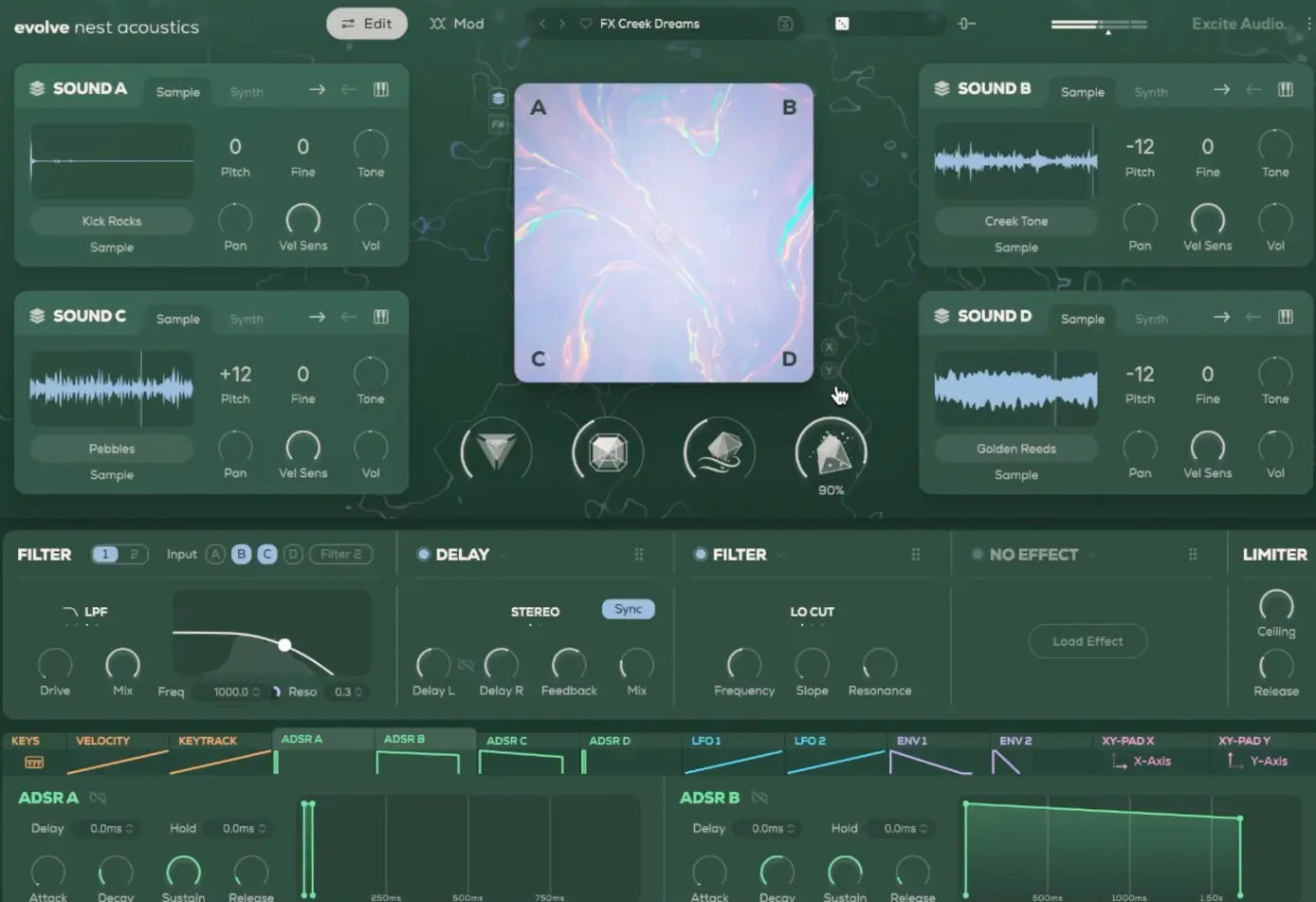
- Inside The Evolve Nest Acoustics Interface
- Key Features And Sound Sources
- What Evolve Nest Acoustics Actually Brings To A Production Workflow
- The Mixing, Mastering And Translation Challenge
- Competitive Positioning: Where Evolve Nest Acoustics Fits In The Current Market
- Evolve Nest Acoustics vs SoundMorph PHUZE
- Who Should Actually Buy Evolve Nest Acoustics?
- Where Evolve Nest Acoustics Falls Short
- Verdict
- FAQ
What Is Evolve Nest Acoustics?
Evolve Nest Acoustics is an atmospheric virtual instrument designed for producers who prioritize texture, movement, and environmental depth over traditional synthesis programming. Rather than competing directly with flagship synthesizers, it focuses on generating organic sonic environments that can be integrated into modern music production, cinematic scoring, game audio, and sound design workflows.
The plugin occupies an interesting position within today’s software instrument market. It sits somewhere between a cinematic sample library and a dedicated sound-design platform. Instead of offering unlimited synthesis architecture, its primary objective is to provide evolving atmospheres, environmental layers, and organic movement that can immediately contribute to an arrangement.
This distinction matters because many producers spend a disproportionate amount of time building supporting textures. Creating convincing atmosphere often requires field recordings, ambient layers, modulation processing, spatial effects, automation, and extensive experimentation. Evolve Nest Acoustics attempts to reduce that workload by presenting complex atmospheric content as a starting point rather than requiring every element to be built manually.
The interface reflects that philosophy. Rather than emphasizing deep routing structures, advanced modulation matrices, or highly technical programming environments, the workflow encourages rapid exploration and creative decision-making. Producers can focus on emotional direction, arrangement role, and spatial placement instead of spending hours constructing environmental layers from scratch.
From a workflow perspective, Evolve Nest Acoustics is best suited for producers working in ambient music, cinematic composition, game audio, hybrid orchestral production, synthwave, experimental electronic genres, and other atmosphere-driven projects. While the plugin can certainly appear in mainstream productions, its value becomes most obvious when texture contributes directly to the listener’s emotional experience.
The instrument should not be viewed as a replacement for comprehensive synthesis platforms such as Omnisphere, Falcon, Pigments, Phase Plant, or Massive X. Those products prioritize sound-design flexibility and programming depth. Evolve Nest Acoustics prioritizes speed, atmosphere, and production-ready environmental content.
That positioning ultimately defines its purpose. The plugin is less concerned with creating entirely new forms of synthesis and more concerned with helping producers reach convincing atmospheric results without disrupting creative momentum. For users who regularly build immersive sonic environments, that workflow advantage may prove more valuable than another collection of oscillators, modulation sources, or synthesis algorithms.
| Specification | Details |
|---|---|
| Developer | Excite Audio |
| Plugin Type | Atmospheric Virtual Instrument |
| Primary Focus | Organic Textures, Environmental Layers, Cinematic Atmospheres |
| Formats | VST3, AU, AAX |
| Platforms | Windows, macOS |
| Copy Protection | Developer Authorization System |
| Content | Atmospheric Presets, Organic Sound Sources, Environmental Textures |
| Price Position | Mid-Market Atmospheric Instrument |
| Best For | Ambient Producers, Film Composers, Game Audio Designers, Hybrid Scoring |
Inside The Evolve Nest Acoustics Interface
A plugin designed around atmosphere lives or dies by its workflow. Producers rarely purchase texture-generation tools because they lack sounds. They purchase them because building convincing atmosphere manually consumes time.
Evolve Nest Acoustics appears to be built around that reality.
The interface favors immediate exploration over deep technical programming. Rather than confronting users with large modulation matrices, complex routing systems, or extensive synthesis architecture, the workflow encourages rapid auditioning and refinement of atmospheric content.
This design choice has important production implications.
Many sound-design environments require users to spend significant time constructing movement before they can evaluate whether a sound contributes to the arrangement. Evolve Nest Acoustics shortens that process by presenting evolving textures as production-ready material rather than raw components.
The result is a workflow that feels closer to arranging than programming.
Instead of asking how to build atmosphere, producers can immediately evaluate where atmosphere belongs inside the track. This shifts attention toward composition, emotion, pacing, and spatial depth rather than technical construction.
In practical use, most producers will likely interact with the instrument through three stages:
| Stage | Primary Goal | Production Outcome |
|---|---|---|
| Exploration | Audition textures and atmospheres | Identify emotional direction |
| Refinement | Adjust movement and density | Define arrangement role |
| Integration | Place texture inside the mix | Support depth without clutter |
This approach will appeal to composers and producers who value creative momentum. Users seeking extensive synthesis programming may eventually encounter limitations, but producers focused on atmosphere creation will likely appreciate how quickly the instrument moves from sound selection to arrangement decisions.
Ultimately, the interface reflects the product’s broader philosophy. Evolve Nest Acoustics is not trying to become another general-purpose synthesizer. It is trying to reduce the time required to create believable environmental depth inside modern productions.
Key Features And Sound Sources
Understanding Evolve Nest Acoustics requires looking beyond marketing descriptions and examining what actually drives its production value. Unlike traditional synthesizers that derive much of their flexibility from oscillator architecture and modulation depth, this instrument is built around the practical application of atmospheric content inside real-world projects.
The core appeal comes from how it combines multiple layers of environmental information into production-ready textures. Rather than presenting isolated sound sources that require extensive processing, the instrument focuses on creating complete atmospheric structures capable of supporting an arrangement immediately.
Several categories of content appear central to the workflow:
| Content Type | Production Function |
|---|---|
| Organic Textures | Create realism, movement, and environmental depth |
| Atmospheric Layers | Support emotional continuity across arrangements |
| Evolving Soundscapes | Introduce motion without distracting from primary elements |
| Environmental Elements | Expand perceived space and immersion |
| Modulated Ambiences | Prevent static backgrounds and repetitive atmospheres |
Equally important is how presets appear to be organized around production outcomes rather than purely technical categories. Many sound-design tools encourage users to think in terms of oscillators, filters, routing structures, and modulation systems. Evolve Nest Acoustics instead encourages producers to think in terms of mood, environment, tension, movement, and spatial depth.
This distinction significantly affects workflow. Producers searching for an atmosphere that supports a scene, transition, arrangement, or emotional moment can often reach a usable result faster than they would inside a conventional synthesis platform.
Another notable aspect is the emphasis on layered complexity. Many of the most convincing atmospheric sounds are not built from a single source but from multiple interacting components. Organic movement, evolving textures, spatial information, and subtle modulation often combine to create sounds that feel more like environments than individual instruments.
From a production perspective, this approach is particularly valuable because it reduces the amount of supporting work required before a texture becomes musically useful. Instead of spending time constructing depth from multiple plugins and sample sources, producers can focus on arrangement decisions and emotional intent.
Ultimately, the strongest feature of Evolve Nest Acoustics is not any individual preset category, modulation function, or sound source. It is the way those elements are combined into atmospheric material that can immediately contribute to a finished production rather than remaining a raw sound-design exercise.
Why Organic Sound Design Matters More Than Ever
The rise of organic sound design is not simply a production trend. It reflects a broader shift in how modern music, film, games, and digital media compete for attention.
For years, production tools were largely judged by their ability to create larger, louder, and more aggressive sounds. Bigger drops, wider leads, heavier low-end, and increasingly dense arrangements dominated commercial workflows. That approach still exists, but it no longer defines the entire market.
Today’s productions are increasingly built around immersion rather than impact alone. Film scores, game soundtracks, ambient releases, hybrid orchestral projects, modern electronica, and even mainstream pop records rely heavily on texture to create emotional context. The goal is not always to command attention. Often, it is to create an environment that keeps the listener engaged without obvious repetition.
This is where organic sound design becomes valuable. Environmental recordings, evolving ambiences, mechanical artifacts, natural movement, and imperfect textures introduce a level of realism that traditional synthesis often struggles to replicate. They help productions feel inhabited rather than assembled.
Listeners rarely identify these elements individually. They are more likely to perceive the cumulative effect: greater depth, stronger atmosphere, and a more convincing sense of space. When those layers disappear, the production often feels smaller even if nothing obvious appears to be missing.
The growing demand for this type of detail has created an entire category of production tools focused on texture generation rather than traditional synthesis. Evolve Nest Acoustics is part of that movement, but its appeal extends beyond sound design alone. It addresses a workflow challenge faced by many producers: creating believable atmospheric complexity without spending hours building it manually.
That distinction matters because modern audiences consume music differently than they did a decade ago. Productions are expected to hold attention across playlists, streaming platforms, games, video content, and long-form listening sessions. Atmosphere has become part of the production value itself.
However, the same characteristics that make organic textures effective also make them fragile. Dense synth leads and aggressive drums survive almost any playback environment. Subtle environmental layers do not. They are more vulnerable to masking, codec degradation, loudness processing, and the limitations of consumer playback systems.
As a result, evaluating a plugin like Evolve Nest Acoustics requires more than judging its sound quality. The real question is whether the atmosphere it generates remains meaningful after the production moves through mixing, mastering, streaming delivery, and real-world playback conditions.
What Evolve Nest Acoustics Actually Brings To A Production Workflow
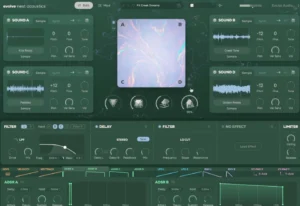 The most valuable aspect of Evolve Nest Acoustics is not its sound quality. At this price point, good sound is expected. The more relevant question is whether a plugin improves decision-making during production.
In that respect, Evolve Nest Acoustics succeeds by reducing the amount of work required to create convincing atmospheric depth.
Building organic environments from scratch is rarely a fast process. A typical workflow may involve multiple layers of field recordings, ambient textures, pads, modulation effects, transient elements, spatial processors, and automation. None of these components are particularly difficult to create individually, but combining them into something coherent often consumes far more time than producers anticipate.
Evolve Nest Acoustics compresses much of that process into a single instrument. Instead of assembling atmospheric layers piece by piece, producers are presented with evolving sound sources that already contain movement, texture, and spatial complexity.
This changes the role of the producer during the early stages of a project.
Rather than spending time constructing atmosphere, attention shifts toward evaluating atmosphere. The workflow becomes less about technical assembly and more about selecting emotional direction, defining depth, and deciding how a texture should interact with the arrangement.
That distinction may sound subtle, but it has significant workflow implications. Creative momentum is often lost when producers become trapped in support work. Building transitional textures, environmental layers, and background movement can easily consume an hour without noticeably advancing the composition itself.
Evolve Nest Acoustics removes much of that friction. It allows atmospheric elements to appear early in the writing process, when arrangement decisions are still fluid and creative experimentation is most valuable.
In practice, the plugin behaves less like a traditional synthesizer and more like a production utility for generating environmental depth. Its strongest sounds are rarely intended to become lead elements. Instead, they occupy the spaces between primary musical events, helping arrangements feel larger, more immersive, and less static.
This workflow differs noticeably from products built around active sound generation and performance-oriented sound design. For example, our SoundMorph PHUZE review examined a platform designed to generate evolving sonic events and cinematic gestures, whereas Evolve Nest Acoustics is more focused on environmental continuity, background movement, and atmospheric support inside an arrangement.
This is also where the plugin’s limitations begin to emerge. Producers looking for deep synthesis architecture, extensive programming flexibility, or highly technical sound design capabilities may find the workflow restrictive. Evolve Nest Acoustics prioritizes speed over complexity and atmosphere over synthesis.
Whether that tradeoff feels limiting or liberating depends entirely on what role the plugin is expected to play inside a production environment.
Core Analysis: Where Evolve Nest Acoustics Succeeds In Real Productions
Many atmospheric plugins sound impressive during demonstrations because they are auditioned in isolation. Real productions impose a different standard. A texture is only valuable if it continues to contribute once vocals, drums, bass, automation, and mix processing enter the picture.
This is where Evolve Nest Acoustics performs better than many products in the same category.
Its strongest patches are not built around grabbing attention. They are built around supporting an arrangement. Instead of dominating the mix, they tend to occupy the spaces between primary musical elements, creating movement and depth without constantly competing for focus.
That distinction becomes important in professional production environments. One of the most common problems with cinematic textures is that they consume far more frequency and spatial real estate than their musical contribution justifies. Producers end up carving EQ holes, adjusting stereo width, or automating levels simply to accommodate a layer that was supposed to make the mix easier, not harder.
Evolve Nest Acoustics generally avoids that behavior. Many of its sounds feel intentionally designed to coexist with an arrangement rather than sit on top of it. The textures often provide perceived depth without creating excessive congestion in the critical midrange, where vocals, leads, and harmonic information already compete for attention.
That makes the plugin particularly effective in productions where atmosphere serves an emotional function rather than a melodic one. Film scoring, ambient music, game audio, downtempo electronic production, synthwave, hybrid orchestral work, and modern experimental genres all rely heavily on elements that shape listener perception without becoming the center of attention.
In these contexts, texture often carries emotional information rather than musical information. The listener may not consciously identify what they are hearing, but they notice when it disappears. A scene feels less immersive. A transition feels less convincing. An arrangement feels flatter even though the primary instruments remain unchanged.
This ability to influence perception without demanding attention is arguably the plugin’s greatest strength.
Evolve Nest Acoustics is not particularly interesting because it generates unusual sounds. The market already offers countless ways to create unusual sounds. What makes it useful is that many of its textures behave like production elements rather than sound-design showcases. They support scale, depth, and atmosphere without forcing the arrangement to revolve around them.
That distinction may explain why texture-focused workflows continue gaining traction across modern audio production. As streaming platforms, video content, interactive media, and long-form listening environments place greater emphasis on immersion, producers increasingly need tools that enhance emotional space rather than simply increase sonic density.
Evolve Nest Acoustics performs best when viewed through that lens. It is less about creating sounds that stand out and more about creating environments that feel believable.
The Mixing, Mastering And Translation Challenge
 The biggest challenge with atmospheric production is not creating texture. It is preserving that texture once the arrangement is complete.
This is where many producers misjudge what they are hearing during composition.
A texture that feels massive while writing a track often becomes surprisingly insignificant once vocals, drums, bass, lead instruments, automation, bus processing, and mix compression enter the equation. The atmosphere remains present technically, but its contribution to the listener’s experience can shrink dramatically.
The reason is simple. Atmospheric elements rarely occupy the top of the priority hierarchy inside a mix.
Vocals demand attention.
Drums establish impact.
Bass defines weight.
Primary melodic elements carry recognition.
Everything else must compete for the remaining space.
Organic textures are particularly vulnerable because much of their perceived value comes from low-level detail, spatial information, subtle modulation, and micro-dynamics. These are the exact characteristics most likely to be masked as arrangements become denser.
This is one of the more interesting challenges exposed by Evolve Nest Acoustics. Many of its sounds arrive with a finished, cinematic quality that can create a false sense of security during production. A texture may feel immersive during composition simply because there is little competing material around it.
Once the track reaches the mixing stage, the situation changes. Additional instrumentation, vocal layers, transient-heavy elements, and dynamic processing begin competing for the same listener attention. What felt expansive during writing can quickly become difficult to perceive in context.
Experienced mix engineers rarely evaluate atmospheric layers in isolation for this reason. The real question is not whether a texture sounds impressive on its own. The real question is whether the arrangement feels noticeably smaller when that texture is muted.
If the answer is no, the layer may be consuming resources without contributing meaningful value.
Many translation issues blamed on mastering actually originate much earlier in the production process. Properly preparing a texture-heavy arrangement before mastering often has a greater impact than any processing applied later. This is especially true when learning how to prepare a mix for mastering without sacrificing depth and spatial information.
Evolve Nest Acoustics can provide sophisticated raw material, but it does not eliminate the need for those decisions. Like most successful texture-generation tools, it creates possibilities rather than guarantees.
The producers who extract the most value from it are usually the ones who treat atmosphere as a mix objective rather than a preset category.
Why Atmospheric Productions Behave Differently During Mastering
Atmospheric productions expose a weakness in many modern mastering workflows. The industry often focuses on loudness, punch, low-end consistency, and competitive level, yet those metrics reveal very little about whether a mix retains its sense of depth after release.
With texture-driven music, the most important elements are often the least obvious. A listener may not consciously identify an evolving ambience, distant environmental layer, or subtle spatial movement, but those details frequently shape the emotional character of the entire production.
The problem is that these details are unusually sensitive to downstream processing.
Master bus compression reduces dynamic separation. Limiting decreases micro-contrast. Lossy codecs discard low-level information. Consumer playback systems narrow perceived depth and stereo complexity. Streaming normalization alters the relationship between transient energy and background detail.
Individually, these changes may appear insignificant. Collectively, they can alter how an atmospheric production feels.
This is why mastering texture-heavy material requires a different mindset than mastering records built primarily around impact. The objective is not simply to preserve technical quality. It is to preserve perception.
A track can maintain acceptable loudness, tonal balance, and translation while still losing much of the atmosphere that made it compelling during production. From a technical standpoint, nothing appears broken. From a listener’s perspective, something feels missing.
This distinction becomes particularly relevant when working with instruments like Evolve Nest Acoustics. Many of its most effective sounds derive their value from motion, depth, and low-level complexity rather than obvious foreground energy. They are designed to shape the listening experience indirectly.
As a result, aggressive loudness optimization can produce diminishing returns. Additional level may increase measurable competitiveness while simultaneously reducing the contrast that allows atmospheric layers to remain perceptible. Producers chasing louder releases often focus on numerical targets without fully understanding how streaming platforms evaluate loudness in the first place. Understanding LUFS measurements in mastering becomes particularly important when atmospheric detail is part of the musical experience.
Experienced mastering engineers encounter this tradeoff regularly. In many cases, preserving a sense of space delivers greater real-world impact than extracting another decibel of loudness. Listeners rarely remember numerical loudness values. They remember records that feel immersive.
This is one reason why engineers often prefer compression approaches that preserve depth and low-level movement rather than aggressively flattening a mix. Similar considerations appeared in our Softube Bus Processor 670 review, where variable-mu compression behavior was evaluated through the lens of musical depth, spatial preservation, and long-term listening comfort.
Evolve Nest Acoustics does not create this challenge, but it makes the consequences easier to hear. The more a production relies on nuance, environmental detail, and spatial information, the more important it becomes to evaluate mastering decisions through the lens of listener perception rather than loudness alone.
Marketing Versus Reality

Like most atmospheric instruments, Evolve Nest Acoustics is easiest to appreciate during the first few minutes of use. Large textures, evolving movement, and immersive environments create an immediate emotional response. That response is real, but it can also be misleading.
The problem is that atmospheric content is often evaluated under ideal conditions: solo playback, sparse arrangements, and full attention from the producer.
Finished productions rarely provide any of those advantages.
Once vocals, drums, bass, harmonic layers, automation, and mix processing enter the session, the criteria change completely. The question is no longer whether a texture sounds impressive. The question is whether it continues to contribute after the arrangement reaches full density.
This is where the gap between marketing and production reality begins to appear.
No atmospheric plugin can compensate for weak arrangement choices. It cannot create emotional depth where none exists. It cannot replace effective orchestration, strong composition, or disciplined mixing decisions. At best, it can provide material that supports those elements.
Evolve Nest Acoustics is no exception.
Some of its textures retain their value remarkably well inside finished productions. Others reveal a common issue found throughout the atmospheric plugin market: they create the impression of importance without actually carrying much musical weight.
This distinction is easy to miss during sound browsing. A patch may feel enormous in isolation while contributing very little once the production is complete. Producers often mistake sonic size for musical significance, particularly when evaluating ambient layers, drones, and environmental textures.
Experienced engineers tend to use a different test. They mute the layer.
If the arrangement immediately feels smaller, flatter, or less immersive, the texture is doing meaningful work. If almost nothing changes, the sound may be consuming attention, CPU resources, and mix space without delivering a proportional benefit.
This evaluation method matters because many atmospheric instruments are marketed around what they can generate rather than what they can sustain throughout an entire production. Creating an interesting texture is relatively easy. Maintaining its relevance from composition through mastering is considerably more difficult.
Viewed through that lens, Evolve Nest Acoustics is neither a shortcut nor a solution. It is a source of production material whose value depends entirely on context. The producers who benefit most from it will be those who evaluate textures by their contribution to the finished record rather than by their impact during preset browsing.
Competitive Positioning: Where Evolve Nest Acoustics Fits In The Current Market
Comparing Evolve Nest Acoustics to traditional synthesizers misses the point of the product entirely.
Producers evaluating it against Serum, Pigments, Falcon, Massive X, or Phase Plant are likely using the wrong benchmark. Those instruments are built around synthesis architecture, modulation depth, and sound-design flexibility. Evolve Nest Acoustics is designed to solve a different problem: creating believable atmospheric complexity with minimal setup.
The more relevant competitors are cinematic instruments, texture-generation tools, ambient production libraries, and workflow-oriented sound-design environments.
Within that segment, Evolve Nest Acoustics occupies an interesting middle ground. It is more immediate than large cinematic ecosystems, yet more focused than general-purpose synthesizers. Instead of offering unlimited programming options, it prioritizes speed, atmosphere, and production-ready textures.
That tradeoff will divide opinion.
Sound designers who enjoy building environments from the ground up may find the workflow restrictive compared to deeper platforms. Producers working under deadlines may reach the opposite conclusion. In professional environments, reducing a two-hour sound-design task to a ten-minute decision can be more valuable than having access to another hundred modulation possibilities.
The plugin’s position becomes clearer when viewed through a workflow lens rather than a feature list.
| Product | Primary Focus | Workflow Advantage | Potential Limitation |
|---|---|---|---|
| Evolve Nest Acoustics | Organic textures and environmental atmospheres | Fast creation of production-ready depth and movement | Less suited for deep synthesis programming |
| Pigments | Advanced synthesis and modulation | Extensive sound-design flexibility | Requires more programming to achieve complex atmospheres |
| Omnisphere | Comprehensive hybrid synthesis and sampling | Enormous sonic range across multiple production styles | Greater complexity, larger learning curve, higher investment |
| Output Portal | Granular transformation and creative processing | Can radically reshape existing audio | Depends heavily on source material quality |
| Straylight | Cinematic ambience and evolving textures | Strong scoring and soundtrack applications | Less immediate for rapid production workflows |
The strongest argument for Evolve Nest Acoustics is not that it outperforms these tools. It addresses a narrower objective.
Many competing products offer greater technical depth. Few are as focused on generating usable atmosphere quickly.
That distinction matters because production bottlenecks rarely occur due to a lack of available sounds. More often, they occur because creating convincing depth takes time. Evolve Nest Acoustics is most valuable for producers who already understand what atmospheric layers should accomplish and simply want to reach that result faster.
Viewed as a workflow tool rather than a synthesis platform, its position in the current market becomes considerably easier to understand.
Evolve Nest Acoustics vs SoundMorph PHUZE
Although both products target producers working with cinematic sound, they approach the problem from different directions.
SoundMorph PHUZE is built around active sound generation. Its strengths lie in creating dramatic sonic events, evolving impacts, hybrid effects, and highly animated sound-design elements capable of driving attention.
Evolve Nest Acoustics serves a different role.
Rather than generating foreground events, it focuses on environmental continuity. The plugin excels at creating atmosphere, depth, movement, and subtle emotional context that supports the arrangement without dominating it.
| Category | Evolve Nest Acoustics | SoundMorph PHUZE |
|---|---|---|
| Primary Focus | Atmosphere and environmental depth | Cinematic sound generation |
| Best Use Case | Background movement and immersion | Foreground effects and transitions |
| Workflow | Atmosphere-first | Event-first |
| Ideal Users | Ambient producers, composers, game audio | Trailer composers, sound designers |
The choice ultimately depends on production goals. Producers looking to create environments will likely find more value in Evolve Nest Acoustics. Producers looking to create events, impacts, and cinematic gestures may gravitate toward PHUZE instead.
Many professional workflows could justify both tools because they address different layers of the production process rather than directly competing for the same role.
Who Should Actually Buy Evolve Nest Acoustics?
The answer depends less on genre and more on workflow.
Evolve Nest Acoustics is most valuable for producers who regularly solve atmospheric problems. If a significant part of your production process involves creating depth, environmental context, transitions, spatial movement, or emotional tension, the plugin addresses a real need. If atmosphere plays only a minor role in your work, its advantages become much harder to justify.
Its natural audience includes ambient producers, cinematic composers, game audio designers, hybrid scoring specialists, synthwave artists, and electronic producers who rely on texture as part of the arrangement rather than as occasional decoration.
In these production environments, atmosphere is often carrying structural weight. It helps define scale, supports transitions, reinforces emotion, and prevents arrangements from feeling static. Building those layers manually can consume substantial time, particularly when deadlines are involved.
Evolve Nest Acoustics is at its strongest when viewed as a solution to that workflow problem.
The value proposition becomes less convincing for producers whose music is driven primarily by impact, virtuosity, or technical synthesis. Festival-oriented EDM, highly aggressive trap productions, traditional rock arrangements, minimalist acoustic recordings, and deep sound-design experimentation often place less emphasis on the type of environmental detail the plugin is designed to generate.
That does not mean the instrument is unusable in those genres. It means the return on investment becomes more dependent on individual creative preferences rather than an obvious production requirement.
There is also a broader consideration that applies to atmospheric tools in general.
Many producers already own more textures than they know how to use effectively.
The limiting factor is rarely access to atmospheric sounds. More often, it is the ability to integrate those sounds into an arrangement without creating clutter. Purchasing another texture-focused instrument does not automatically solve that problem.
For that reason, Evolve Nest Acoustics is unlikely to provide the same value to every producer. The strongest candidates are not necessarily those searching for new sounds. They are the ones repeatedly building atmospheric layers and looking for a faster, more efficient way to reach the same destination.
If environmental depth is already an important part of your production workflow, the plugin makes a compelling case. If it is not, there are likely more impactful investments elsewhere in the studio.
Who Should Skip Evolve Nest Acoustics?
Not every producer needs an atmosphere-focused instrument, and Evolve Nest Acoustics becomes far less compelling when environmental depth is not a meaningful part of the workflow.
Producers primarily creating EDM festival tracks, aggressive bass music, lead-driven electronic production, technical synthesis showcases, or traditional rock arrangements may discover that the plugin spends more time in the browser than inside actual sessions.
The instrument is also unlikely to satisfy users who enjoy building sounds entirely from scratch. Its workflow emphasizes results rather than deep programming. Producers looking for extensive modulation architecture, custom synthesis design, advanced routing possibilities, and near-unlimited sound creation will generally find more flexibility in platforms such as Omnisphere, Falcon, Pigments, or Phase Plant.
There is another category of user who may not benefit significantly: producers already maintaining an efficient atmospheric workflow. If environmental layers are already being created quickly through existing libraries, field recordings, synthesis tools, and established template sessions, Evolve Nest Acoustics may provide convenience rather than a transformative workflow improvement.
The plugin delivers its strongest value when atmosphere repeatedly becomes a production bottleneck. If creating depth, movement, and environmental context already feels effortless inside your sessions, the practical gains may be smaller than expected.
Real-World Production Perspective: Translation, Streaming, And Playback Reality
The most important evaluation of Evolve Nest Acoustics happens after the track leaves the DAW.
Inside a controlled studio environment, atmospheric textures rarely struggle. High-resolution monitors, low ambient noise, and focused listening conditions allow subtle movement, depth cues, and environmental details to remain fully exposed. Most texture-based instruments sound impressive under those circumstances.
The real test begins when the production enters the playback environments where listeners actually consume music.
Atmospheric content is inherently vulnerable to translation loss because much of its value comes from information that sits outside the foreground of a mix. Spatial cues, low-level detail, evolving ambience, stereo movement, and environmental artifacts contribute heavily to immersion but rarely dominate listener attention.
Unfortunately, these are also among the first elements degraded by real-world playback systems.
Small Bluetooth speakers reduce perceived depth. Earbuds often exaggerate certain frequency ranges while masking others. Smartphone playback limits spatial presentation. Cars introduce environmental noise that competes directly with subtle background information. Streaming codecs simplify complex material in ways that are often difficult to predict during production.
None of these systems are necessarily reproducing the mix incorrectly. They are simply operating within physical limitations that affect atmospheric material more aggressively than conventional instrumentation.
This creates one of the most common disconnects in modern production.
The producer remembers the emotional experience of hearing the track in the studio. The listener experiences a version shaped by codecs, playback hardware, acoustic environments, and listening habits that the producer cannot control.
Evolve Nest Acoustics makes this issue particularly relevant because many of its strongest sounds depend on nuance rather than dominance. The textures often derive their value from movement, depth, and environmental realism instead of obvious musical foreground information.
As a result, translation becomes part of the production process rather than a final quality-control check.
Projects built around atmospheric detail benefit significantly from playback verification across multiple systems. A texture that feels immersive on studio monitors may become nearly irrelevant on earbuds. Conversely, a layer that appears subtle during mixing may translate surprisingly well if it occupies the right perceptual space.
Engineers who regularly work with atmospheric productions often include these translation tests as part of a broader release-validation process. A comprehensive mastering checklist can reveal problems that remain hidden inside ideal studio monitoring conditions.
This is why experienced producers frequently test atmospheric productions on headphones, consumer earbuds, laptops, small speakers, and automotive systems before release. The objective is not to make every playback environment sound identical. The objective is to ensure that the emotional intent survives regardless of the playback environment.
Ultimately, the success of Evolve Nest Acoustics is not determined by how impressive its textures sound during production. It is determined by how much of that atmosphere remains intact once real listeners encounter the finished record.
CPU Performance And Workflow Efficiency
Workflow efficiency has become a competitive advantage in modern production. Large sessions routinely combine virtual instruments, oversampled processors, dynamic effects, spatial rendering tools, and increasingly complex automation. In that environment, a plugin’s value is determined not only by what it can do, but by how quickly it allows producers to reach a usable result.
Evolve Nest Acoustics performs well in this regard because it minimizes the amount of setup required before meaningful creative decisions can be made.
Many atmospheric workflows involve a surprising amount of technical overhead. Producers often spend considerable time layering sources, building movement, creating depth, managing effects chains, and automating multiple parameters before arriving at a texture that feels production-ready. The process can be rewarding, but it is rarely efficient.
Evolve Nest Acoustics shortens that path considerably. Instead of constructing environments from individual components, users can begin evaluating atmosphere almost immediately. This shifts the workflow away from technical assembly and toward arrangement, composition, and production decisions.
That distinction becomes increasingly valuable in professional settings where deadlines matter. Creative momentum is easier to maintain when ideas can be tested quickly without interrupting the writing process to solve engineering problems.
The plugin’s design philosophy reflects this priority. Rather than offering endless layers of synthesis architecture, modulation routing, and deep parameter access, it focuses on delivering atmospheric material that is ready to function inside a track.
For some producers, this will be a significant advantage. For others, particularly those who enjoy extensive sound-design programming, it may feel restrictive compared to more open-ended platforms.
Neither approach is inherently better. They serve different production goals.
Producers looking for a dedicated synthesis environment may eventually encounter the boundaries of the workflow. Producers looking for a reliable source of organic textures will likely appreciate how quickly those results can be achieved.
Ultimately, the strongest argument for Evolve Nest Acoustics is not CPU efficiency in isolation. It is workflow efficiency. The plugin consistently reduces the distance between an idea and a usable atmospheric layer, which is often a more meaningful metric in day-to-day production than technical specifications alone.
The Hidden Risk Of Atmospheric Production: More Layers Do Not Automatically Create More Emotion
One of the most persistent myths in modern production is that emotional depth scales with layer count.
In reality, many atmospheric productions fail for the opposite reason. Instead of lacking texture, they contain too much of it.
As atmospheric tools become more accessible, producers gain the ability to add environmental recordings, evolving drones, ambient beds, transitional effects, granular movement, and spatial textures almost without limitation. The result is often a mix that feels larger but communicates less.
Every atmospheric element occupies attention, even when it appears subtle. When multiple layers attempt to perform the same emotional function, they begin competing with one another rather than strengthening the arrangement.
This is where Evolve Nest Acoustics can become either extremely effective or unexpectedly counterproductive.
The plugin generates textures that are often convincing enough to justify their inclusion individually. The danger emerges when producers interpret every interesting sound as a necessary sound. What begins as atmospheric enhancement can gradually become atmospheric congestion.
At that point, depth starts working against clarity.
The arrangement becomes increasingly occupied by elements that contribute mood but contribute little structure. The listener perceives density without experiencing greater emotional impact.
Experienced producers tend to approach atmospheric content differently. Rather than asking what additional layer could improve the track, they evaluate what role each existing layer performs.
A useful texture should create a measurable change in perception. It may increase tension, reinforce scale, establish a sense of place, support a transition, or strengthen emotional continuity between sections. If muting the layer produces no meaningful change, its contribution is probably smaller than its presence suggests.
This simple test exposes a surprising amount of unnecessary complexity.
Many successful film scores, game soundtracks, ambient records, and hybrid productions achieve their atmosphere through careful placement rather than sheer quantity. Their sense of scale comes from contrast, movement, automation, and arrangement discipline, not from continuously adding new layers.
That observation is particularly relevant when evaluating Evolve Nest Acoustics. The plugin performs best when used as a source of intentional atmospheric information rather than a constant source of background decoration.
Its strongest textures are often the ones given enough space to matter.
Why Some Atmospheric Plugins Age Better Than Others
Most plugin releases follow a familiar trajectory. A new product arrives, demonstrations flood YouTube, social media attention peaks, preset walkthroughs appear everywhere, and early adopters rush to explore the latest sounds. Six months later, many of those same plugins are rarely opened.
The difference between a short-lived purchase and a long-term studio tool usually has very little to do with sound quality.
It comes down to utility.
Producers eventually stop evaluating plugins based on novelty. Once the excitement fades, the only question that matters is whether the product continues to solve problems inside real projects.
This is particularly important in the atmospheric plugin category, where many products initially succeed because they offer unusual textures or unfamiliar sonic aesthetics. Unique sounds attract attention. Useful workflows retain users.
Evolve Nest Acoustics will ultimately be judged by that standard.
Its long-term value does not depend on whether the textures sound impressive today. Most modern atmospheric instruments are capable of producing impressive demonstrations. The more difficult challenge is remaining relevant after dozens of sessions, deadlines, revisions, and completed projects.
In professional environments, the tools that survive are usually the ones that remove friction. They shorten repetitive tasks, accelerate decision-making, and consistently produce results without demanding excessive setup. Producers tend to revisit the same plugins repeatedly not because they are exciting, but because they are dependable.
This is where Evolve Nest Acoustics appears strongest.
The plugin is less interesting as a source of novelty than as a source of efficiency. Building convincing environmental depth manually often requires multiple instruments, effects chains, automation passes, and considerable experimentation. Reducing that workload can provide more long-term value than introducing another collection of unusual sounds.
That distinction often determines which atmospheric tools remain part of a producer’s workflow years after purchase.
Many plugins become obsolete once their presets become familiar. Workflow advantages tend to age much better. Producers rarely abandon tools that consistently save time while improving creative output.
If Evolve Nest Acoustics continues appearing in finished productions several years from now, it will likely be because it helps users reach atmospheric results faster—not because its sounds remain novel.
In the long run, usefulness almost always outlasts excitement.
Where Evolve Nest Acoustics Falls Short
No atmospheric instrument is equally effective for every production workflow, and Evolve Nest Acoustics is no exception.
Its biggest limitation is also one of its defining strengths. By prioritizing speed and atmosphere generation, the plugin sacrifices some of the deep programming flexibility available in dedicated synthesis platforms.
Producers who enjoy building sounds from the ground up may eventually encounter the boundaries of the system. Instruments such as Omnisphere, Falcon, Phase Plant, or Pigments provide substantially greater control over synthesis architecture, modulation design, and custom sound creation.
Evolve Nest Acoustics is not attempting to compete in that category, but users expecting that level of flexibility should understand the distinction before purchasing.
The plugin is also less compelling in genres where atmosphere plays a secondary role. Producers focused primarily on EDM leads, festival-oriented drops, aggressive bass design, or highly technical synthesis workflows may find that its strengths rarely become central to the production process.
Another consideration involves repetition.
Like many atmosphere-focused instruments, the long-term value of the plugin depends on how creatively its textures are integrated into arrangements. Producers who rely heavily on presets without substantial variation, automation, or contextual processing may eventually notice familiar characteristics appearing across multiple projects.
There is also a common misconception that atmospheric tools automatically create emotional depth. They do not.
Evolve Nest Acoustics can provide compelling material, but it cannot replace arrangement judgment, composition skill, or effective mixing decisions. A poorly balanced production remains poorly balanced regardless of how sophisticated the textures may be.
Perhaps the most important limitation is that atmospheric content remains highly vulnerable to translation problems. The plugin can generate immersive environments inside the studio, but preserving those environments through mixing, mastering, streaming delivery, and consumer playback still requires experience.
In other words, Evolve Nest Acoustics can accelerate atmosphere creation. It cannot automate the production decisions that determine whether that atmosphere survives after release.
Verdict
Evolve Nest Acoustics arrives in one of the most crowded segments of the plugin market. Producers already have access to countless cinematic libraries, atmospheric instruments, texture generators, and sound-design platforms. Standing out requires more than attractive presets or impressive demonstrations.
The plugin succeeds because it solves a practical production problem.
Creating convincing atmosphere usually requires time. Environmental depth, movement, spatial complexity, and organic detail often emerge through layering, processing, automation, and experimentation. Evolve Nest Acoustics reduces much of that workload without sacrificing the sense of immersion that producers are typically chasing.
Its greatest strength is not sonic innovation. The industry is full of interesting sounds. Its strength is workflow efficiency. The plugin consistently shortens the path between an idea and a believable atmospheric result.
That makes it particularly relevant for ambient producers, film composers, game audio designers, hybrid scoring professionals, synthwave artists, and electronic producers whose arrangements rely heavily on texture and environmental storytelling.
At the same time, Evolve Nest Acoustics should be evaluated realistically.
It does not replace composition. It does not solve arrangement problems. It does not eliminate the need for disciplined mixing. It does not guarantee that atmospheric detail will survive mastering, codec conversion, or consumer playback systems.
In fact, many of the issues producers attribute to atmospheric instruments are ultimately translation problems rather than sound-design problems. Understanding common mastering problems often explains why a texture that felt immersive during production can feel far less effective after release.
In many ways, the plugin highlights those challenges rather than hiding them. The more a production depends on subtle movement, environmental realism, and spatial depth, the more important translation becomes.
Producers who understand that relationship will extract the most value from the instrument. They will recognize that atmosphere is not created by presets alone. It is created by how those textures are integrated, balanced, and preserved throughout the production process.
Viewed through that lens, Evolve Nest Acoustics delivers on its promise.
Not because it generates larger sounds.
Because it helps producers create more believable environments, and in modern production, that distinction is often far more valuable.

Yurii Ariefiev is a mastering engineer who regularly evaluates how atmospheric textures, environmental layers, and spatial effects survive real-world playback. His mastering work focuses on preserving depth, movement, and listener immersion after loudness processing, streaming conversion, and consumer-device translation.
This review examines Evolve Nest Acoustics from a production and mastering perspective, focusing on workflow efficiency, mix integration, playback translation, and whether organic textures continue to deliver meaningful emotional impact after release.

FAQ
Is Evolve Nest Acoustics useful for professional music production or mainly for sound design?
It is most effective when used as a production tool rather than a sound-design showcase. Its strengths become apparent during arrangement and composition, where atmospheric layers, environmental depth, and subtle movement help shape the emotional character of a track.
How does Evolve Nest Acoustics compare to Omnisphere?
The two products serve different purposes. Omnisphere is a comprehensive synthesis and sampling platform capable of covering an enormous range of production tasks. Evolve Nest Acoustics is far more specialized, focusing on rapid creation of organic textures and atmospheric environments.
Can Evolve Nest Acoustics help a mix sound bigger?
Potentially, but not in the traditional sense. The plugin is more likely to increase perceived depth, scale, and immersion than raw size. Its strongest contributions often come from creating environmental context rather than adding obvious foreground elements.
Do atmospheric textures survive streaming platforms like Spotify and Apple Music?
They can, but successful translation depends heavily on the mix. Textures built around subtle spatial information, low-level movement, or delicate ambience are more vulnerable to codec processing and consumer playback limitations than dominant musical elements.
Is Evolve Nest Acoustics suitable for genres outside ambient and cinematic music?
Yes. Atmospheric layers are increasingly common in synthwave, modern electronic music, experimental pop, game audio, trailer music, and even selected mainstream productions. The plugin’s usefulness depends more on arrangement style than genre labels.
What is the biggest mistake producers make when using atmospheric plugins?
Adding layers without defining their purpose. Atmospheric elements work best when they reinforce tension, depth, transition, scale, or emotional continuity. Layers added solely because they sound interesting often create clutter rather than impact.
Does Evolve Nest Acoustics replace traditional synthesizers?
No. It complements them. Traditional synthesizers remain better suited for lead sounds, basses, harmonic content, and deep sound-design work. Evolve Nest Acoustics focuses primarily on atmosphere, texture, and environmental detail.
How important is mixing when working with atmospheric textures?
Extremely important. Atmospheric layers are often among the easiest elements to mask within a dense arrangement. Effective depth management, automation, frequency allocation, and stereo positioning frequently determine whether those textures remain audible after release.
Will experienced producers benefit more from Evolve Nest Acoustics than beginners?
Generally, yes. Producers who already understand arrangement depth, texture placement, and playback translation are more likely to recognize where the plugin adds value and where additional layers may become unnecessary.
Is Evolve Nest Acoustics worth buying if you already own atmospheric libraries?
The answer depends on workflow efficiency rather than sound quality. If creating environmental depth still requires significant setup, layering, and experimentation, the plugin may save considerable production time. If your existing workflow already delivers those results efficiently, the benefit may be less significant.
Is Evolve Nest Acoustics royalty free?
In most production scenarios, sounds created with Evolve Nest Acoustics can be used in commercial music releases, film projects, games, and client work without additional royalty payments. Users should always review the current license agreement provided by the developer, particularly when working on commercial media projects or large-scale content libraries.
Does Evolve Nest Acoustics use samples or synthesis?
The instrument is primarily oriented toward texture generation and atmospheric content rather than traditional oscillator-based synthesis. Its workflow emphasizes organic layers, environmental detail, and evolving sound sources designed to create depth and movement inside a production.
Can Evolve Nest Acoustics replace field recordings?
Not entirely. The plugin can provide many of the atmospheric qualities producers often seek from field recordings, but dedicated field recording remains valuable when a project requires unique locations, identifiable environments, or highly specific sonic characteristics.
Is Evolve Nest Acoustics useful for film scoring?
Yes. Film composers are among the most natural users of the instrument because cinematic storytelling often depends on environmental depth, emotional continuity, and evolving background textures rather than constant foreground activity.
Does Evolve Nest Acoustics work inside Kontakt?
No. Evolve Nest Acoustics operates as its own instrument rather than a Kontakt library. Producers can load it directly inside supported DAWs without requiring the Kontakt platform as a host environment.