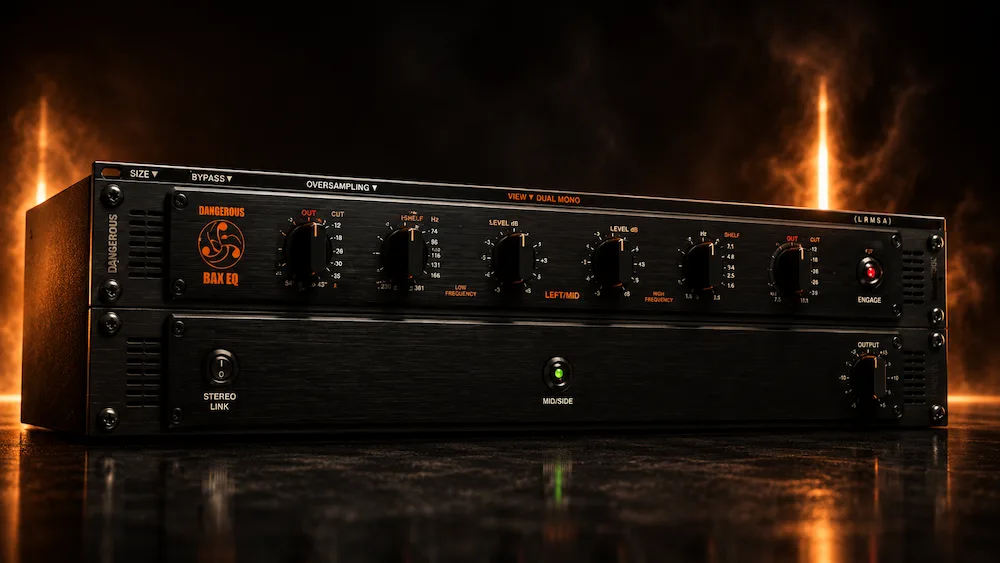
Few analog equalizers have achieved the long-term reputation of the Dangerous Music BAX EQ. While many mastering processors are known for adding color or solving specific technical problems, the BAX EQ became a reference for something more difficult to achieve: broad tonal shaping that preserves the balance and depth of a finished mix. When engineers describe it as “invisible,” they usually mean the EQ improves the program material without leaving an obvious sonic fingerprint.
That reputation makes the Dangerous Music BAX EQ Plugin more than another analog emulation. Developed by Acustica Audio in collaboration with Dangerous Music and original designer Chris Muth, it is the first officially approved software version of the hardware. The development process reportedly involved multiple production units, repeated hardware comparisons, and direct validation from the engineers responsible for the original design rather than relying solely on reverse engineering.
That alone, however, doesn’t make it essential. Today’s mastering engineers already have access to exceptionally transparent digital EQs, advanced analog models, and several Bax-style plugins that cover much of the same territory. Any new mastering plugin entering this market has to offer more than historical credibility—it needs to justify its place in a modern production workflow.
The real question isn’t whether this plugin sounds like the hardware. It’s whether the combination of official circuit modeling, software-only workflow enhancements, and Acustica’s modeling approach delivers practical advantages that experienced mixing and mastering engineers will notice in everyday sessions. That’s ultimately what determines whether this release becomes a long-term production tool or simply another premium analog emulation.
Quick Verdict
| Best For | Mastering engineers, stereo bus processing, hybrid analog/digital studios |
| Not Ideal For | Heavy corrective EQ, large mixing sessions, producers looking for one all-purpose EQ |
| Overall Rating | 8.9/10 |
Contents
Specifications
| Developer | Acustica Audio in collaboration with Dangerous Music |
| Product Type | Mastering equalizer plugin |
| Launch Price | £179 |
| Supported Formats | VST3, AU, AAX |
| Operating Systems | Windows 10 or later • macOS 10.15 or later |
| Processing Modes | Stereo • Mid-Side • Dual Mono |
| Release | 2026 |
Why Bax EQ Still Matters in Modern Mastering
 Digital equalizers have never been more capable. Modern processors such as FabFilter Pro-Q 4, Kirchhoff-EQ, DMG Audio Equilibrium, and Weiss EQ MP combine surgical precision, dynamic processing, linear-phase operation, and extensive visual analysis within a single interface. For corrective work, they leave very little to be desired.
Yet many mastering engineers continue reaching for Bax-style equalizers when the mix is already close to finished. That isn’t driven by nostalgia or preference for analog hardware—it reflects a different approach to tonal shaping.
Mastering rarely requires dramatic EQ moves. More often, the goal is to rebalance an entire mix with adjustments measured in fractions of a decibel. Highly flexible parametric EQs excel at solving specific problems, but their endless filter options, variable Q settings, and visual feedback can encourage unnecessary intervention. The more control an engineer has, the easier it becomes to keep adjusting after the mix has already reached the point where it simply needs to be left alone.
The BAX EQ follows the opposite philosophy. Its fixed shelf frequencies and exceptionally broad curves are designed to reshape overall tonal balance rather than individual frequency bands. Instead of inviting endless optimization, it encourages decisive adjustments based on listening rather than visual analysis. That’s one reason Bax equalizers have remained common fixtures in mastering rooms long after digital EQs surpassed them in flexibility.
This workflow has become even more relevant as mastering increasingly moves inside the DAW. Engineers aren’t looking for software that merely reproduces an analog frequency curve—they expect it to capture the broader behavior of the hardware, including filter interaction, phase response, gain structure, and the subtle characteristics that define how the processor feels during real mastering work. Whether every one of those differences survives blind listening tests is still debated, but the demand for faithful analog modeling has unquestionably grown.
That context makes the Dangerous Music BAX EQ Plugin more significant than a typical hardware emulation. Rather than reverse-engineering a classic design, Acustica Audio developed the plugin with direct access to production hardware and the original Dangerous Music engineering team. For professionals who have already committed to an entirely in-the-box mastering workflow, that level of collaboration carries practical value. It offers the possibility of preserving the familiar BAX workflow while eliminating hardware recall, converter routing, calibration, and maintenance.
Hear What Professional Mastering Can Really Add
Even a well-balanced mix can gain greater depth, tighter low end, smoother highs, and better translation with the right mastering decisions. Upload up to 35 seconds of your track and receive a free mastering demo created by a professional mastering engineer. Compare your original mix with the mastered version before deciding whether to move forward.
Request your free mastering demo →
How the Dangerous Music BAX EQ Plugin Fits into a Professional Mastering Workflow
The value of the Dangerous Music BAX EQ Plugin isn’t determined by how accurately it recreates analog hardware. It depends on where it sits in the mastering chain—and what it’s expected to accomplish once the mix is essentially finished.
Unlike a surgical parametric EQ, the BAX EQ isn’t built to hunt resonances or repair problematic mixes. By the time it enters the mastering chain, corrective EQ, dynamics processing, stereo balance, and most tonal decisions should already be complete. Its role is refinement rather than repair.
That distinction comes directly from the Baxandall topology. The shelves are unusually broad, producing gradual tonal shifts across a wide frequency range instead of emphasizing narrow areas of the spectrum. Raising the high shelf tends to increase openness without exaggerating presence, while low-frequency adjustments reinforce weight without creating the low-mid buildup often associated with conventional shelving filters.
In practice, mastering moves are typically small. Half a decibel is often enough, and one decibel is already a meaningful adjustment on a finished mix. The strength of a Bax EQ isn’t that it allows larger boosts—it’s that small changes remain natural even when applied across the entire stereo image.
The software expands that workflow in several practical ways. Mid-Side processing is the most important addition because it allows tonal balance to be adjusted independently between the phantom center and the stereo field. That’s particularly useful when a vocal needs slightly more openness without brightening wide reverbs, synth layers, room microphones, or stereo effects at the same time.
The feature itself isn’t unique—many mastering EQs support Mid-Side processing—but integrating it into a Bax-style equalizer changes how the processor can be used. Instead of treating it as a fixed stereo finishing tool, engineers can apply the same broad tonal philosophy selectively across different parts of the stereo image.
Dual Mono processing addresses another real-world scenario. Stereo recordings occasionally develop subtle left-right imbalances caused by microphone placement, room asymmetry, or inconsistencies introduced during mixing. Independent channel control allows those differences to be corrected without abandoning the broad, musical curves that define the BAX design.
An output trim may sound insignificant, but in mastering it becomes a practical necessity. Small EQ moves are easy to misjudge when playback levels change. Matching output gain before A/B comparisons removes loudness bias and makes tonal decisions more reliable, especially when evaluating changes below one decibel.
For many engineers, the biggest advantage isn’t sonic at all—it’s recall. It comes from replacing analog recall with instant project recall. Engineers working on catalog remasters, label revisions, or long-term client relationships often revisit projects months after delivery. Rebuilding hardware settings from photographs and recall sheets is rarely difficult, but it is time-consuming. The plugin eliminates that process entirely while preserving the same operational philosophy as the original hardware.
For studios that already own a Dangerous BAX EQ, the plugin is unlikely to replace the rack unit outright. It makes more sense as a complementary tool for revisions, remote work, mobile mastering, or collaborative projects where portability and instant recall outweigh the benefits of keeping the signal path entirely analog.
Does every mastering engineer actually need a Bax EQ? Probably not. Engineers who rely heavily on corrective processing will gain more from an advanced parametric equalizer. But once a mix reaches the stage where every additional adjustment risks doing more harm than good, the deliberately limited control set begins to make sense.
Separating Real Engineering Value from Marketing Claims
 The biggest selling point behind the Dangerous Music BAX EQ Plugin is its official development process. Acustica Audio worked directly with Dangerous Music, modeled production hardware, and refined the software with input from Chris Muth and the original engineering team. That certainly adds credibility—but it doesn’t guarantee better masters.
The question isn’t whether the plugin accurately captures the hardware. It’s whether the hardware itself offers advantages that modern digital equalizers cannot easily replicate. That’s where many discussions around analog modeling become misleading.
A modern parametric EQ can reproduce remarkably similar frequency curves. What it doesn’t necessarily reproduce is the overall behavior of the circuit—the way broad shelves interact, how phase shifts accumulate across the spectrum, and how those subtle changes influence perception when adjustments stay below one decibel. Those characteristics are difficult to quantify, which explains why experienced mastering engineers often describe certain analog processors as feeling easier to work with rather than sounding dramatically different.
That distinction is important because the Dangerous BAX EQ Plugin is not designed to rescue weak mixes. It won’t compensate for poor monitoring, excessive limiting, harsh balances, or unresolved arrangement problems. Like the hardware, it delivers the greatest benefit after the technical problems have already been solved and only broad tonal refinement remains.
Anyone expecting obvious analog coloration should probably look elsewhere. The BAX EQ was never intended to behave like a vintage tube EQ or a transformer-based mastering processor. It doesn’t add noticeable harmonic density or vintage character. Its defining quality is transparency—the ability to reshape tonal balance while leaving the overall presentation remarkably intact.
The software-exclusive additions follow that same philosophy. Mid-Side processing, Dual Mono operation, and integrated output trim don’t reinvent the processor, but they remove several practical limitations of the hardware. They make the BAX EQ easier to integrate into contemporary mastering workflows without changing what made the original design successful.
Performance is one area where expectations should remain realistic. Acustica’s modeling technology has historically favored circuit accuracy over efficiency—a characteristic we’ve also observed in our Acustica Audio Mystic 2 review. There is little reason to expect the BAX EQ Plugin to behave differently. While comprehensive independent benchmarks are still limited, users should anticipate higher CPU usage than lightweight algorithmic EQs from developers such as FabFilter, DMG Audio, or Tokyo Dawn Labs.
Fortunately, that’s rarely a serious limitation. The BAX EQ is designed for stereo buses, mastering chains, and occasional stem processing—not for inserting across fifty channels in a dense mix. In its intended role, sound quality and instant recall matter far more than raw CPU efficiency.
Its value proposition also deserves realistic expectations. Engineers comparing specifications alone will almost certainly conclude that more flexible EQs offer better value. That’s true if versatility is the goal. The Dangerous Music BAX EQ Plugin isn’t trying to replace a modern parametric equalizer. It’s built for engineers who prefer dedicated tools that perform one specific mastering task exceptionally well.
Viewed that way, the plugin justifies its place in a professional mastering workflow. Judged as an all-purpose equalizer, it becomes much harder to recommend.
How the Dangerous Music BAX EQ Plugin Stacks Up Against Leading Mastering EQs
Comparing the Dangerous Music BAX EQ Plugin to every premium mastering EQ on the market is misleading because they aren’t solving the same problem. Some processors are designed for precision editing, others for transparent mastering, and some for adding analog character. The BAX EQ occupies a much narrower niche: broad tonal shaping with minimal intervention.
| Plugin | Primary Strength | Best Use Case | Main Trade-Off |
|---|---|---|---|
| Dangerous Music BAX EQ Plugin | Broad, transparent tonal shaping | Mastering and stereo bus processing | Limited corrective flexibility |
| FabFilter Pro-Q 4 | Comprehensive parametric and dynamic EQ | Mixing and precision mastering | Less focused on analog-style workflow |
| Kirchhoff-EQ | Highly configurable mastering platform | Precision equalization | Greater workflow complexity |
| Weiss EQ MP | Transparent digital mastering | Critical mastering applications | Premium price |
| Brainworx BAX EQ | Established Bax workflow | General mastering | Older-generation circuit modeling |
| Maag EQ4 | Air Band enhancement | Vocals and mix enhancement | Designed for coloration rather than full-range mastering |
FabFilter Pro-Q 4 remains the benchmark for versatility. It handles corrective EQ, dynamic processing, linear-phase mastering, surround formats, and detailed automation within a single processor. If the goal is solving almost any EQ problem with one plugin, Pro-Q is still difficult to surpass.
The Dangerous BAX EQ Plugin isn’t trying to compete on versatility. In many professional mastering chains, the two processors complement each other rather than compete. Pro-Q handles corrective work and problem frequencies, while the BAX EQ is reserved for broad tonal shaping once the technical issues have already been addressed.
Kirchhoff-EQ follows a similar philosophy of maximum flexibility. Its filter architecture, low CPU footprint, and extensive customization make it one of the most technically capable digital EQs available. The trade-off is complexity. Engineers who prefer making quick tonal decisions instead of building elaborate filter structures may find the BAX workflow considerably faster.
Weiss EQ MP approaches mastering from another direction. It emphasizes digital precision rather than analog circuit behavior, making it an excellent choice for engineers who prioritize transparency above all else. The Dangerous plugin targets a different audience—those who appreciate the subtle behavior of analog shelving curves without maintaining outboard hardware.
The most direct competitor is still Brainworx BAX EQ. Both plugins pursue the same mastering philosophy, but they differ in execution. Brainworx relies on an established modeling approach that has proven reliable for years, while the Acustica version emphasizes official hardware collaboration and deeper circuit capture. Whether those differences produce a meaningful audible advantage is something only careful listening tests—not marketing claims—can answer.
Choosing between these processors ultimately comes down to workflow rather than specifications. Engineers looking for a single equalizer to cover every production task will likely see greater value in Pro-Q 4 or Kirchhoff-EQ. Those who build mastering chains from specialized processors may find the Dangerous Music BAX EQ Plugin a better long-term fit because it focuses on one job and performs it exceptionally well.
Real-World Mastering Performance: Translation, Recall, and Workflow
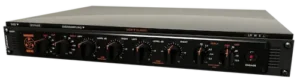 A mastering EQ isn’t judged solely by how it sounds in a controlled listening room. It also has to produce reliable results across streaming platforms, consumer playback systems, and future revision sessions.
The Bax topology naturally favors broad spectral adjustments over narrow corrective moves. That approach tends to translate well because it alters the overall tonal balance instead of emphasizing isolated frequency bands that may become more noticeable on different playback systems. While no equalizer guarantees consistent translation, broad shelves generally produce more predictable results than aggressive corrective boosts applied late in the mastering process.
The low-cut filter remains one of the most practical features in everyday mastering. Modern productions frequently contain unnecessary subsonic energy generated by synthesizers, virtual instruments, room rumble, or accumulated low-frequency processing. Removing information below the useful musical range can recover headroom before peak limiting without changing the perceived weight of the mix.
The high-cut filter serves a similarly practical role. Rather than darkening a master, it’s better viewed as a tool for controlling excessive ultrasonic content that contributes little to audible musical detail while increasing unnecessary bandwidth. Used conservatively, it helps maintain a cleaner spectral balance without compromising perceived openness.
None of these processes should be viewed as shortcuts to better translation. Playback consistency still depends far more on monitoring accuracy, mix balance, dynamics, and engineering decisions than on any individual mastering processor. The BAX EQ simply provides a controlled way to make subtle tonal adjustments once those larger issues have already been solved.
Its biggest day-to-day advantage is arguably workflow rather than sound. Engineers using highly configurable digital EQs often spend more time evaluating alternative settings than making actual mastering decisions. The BAX EQ limits those choices by design, encouraging engineers to judge the result with their ears instead of continuously refining parameters that produce increasingly marginal improvements.
That philosophy becomes especially valuable during revisions. Minor client requests—a touch more air, slightly tighter low end, or a small tonal correction—can often be completed with one or two shelf adjustments instead of rebuilding an elaborate parametric curve. Combined with instant session recall, the plugin fits naturally into commercial mastering environments where revisions are part of the daily workload.
It is less compelling as a general-purpose mixing EQ. While it performs well on stereo buses, stems, and selected instrument groups, its strengths don’t scale efficiently across large multitrack sessions. More versatile parametric processors remain better suited for routine channel processing, leaving the BAX EQ to do what it was originally designed for: applying the final layer of tonal refinement to an already well-balanced mix.
The Final 1% Is What Listeners Remember
Premium EQs and mastering plugins can refine a great mix, but they can’t replace critical listening, accurate judgment, or years of mastering experience. The difference between a good master and a release-ready record often comes down to subtle decisions that improve balance, depth, punch, and translation without making the processing obvious.
Hear those decisions before committing to a full project. Upload up to 35 seconds of your mix and receive a free mastering demo prepared by a professional mastering engineer. Compare your original mix with the mastered version and decide whether the improvement is worth it.
Request your free mastering demo →
Verdict
The Dangerous Music BAX EQ Plugin isn’t trying to become the next all-purpose mastering EQ—and that’s precisely why it works. It focuses on a narrow but important part of the mastering process: making broad tonal adjustments with as little disruption to the existing mix as possible.
Engineers expecting advanced corrective tools, dynamic equalization, or obvious analog coloration will find more capable alternatives elsewhere. Products such as FabFilter Pro-Q 4 or Kirchhoff-EQ offer significantly greater flexibility, while transformer- and tube-based equalizers provide far more audible character. The BAX EQ deliberately avoids both extremes.
Its strengths become apparent during the final stages of professional mastering, once a mix is already in good shape. Broad shelves, transparent filtering, and bus processors such as M Media Audio’s The New Yorker often complement one another because they address different aspects of the finishing process. The BAX EQ shapes tonal balance, while a Vari-Mu compressor influences dynamics and musical glue. Thoughtful software additions such as Mid-Side processing and instant recall make it well suited to professional mastering environments where subtle decisions matter more than endless parameter control.
The official collaboration between Acustica Audio and Dangerous Music adds credibility, but it shouldn’t be the primary reason to buy the plugin. What matters is whether the workflow matches the way you already master records. Engineers who prefer specialized processors for specific stages of the mastering chain are likely to appreciate what the BAX EQ offers. Those looking for a single equalizer to handle every production task probably won’t.
Used as intended, it’s one of the strongest Bax-style plugins currently available. Used as a general-purpose EQ, it quickly loses its advantage. If that workflow matches the way you already master records, it’s easy to recommend. If it doesn’t, there are more versatile EQs for less money.
Overall Rating
| Category | Rating |
|---|---|
| Sound Quality | 9.5/10 |
| Mastering Workflow | 9.5/10 |
| Mix Translation | 9/10 |
| CPU Efficiency | 7.5/10 |
| Feature Set | 8.5/10 |
| Value for Money | 8.5/10 |
| Overall | 8.9/10 |
Sound Quality — 9.5/10
The BAX EQ delivers exactly what mastering engineers expect from a Bax-style equalizer: broad, transparent tonal shaping that remains natural even with very small adjustments. It is designed to preserve musical balance rather than impose an obvious analog signature.
Mastering Workflow — 9.5/10
This is where the plugin stands out. The intentionally restrained control set encourages faster decisions, while Mid-Side processing, Dual Mono operation, and instant recall modernize a workflow that traditionally depended on outboard hardware.
Mix Translation — 9/10
Wide shelving curves tend to produce reliable tonal balance across different monitoring systems when used conservatively. The plugin supports good translation, but—as with any mastering processor—the final result still depends far more on the mix, monitoring environment, and engineering decisions.
CPU Efficiency — 7.5/10
Like many Acustica Audio processors, the BAX EQ favors detailed circuit modeling over computational efficiency. CPU consumption is higher than most algorithmic mastering EQs, although this is rarely a serious limitation when used on a stereo bus or mastering chain.
Feature Set — 8.5/10
Compared with modern parametric equalizers, the feature list is intentionally narrow. However, the available tools are carefully chosen for mastering applications, and every control serves a practical purpose rather than increasing complexity.
Value for Money — 8.5/10
The official collaboration with Dangerous Music gives the plugin additional credibility, but its premium price places it alongside some of the industry’s most capable mastering EQs. Engineers who already understand the Bax workflow will see the strongest return on investment, while many producers may find a versatile parametric EQ to be the more economical choice.
Overall — 8.9/10
The Dangerous Music BAX EQ Plugin succeeds by remaining focused. It is not a universal equalizer, nor is it intended to replace modern parametric processors. Instead, it excels as a dedicated mastering EQ for engineers who value broad tonal refinement, transparent filtering, and a workflow built around decisive listening rather than unlimited control.
Pros & Cons
| Pros | Cons |
|---|---|
| ✔ Exceptionally transparent shelving curves ✔ Officially approved hardware modeling ✔ Excellent mastering workflow ✔ Mid-Side and Dual Mono processing ✔ Instant DAW recall | ✘ Higher CPU usage than algorithmic EQs ✘ Premium pricing ✘ Limited corrective capabilities ✘ Not intended as a universal EQ |
Who Should Buy the Dangerous Music BAX EQ Plugin?
| Recommended For | Consider Alternatives If… |
|---|---|
| Professional mastering engineers Hybrid analog/digital studios Mastering and stereo bus engineers Engineers who prefer dedicated mastering tools | You need surgical corrective EQ You need a low-CPU workflow You want one EQ for every mixing task |
FAQ
Is the Dangerous Music BAX EQ Plugin better suited for mastering than mixing?
Yes. Although it works well on stereo buses and selected instrument groups, its design is centered on final tonal shaping. Most engineers will get the greatest benefit when using it near the end of a mastering chain rather than throughout a multitrack mix.
Can the Dangerous Music BAX EQ Plugin replace FabFilter Pro-Q 4?
No. Pro-Q 4 remains a far more versatile processor for corrective EQ, dynamic processing, and detailed frequency shaping. The BAX EQ is best viewed as a complementary mastering tool rather than a replacement.
How different is it from the Brainworx BAX EQ?
Both plugins are built around the same Bax EQ concept, but they differ in their modeling approach and workflow. The Acustica version emphasizes official hardware collaboration and additional mastering features, while the Brainworx version remains lighter on CPU and has an established track record in professional studios.
Does the plugin add analog warmth or saturation?
Not by design. The BAX EQ has always been valued for transparency rather than harmonic coloration. Engineers looking for obvious tube or transformer character should consider a different type of mastering EQ.
Is the CPU usage high compared to other mastering EQs?
It is expected to require more processing power than most algorithmic equalizers because of Acustica Audio’s modeling technology. In typical mastering sessions, however, CPU load is rarely a limiting factor since the plugin is usually inserted only on the stereo bus or master channel.
Is it worth buying if you already own another Bax-style EQ?
That depends on your workflow. If your existing plugin already delivers the results you need, the improvement may be incremental. Engineers seeking an officially licensed recreation with modern features such as Mid-Side processing and enhanced recall are more likely to justify the investment.
Can it improve streaming translation?
Not directly. No EQ can guarantee better translation across Spotify, Apple Music, YouTube, or consumer playback systems. Its advantage lies in making subtle tonal adjustments that generally translate more naturally than aggressive mastering EQ moves.
Who should consider buying the Dangerous Music BAX EQ Plugin?
It makes the most sense for mastering engineers, experienced mix engineers, and hybrid studios looking for a transparent finishing EQ. Beginners and producers searching for an all-purpose equalizer will usually get more value from a modern parametric EQ.
Does the Dangerous Music BAX EQ Plugin work well on a mix bus?
Yes. Although it was developed with mastering in mind, many engineers will find it equally effective on a stereo mix bus where broad tonal shaping is preferred over surgical equalization. It is less suitable for individual channel processing, where a fully parametric EQ usually offers greater flexibility.

Yurii Ariefiev is a mastering engineer and audio production editor specializing in critical listening, stereo bus processing, and final-stage tonal balance. His editorial reviews evaluate professional audio tools in real mastering workflows, focusing on audible results, engineering decisions, and long-term production value rather than marketing claims or feature lists.
This review analyzes the Dangerous Music BAX EQ Plugin from the perspective of practical mastering, examining where broad shelving EQ improves translation, workflow, and finishing decisions—and where modern parametric equalizers remain the better choice.