The Crow Hill Company Crystal Pads Review: Workflow, Sound Quality & Real-World Production Performance
Pad instruments have become increasingly complex. Modern libraries and synthesizers often rely on layered modulation, generative movement, and extensive macro systems to create evolving textures. While those capabilities can sound impressive in isolation, they frequently introduce new challenges once a track reaches the arrangement and mixing stages. A pad that feels alive on its own can quickly become a source of masking, instability, or unnecessary density inside a full production.
The Crow Hill Company Crystal Pads approaches the problem from a different angle. Instead of building movement through deep modulation architecture, it gives users direct control over three independent sound layers that can be blended and performed in real time. The concept is less focused on sound design and more focused on musical interaction, which immediately separates it from many modern texture instruments.
That distinction makes Crystal Pads worth examining beyond the usual feature list. For producers working with acoustic instruments, cinematic arrangements, ambient productions, neo-classical compositions, and hybrid scoring projects, the more relevant question is not how much movement the instrument can generate, but how effectively that movement survives the realities of arrangement, mixing, and mastering.
This review looks at The Crow Hill Company Crystal Pads from a production perspective, evaluating how its design choices affect workflow, mix integration, long-term usability, and its position within a market increasingly dominated by complexity.
Contents
Why Crystal Pads Feels Relevant in Today’s Production Environment
The challenge in modern production is no longer creating movement. The challenge is controlling it once multiple instruments begin competing for space inside a mix. Between advanced wavetable synthesizers, granular engines, cinematic sample libraries, and AI-assisted composition tools, producers have access to more movement, modulation, and sonic variation than ever before. The challenge is no longer generating complexity. The challenge is preventing that complexity from becoming a mixing problem later.
One of the recurring issues in modern arrangements is that instruments are designed to remain interesting in isolation. Pads evolve continuously, modulation systems introduce constant variation, and layered textures occupy increasingly large portions of the frequency spectrum. What sounds impressive during sound selection can become problematic once vocals, drums, bass, guitars, orchestral elements, and effects compete for the same space.
Mix engineers encounter this scenario regularly. A texture that feels rich and immersive in solo mode may require substantial EQ, automation, stereo control, or dynamic processing before it stops interfering with the rest of the arrangement. In some cases, the movement itself becomes the problem. Constant spectral shifts make it harder to establish a stable balance, particularly in dense productions.
Crystal Pads enters the market with a noticeably different philosophy. Rather than generating complexity through increasingly sophisticated modulation systems, it focuses on direct control of independent sound layers. The objective is not to create the most elaborate evolving texture possible, but to give producers a more predictable way of shaping movement inside a musical context.
That approach aligns with a broader shift occurring across professional production workflows. Many producers are becoming less interested in instruments that demonstrate technical complexity and more interested in instruments that reach usable results quickly. In that respect, Crystal Pads is less about sound design experimentation and more about arrangement efficiency, mix compatibility, and musical decision-making.
Understanding the Core Design Philosophy Behind The Crow Hill Company Crystal Pads
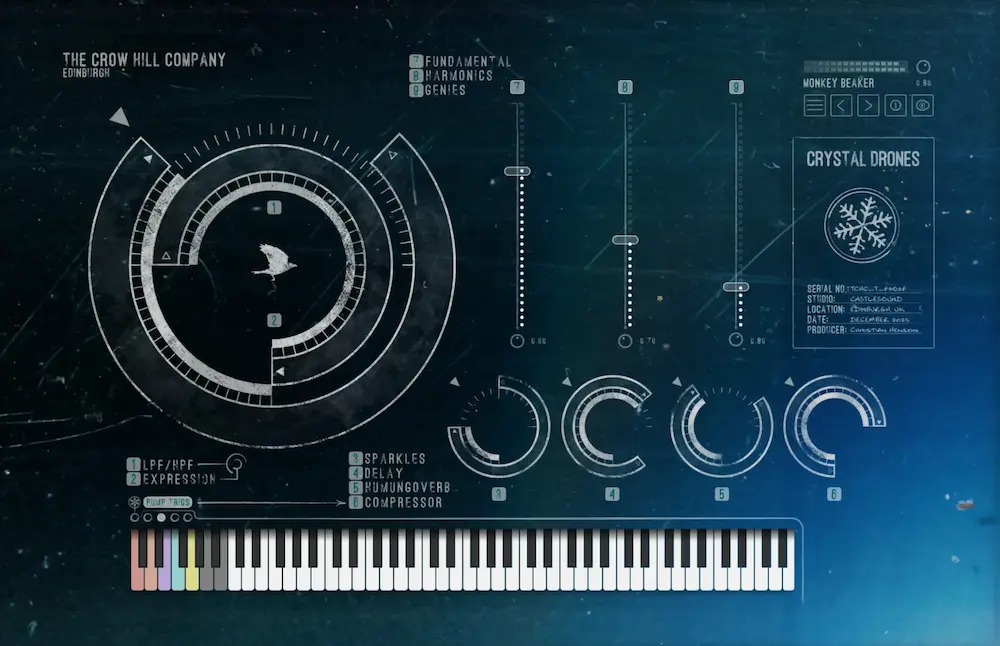
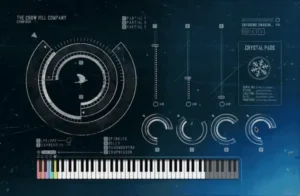
 Most modern texture instruments generate movement through modulation. LFOs, evolving envelopes, macro assignments, sequencers, and randomized processes continuously reshape the sound behind the scenes. Crystal Pads takes a different approach. Instead of building complexity through modulation architecture, it separates the instrument into three independently controllable partials: Glassy, Harmonic, and Unexpected.
- Glassy provides the fundamental tonal foundation and establishes the core pitch content.
- Harmonic introduces additional overtones, density, and spectral complexity.
- Unexpected adds longer evolving events and transient moments that prevent static repetition across sustained passages.
The concept may sound similar to traditional layer blending, but the practical workflow is different. Rather than programming movement and then reacting to the result, the user actively controls how much tonal information, harmonic density, and textural development enters the arrangement at any given moment.
This distinction becomes more significant as projects grow in complexity. In many pad instruments, movement is generated automatically and must later be managed through automation, EQ, or additional processing. Crystal Pads shifts more of that decision-making to the performance stage. Instead of correcting unwanted movement after the fact, producers can shape the behavior of the texture as part of the arrangement process itself.
From a production standpoint, the design encourages intentional layering rather than continuous modulation. That may seem like a subtle difference, but it directly affects how quickly a sound finds its place in a mix. A producer can increase harmonic complexity during a transition, reduce density beneath a vocal phrase, or introduce additional motion during a breakdown without rebuilding the patch or creating extensive automation lanes.
For composers working in film, television, advertising, trailer music, and production music, that workflow has practical value. Deadlines rarely reward deep sound-design sessions. Instruments that deliver controlled variation while remaining easy to place inside an arrangement often prove more useful than instruments capable of generating unlimited complexity.
What Does Crystal Pads Actually Sound Like?
Crystal Pads is closer to a cinematic texture instrument than a traditional pad library. The sound focuses on atmosphere, harmonic support, and controlled movement rather than aggressive synthesis, oversized modulation, or attention-grabbing sound design.
The Glassy partial provides a clean tonal foundation that remains relatively unobtrusive inside a mix. Harmonic introduces additional richness and width without immediately pushing the sound into oversized cinematic territory. Unexpected contributes evolving details that help sustain interest over longer passages without constantly demanding attention.
The result is a collection of textures that generally feel more supportive than dominant. Producers expecting huge festival-style supersaws, aggressive hybrid trailer impacts, or heavily animated synth architecture may find Crystal Pads restrained. Producers looking for depth, motion, and emotional support behind vocals, strings, pianos, and acoustic arrangements are likely to understand the design goals immediately.
Perhaps the most notable characteristic is that the instrument rarely sounds like it is trying to impress the user. Instead, it tends to behave like an arrangement layer that becomes more valuable as additional instruments enter the production.
Sonically, Crystal Pads sits closer to modern scoring textures and atmospheric support instruments than traditional synthesizer pads. The sound is generally polished, spacious, and harmonically rich, but avoids the exaggerated brightness, oversized stereo width, and aggressive motion often found in cinematic showcase libraries.
From a review perspective, Crystal Pads succeeds not because it introduces a completely new synthesis concept, but because it addresses a practical production problem. Many evolving instruments generate more movement than a mix actually needs. Crystal Pads focuses on creating movement that remains useful once additional instruments enter the arrangement.
For most producers, the real value of Crystal Pads is not replacing an existing flagship instrument. The value is reaching usable atmospheric textures faster and with fewer arrangement compromises later in the production process.
What Crystal Pads Does Differently Than Traditional Pad Instruments
The majority of modern pad instruments are designed around automated movement. Whether that movement comes from modulation matrices, evolving envelopes, granular processing, sequencers, or randomization systems, the underlying principle is largely the same: the instrument generates internal activity while the user defines the boundaries.
That approach has produced some of the most impressive software instruments on the market. It has also created a common production problem. The more movement a sound generates automatically, the less predictable its behavior becomes once it is placed inside a full arrangement. Frequency balance shifts over time, stereo information changes continuously, and elements that initially complement the mix can begin competing with vocals, lead instruments, or other focal points.
Crystal Pads approaches movement from the opposite direction. Instead of relying on an extensive modulation framework, it places control of the instrument’s evolving behavior directly in the hands of the user. The interaction between the Glassy, Harmonic, and Unexpected partials becomes the primary source of development, allowing movement to emerge through performance decisions rather than automated processes.
Crystal Pads is best understood as a cinematic texture instrument and evolving pad library rather than a traditional synthesizer or deep-programming virtual instrument. Its design is focused less on creating sounds from scratch and more on shaping movement, atmosphere, and harmonic support within an arrangement.
From an arrangement perspective, this creates a more deliberate workflow. Producers are not shaping modulation curves or adjusting dozens of parameters to achieve variation. They are controlling tonal weight, harmonic complexity, and textural activity in real time. The instrument behaves less like a traditional synthesizer and more like a collection of interconnected musical layers that can be introduced, reduced, or reshaped as the arrangement evolves.
This distinction affects more than workflow speed. It also affects predictability during mixing. Sounds built around aggressive modulation often require additional management because their spectral content changes constantly throughout a song. Crystal Pads generally produces movement that remains easier to anticipate, making it simpler to balance against other instruments and easier to maintain across different sections of a production.
Whether that philosophy is an advantage depends largely on the user’s priorities. Producers interested in deep synthesis, experimental sound design, or highly programmable modulation environments may find the instrument intentionally limited. Producers focused on composition, arrangement, and efficient production workflows are more likely to appreciate the restraint built into the design.
Mixing Implications: Why Crystal Pads Behaves Differently Inside Dense Arrangements
One of the more interesting claims surrounding Crystal Pads is its ability to sit naturally alongside acoustic instruments. While marketing language often overstates this kind of compatibility, the underlying challenge is real. Pads are frequently among the most difficult elements to manage in modern mixes because they occupy large portions of the spectrum while contributing relatively little transient definition.
A dense pad can simultaneously consume low-mid energy, mask upper-mid detail, and widen the stereo image to the point where other instruments begin losing perceived focus. The problem becomes even more noticeable in productions built around pianos, strings, acoustic guitars, orchestral recordings, or lead vocals, where clarity depends on preserving subtle detail rather than simply creating size.
What makes Crystal Pads noteworthy is not that its sounds are inherently easier to mix, but that its architecture allows producers to control complexity before it becomes a mixing problem. Because tonal content, harmonic density, and evolving texture are separated into independent partials, users can decide how much information enters the arrangement at each stage rather than relying on corrective processing later.
That distinction reflects a principle experienced mix engineers encounter constantly: arrangement decisions usually have a greater impact on clarity than EQ decisions. Removing unnecessary density before it reaches the mix bus is often more effective than attempting to carve space after multiple layers are already competing for attention. The same principle becomes critical when you prepare a mix for mastering, where unresolved masking and arrangement problems are often mistaken for mastering issues.
In practical terms, this can reduce dependence on aggressive EQ cuts, dynamic equalization, multiband compression, and automation. A producer may choose to reduce harmonic complexity beneath a vocal section, introduce additional movement during an instrumental passage, or simplify the texture during a dense chorus without redesigning the entire sound.
The benefit becomes most apparent in hybrid productions where acoustic and electronic elements share the same space. Instead of treating the pad as a static layer that must be controlled throughout the mix, Crystal Pads encourages a more adaptive approach in which the texture can evolve according to the needs of the arrangement. That does not eliminate mixing challenges, but it can reduce the amount of corrective work required later in the production process.
The Role of the Unexpected Layer in Modern Arrangements
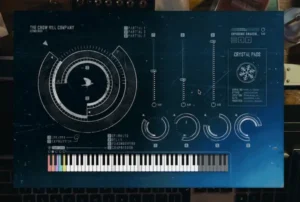 Among the three partials, Unexpected is arguably the component that defines the instrument’s identity. Glassy and Harmonic establish the tonal and spectral foundation, but Unexpected is responsible for introducing motion that extends beyond simple layer blending.
This addresses a common challenge in ambient, cinematic, neo-classical, and atmospheric electronic productions. Sustained textures are effective at creating space and mood, yet they often become static over the course of a three- or four-minute arrangement. Producers typically compensate by adding automation, introducing supplementary layers, increasing modulation depth, or building additional effects chains to maintain a sense of development.
Unexpected takes a less interventionist approach. Rather than requiring the producer to continuously manufacture variation, it introduces evolving events that create movement within the texture itself. The result is a pad that can remain active over longer passages without demanding constant automation or arrangement changes.
From a compositional perspective, this can be particularly useful when supporting foreground elements. Instead of competing for attention, the texture contributes subtle development behind vocals, solo instruments, or orchestral themes. The arrangement feels less static, but it does not necessarily become more crowded.
At the same time, this behavior introduces a tradeoff that experienced producers will immediately recognize. Any source of semi-autonomous movement reduces predictability. The more an instrument contributes evolving events on its own, the more carefully those events must be evaluated within the broader context of the production.
In cinematic scoring, ambient music, and slow-moving arrangements, that unpredictability can be beneficial because it helps prevent repetition from becoming noticeable. In tightly programmed electronic productions, trailer cues built around precise transitions, or arrangements that depend on highly controlled automation, those same moments may require additional attention. What feels organic in one context can become a distraction in another.
The real value of the Unexpected layer is not that it generates surprise. It is that it introduces variation without forcing the producer to build a complex movement system around the instrument. That philosophy mirrors a broader trend toward performance-driven movement found in tools such as Movimento Strings Inflections, where expressive variation is generated through musical interaction rather than extensive programming. Whether that tradeoff is desirable depends largely on how much control the production demands and how much freedom the arrangement can tolerate.
Marketing Claims Versus Production Reality
The Crow Hill Company describes Crystal Pads as a source of evolving textures that can introduce unexpected moments without taking control of the composition. The concept is appealing, particularly for producers who want movement without building complex automation systems. In practice, however, the relationship between unpredictability and musical control is rarely that simple.
No instrument that generates evolving behavior is completely neutral. The moment movement is built into the sound itself, the instrument begins influencing arrangement decisions. Certain textures encourage longer note durations. Certain transitions feel more natural than others. Some evolving events draw attention to themselves, while others remain in the background. These characteristics become part of the composition whether the producer intends them to or not.
Crystal Pads avoids many of the extremes associated with generative instruments and heavily randomized environments. Its behavior remains more controlled than systems that continuously reshape pitch, rhythm, or timbre. That restraint makes it easier to integrate into structured productions where consistency matters.
At the same time, the instrument is not a blank canvas. The evolving content embedded within the partials carries its own musical identity. Producers are not designing movement from the ground up; they are shaping and directing movement that already exists within the source material. For many workflows, that distinction is an advantage because it reduces programming time. For others, it represents a creative limitation.
This is where the gap between marketing language and production reality becomes most apparent. The real strength of Crystal Pads is not unlimited flexibility. It is curated flexibility. The instrument narrows the range of available outcomes in exchange for speed, cohesion, and ease of use.
Whether that tradeoff is desirable depends on the role the instrument is expected to play. Composers, producers, and mixers looking for atmospheric layers that integrate quickly into a project will likely view the constraints as beneficial. Dedicated sound designers, experimental electronic artists, and users who prefer constructing every aspect of a texture from scratch may find those same constraints restrictive.
Viewed through that lens, Crystal Pads is best understood not as an open-ended sound design platform, but as a specialized production tool designed to deliver controlled movement with minimal setup. That is a narrower objective than the marketing language might imply, but it is also a more realistic description of where the instrument provides value.
Competitive Positioning: Where Crystal Pads Fits Among Modern Alternatives
Comparing Crystal Pads directly against flagship synthesizers can lead to misleading conclusions because the instrument is solving a different problem. Products such as Omnisphere, Pigments, Falcon, or advanced granular environments are designed as open-ended sound creation platforms. Crystal Pads is closer to a production-focused texture instrument whose primary goal is delivering usable musical movement with minimal programming.
That distinction matters because workflow requirements vary significantly between producers. A film composer working against a deadline may prioritize speed, consistency, and mix-ready textures. A sound designer building custom atmospheres for games or experimental electronic music may prioritize flexibility above everything else. Both goals are valid, but they favor different tools.
| Instrument | Best Use Case | Programming Depth | Workflow Speed | Mix Readiness |
|---|---|---|---|---|
| Crystal Pads | Atmospheric layering and evolving textures | Moderate | High | High |
| Omnisphere | Deep synthesis and hybrid sound design | Very High | Moderate | Variable |
| Pigments | Modern synthesis and modulation design | Very High | Moderate | Good |
| Kontakt-based cinematic libraries | Scoring and realistic instrumentation | Low to Moderate | High | Good |
| Granular texture instruments | Experimental atmospheres and sound manipulation | Very High | Variable | Variable |
The more relevant comparison is not whether Crystal Pads can match the flexibility of Omnisphere or the modulation capabilities of Pigments. It cannot, and it is not intended to. The better question is whether the instrument reaches a useful result faster than more complex alternatives.
In that respect, Crystal Pads occupies a space that is often underserved. Many modern instruments offer nearly unlimited control but require substantial programming before they become arrangement-ready. Crystal Pads trades some of that flexibility for immediacy. The user spends less time building movement and more time deciding how that movement supports the composition.
For producers whose workflow revolves around custom synthesis, that tradeoff may feel restrictive. For composers, arrangers, and production-focused musicians, it may be exactly the reason to choose the instrument over more sophisticated alternatives. The value proposition is not maximum sonic possibility. It is efficient access to evolving textures that remain manageable throughout the production process.
Producers searching for a Crystal Pads alternative should first determine whether they need deeper sound-design capabilities or faster access to mix-ready textures. Instruments such as Omnisphere, Pigments, and Falcon offer substantially greater programming depth, while Crystal Pads focuses on speed, simplicity, and arrangement integration.
Crystal Pads in Real Production Scenarios
One of the easiest ways to evaluate Crystal Pads is to look beyond its feature set and consider how it behaves inside real productions. Crystal Pads tends to function as a supporting layer rather than a primary focal element within an arrangement. Its strengths become more apparent when supporting other elements and creating depth around the primary musical focus.
In vocal-driven pop productions, Crystal Pads can function as an atmospheric layer that adds width and emotional weight without competing directly with the lead vocal. Because the harmonic and textural components can be controlled independently, producers can reduce density during verses and introduce additional movement during transitions or choruses.
For film scoring and television composition, the instrument is often more useful as a storytelling tool than as a traditional pad source. The evolving behavior of the partials allows sustained cues to develop naturally over time, helping maintain interest during scenes that rely on long-form emotional movement rather than rhythmic intensity.
Ambient producers may find the Unexpected layer particularly valuable. Instead of relying on extensive automation or stacked effects chains, the instrument can generate subtle variation across extended passages while preserving a coherent sonic identity. This helps prevent repetition without forcing constant intervention from the producer.
Hybrid orchestral arrangements present another practical application. Modern scoring productions frequently combine acoustic recordings with synthetic textures, creating challenges related to masking, density, and spatial balance. Crystal Pads is generally more effective when used to support strings, pianos, and orchestral elements rather than compete with them, allowing composers to add atmosphere without overwhelming the arrangement.
Across all of these scenarios, the instrument’s strongest attribute is not the amount of movement it creates, but the degree of control it gives producers over how that movement interacts with the rest of the production.
Who Should Consider Crystal Pads — And Who Probably Should Not
 Crystal Pads is easier to evaluate when viewed through the lens of workflow rather than genre. The instrument is not attempting to compete with advanced synthesis platforms, modular environments, or dedicated sound design tools. Its strengths emerge when the goal is creating movement, atmosphere, and harmonic support without spending significant time building the underlying mechanics.
That makes it particularly relevant for composers and producers working under practical production constraints. Film and television composers, trailer music writers, ambient producers, neo-classical artists, and musicians combining acoustic and electronic elements are likely to benefit most from the instrument’s design. Similar workflow priorities can be seen in our LUX Orchestral Strings Essentials review, where ease of integration and arrangement efficiency often prove more valuable than unlimited programming depth. In these environments, speed often matters as much as flexibility, and sounds that integrate quickly into an arrangement can be more valuable than sounds that offer unlimited programming options.
The same logic applies to producer-songwriters and arrangers working with vocals, pianos, strings, or other acoustic sources. Crystal Pads is at its strongest when used as a supporting texture rather than the centerpiece of a sound design session. Its architecture encourages musical decisions, not technical experimentation.
That focus also defines its limitations. Producers who enjoy building patches from scratch, designing custom modulation systems, or exploring highly experimental sonic territory may find the instrument restrictive. Much of the creative direction is already embedded within the source material, which means users are shaping existing behaviors rather than constructing entirely new ones.
This is not a question of quality or capability. It is a question of creative priorities. Crystal Pads favors efficiency, consistency, and immediate musical application. Users looking for those qualities will likely understand its appeal quickly. Users searching for a blank canvas for deep synthesis and unrestricted sound design may find more suitable options elsewhere.
Real-World Production Perspective: Translation, Mastering, and Streaming Considerations
Many pad sounds are evaluated in isolation, where width, movement, and density can be appreciated without competing elements. The real test begins later. Once a production reaches the mixing and mastering stages, textures that initially sounded impressive often become the source of translation problems across playback systems.
Large atmospheric layers tend to expose weaknesses that are easy to overlook during composition. Excessive stereo information may lose impact on smaller devices. Low-mid energy can accumulate as arrangements become denser. Constant modulation may alter perceived balance from one section to another, forcing engineers to spend additional time managing behavior that was originally intended to create excitement.
While no pad instrument is immune to translation problems, Crystal Pads gives producers more opportunities to manage complexity before those issues reach the mix or mastering stage. Because movement is distributed across independently controlled partials rather than driven by aggressive modulation systems, producers have more opportunity to control complexity before the mix reaches a corrective stage. The instrument encourages selective layering rather than continuous expansion.
This becomes particularly relevant during mastering. Highly animated textures can react unpredictably to broadband compression, limiting, and loudness optimization. Understanding how those decisions are evaluated during a professional mastering session helps explain why arrangement control often matters as much as processing itself. A detailed breakdown of that workflow can be found in our guide on how professional mastering works. As density increases, subtle movement may become exaggerated, while frequency buildups that seemed insignificant during production become more apparent. Sounds with a more stable spectral profile generally translate more consistently through downstream processing.
Apple Music introduces additional considerations because AAC encoding can reveal weaknesses that are less obvious inside a DAW session. Producers concerned with streaming translation may benefit from understanding how Apple Digital Masters mastering evaluates content before distribution. Pads that rely heavily on extreme stereo width or intricate micro-detail often lose some of their impact outside controlled monitoring environments. Textures that maintain a clear tonal foundation tend to survive those transitions more effectively.
That does not mean Crystal Pads is inherently mix-ready. Wide textures can still compete with vocals. Low-mid congestion remains possible. Reverbs, delays, and additional processing can easily push atmospheric layers beyond their intended role within an arrangement. The same engineering discipline required for any pad instrument still applies.
What separates Crystal Pads from many texture-focused instruments is that its workflow encourages producers to think about arrangement density before those issues reach the mix bus. From a mixing and mastering perspective, that may be one of its most practical strengths. The fewer problems that need correction later, the more likely a production is to retain clarity, depth, and translation across real-world listening environments. Many of the issues producers attribute to mastering are actually introduced much earlier in the arrangement and production stages, which is why understanding common mastering problems remains important even when evaluating instruments like Crystal Pads.
Where Crystal Pads Excels — And Where It Doesn’t
Crystal Pads performs best when the goal is adding atmosphere, motion, and harmonic support without introducing excessive programming overhead. The instrument excels in workflows where composers need evolving textures that remain manageable throughout arrangement, mixing, and mastering.
Its most practical advantage is the ability to control density and movement before those decisions become mixing problems. Because the Glassy, Harmonic, and Unexpected partials remain independently controllable, producers can simplify arrangements long before corrective EQ, compression, or automation become necessary.
The tradeoff is that Crystal Pads offers less freedom than advanced synthesis platforms. Users who enjoy building modulation systems, designing custom signal paths, or creating highly experimental textures may eventually reach the limits of the instrument’s architecture.
For composition-focused workflows, those limitations are unlikely to be problematic. For dedicated sound design workflows, they may become the deciding factor.
Verdict
Crystal Pads succeeds because it focuses on a production problem that many modern instruments ignore. Creating movement is easy. Creating movement that remains useful during arrangement, mixing, and mastering is considerably harder. Rather than adding more layers of complexity, Crystal Pads concentrates on giving producers direct control over how texture develops inside a track.
The instrument’s defining strength is not the individual sounds, nor is it the level of customization available to the user. Its value comes from the relationship between the Glassy, Harmonic, and Unexpected partials and the way those layers encourage arrangement-driven decision-making. Instead of spending time constructing movement, producers spend more time deciding how that movement supports the music.
That philosophy will not appeal to everyone. Sound designers looking for complete control over modulation behavior, custom signal paths, and highly experimental textures will find more capable platforms elsewhere. Crystal Pads deliberately sacrifices some flexibility in exchange for speed, consistency, and ease of integration.
For composers, arrangers, and producers working with cinematic textures, acoustic instruments, ambient layers, or hybrid productions, that tradeoff makes far more sense. The instrument is at its strongest when used as part of a larger arrangement rather than as the centerpiece of a sound design workflow.
Perhaps the most compelling aspect of Crystal Pads is that it addresses a production problem rather than a technical one. Modern software instruments rarely struggle to generate complexity. More often, they generate too much of it. Crystal Pads takes a more restrained approach, giving users access to evolving textures without demanding constant management once those sounds enter a mix.
Viewed through that lens, Crystal Pads is less a synthesizer and more a compositional tool. Producers searching for endless possibilities may find it limited. Producers searching for faster decisions, cleaner arrangements, and textures that remain practical throughout mixing and mastering are likely to understand its appeal immediately.

Yurii Ariefiev is a mastering engineer and audio production editor specializing in mix translation, mastering evaluation, and real-world playback consistency. His work focuses on how production decisions made during composition, arrangement, and mixing affect the final master across streaming platforms, consumer playback systems, and professional monitoring environments.
This review examines The Crow Hill Company Crystal Pads from a production and mastering perspective, analyzing how evolving textures, harmonic density, stereo behavior, and arrangement choices influence mix clarity, mastering outcomes, and long-term translation beyond the studio environment.
FAQ
Is The Crow Hill Company Crystal Pads a synthesizer or a sample-based instrument?
Crystal Pads behaves more like a texture-focused instrument than a traditional synthesizer. Its workflow is built around shaping pre-existing layers rather than creating sounds from raw oscillators and complex synthesis engines.
Can Crystal Pads sit behind vocals without causing masking issues?
It can, but the result depends on arrangement choices. The ability to independently control tonal, harmonic, and evolving elements makes it easier to reduce density around a vocal than with heavily layered pad patches that function as a single sound source.
Is Crystal Pads useful for cinematic and trailer music production?
Yes, particularly for composers looking to create motion and atmosphere without building extensive automation systems. The instrument is better suited to supporting emotional development than generating highly aggressive sound design effects.
How does Crystal Pads compare to Omnisphere for atmospheric textures?
Omnisphere offers significantly deeper synthesis, modulation, and sound design capabilities. Crystal Pads focuses on faster access to evolving textures and a more streamlined production workflow.
Does Crystal Pads require extensive automation to stay interesting?
Not to the same extent as many pad instruments. Much of the variation comes from interaction between the partials, reducing the need for continuous parameter automation throughout an arrangement.
Can Crystal Pads create problems during mastering?
No more than any other atmospheric instrument. The primary risks remain excessive stereo width, low-mid buildup, and conflicts with lead elements. Those issues are determined more by arrangement and mixing decisions than by the instrument itself.
How well do Crystal Pads textures translate to streaming platforms?
Textures with a stable tonal foundation generally survive normalization, lossy encoding, and consumer playback systems more effectively than sounds that rely entirely on extreme stereo effects or constant modulation.
Is Crystal Pads a good choice for sound designers?
That depends on the objective. Producers seeking deep synthesis environments, custom modulation networks, and unrestricted experimentation will likely prefer dedicated sound design platforms. Crystal Pads is optimized for composition and arrangement workflows rather than advanced synthesis.
Can Crystal Pads replace multiple atmospheric libraries?
For some workflows, yes. For others, no. The instrument covers a specific category of evolving textures well, but it is not intended to replace orchestral libraries, advanced synthesizers, granular environments, or specialized cinematic collections.
Is Crystal Pads a Kontakt library?
No. Although the instrument targets many of the same composers and cinematic producers who use Kontakt-based tools, Crystal Pads follows its own workflow and control structure rather than functioning as a traditional Kontakt library.
Is Crystal Pads worth using if you already own Omnisphere?
That depends on how you work. Omnisphere offers significantly greater synthesis depth, while Crystal Pads focuses on immediate access to evolving textures and performance-driven control. Many producers may view the two instruments as complementary rather than directly competitive.
What type of producer will get the most value from Crystal Pads?
Composers, arrangers, ambient producers, film scorers, and musicians working with hybrid acoustic-electronic productions are likely to benefit most. The instrument rewards users who prioritize workflow efficiency and mix-ready textures over extensive sound design flexibility.