Convolution has traditionally served one purpose: reproducing real acoustic spaces with maximum accuracy. Whether capturing a legendary scoring stage, a vintage hardware processor, or a concert hall, most convolution reverbs prioritize realism over experimentation. That’s why many producers still rely on separate delays, modulation effects, dynamics processors, and automation when designing more aggressive spatial textures.
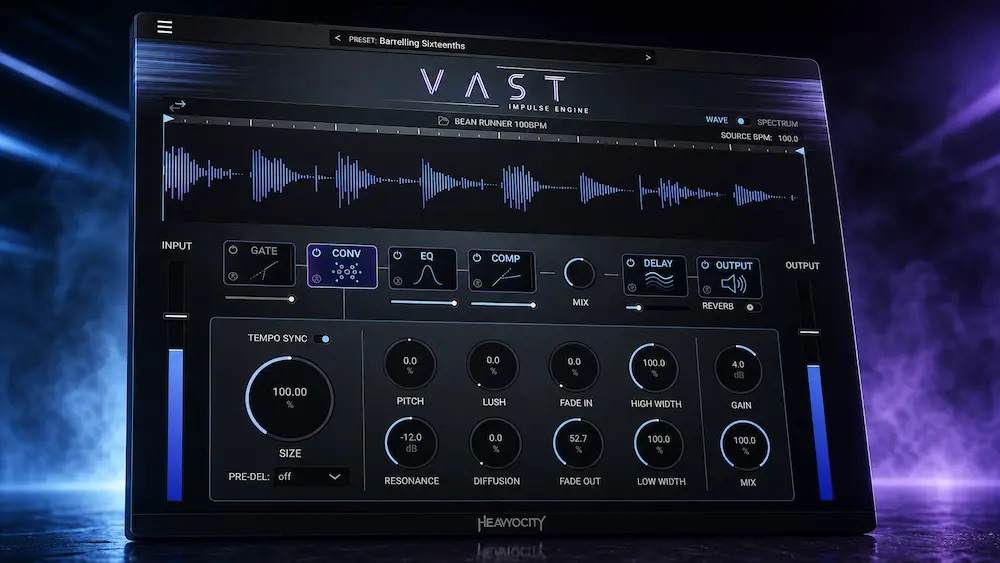
Heavyocity VAST approaches convolution from the opposite direction. Instead of treating an impulse response as a finished acoustic environment, it uses it as the foundation of a flexible effects engine where convolution, delay, dynamics, gating, EQ, and modulation interact as part of a single creative workflow. The goal isn’t to simulate another room—it’s to reshape the source into something that would be difficult or unnecessarily time-consuming to build with a conventional plugin chain.
That makes VAST difficult to compare with traditional convolution reverbs. Its real competition isn’t Altiverb or Reverberate as much as the collection of creative processors many producers combine for cinematic transitions, vocal effects, evolving synth textures, and modern sound design. The question is less about reverb quality and more about whether consolidating those processes inside one plugin leads to faster decisions without sacrificing control.
This review evaluates VAST from the perspective of real-world audio production, focusing on workflow efficiency, mixing applications, sound design, CPU practicality, and long-term value for professional studios rather than launch-day marketing claims.
This evaluation focuses on production workflow, mix integration, CPU efficiency, and practical studio usability rather than launch-day feature announcements. The plugin is assessed from the perspective of modern music production, mixing, and mastering workflows to determine where it provides measurable value inside professional sessions.
Key Takeaways
- Heavyocity VAST is a creative convolution processor—not a replacement for traditional mix reverbs.
- Its greatest advantage is combining impulse responses with dynamics, gating, delay, and EQ inside a unified workflow.
- Film scoring, trailer production, electronic music, and cinematic sound design benefit the most.
- Studios focused on transparent mixing or mastering will gain less value than producers building feature effects.
Contents
- Why Creative Convolution Matters More Than Ever
- How VAST Changes the Creative FX Workflow
- Understanding the Impulse Engine
- Where VAST Improves Workflow—and Where It Doesn’t
- How VAST Compares with Competing Plugins
- Real-World Mixing and Production Performance
- Best Production Scenarios
- Who Will Get the Most Value from VAST
- Verdict & Independent Evaluation
Why Creative Convolution Matters More Than Ever
 Convolution has traditionally occupied a narrow role in audio production. Most engineers associate it with realistic room simulation, hardware captures, or post-production environments where accuracy takes priority over creativity. For years, that left convolution largely separate from the effects producers reached for when building transitions, evolving textures, or larger-than-life spatial effects.
Modern production has changed those priorities. Electronic music, cinematic scoring, hybrid orchestral writing, and contemporary pop increasingly rely on movement rather than static ambience. Reverb is no longer just about placing a sound inside a believable space. It often becomes part of the arrangement itself, creating rhythmic motion, transitional energy, or harmonic texture that evolves alongside the performance.
That shift has driven the popularity of creative processors that blur the line between reverb, delay, modulation, and sound design. Instead of asking how accurately a plugin reproduces a concert hall, producers are asking how quickly it can generate fresh ideas without forcing them to assemble complex FX chains from half a dozen separate processors.
Heavyocity VAST is a response to that workflow. Rather than treating convolution as the final stage of spatial processing, it places impulse responses at the center of a modular creative environment where dynamics, EQ, gating, delay, and other processing stages work together as a single instrument. The emphasis moves away from acoustic realism and toward designing spaces that never existed in the physical world.
That philosophy is consistent with Heavyocity’s broader product lineup. The company has spent years developing instruments aimed at film composers, trailer producers, and sound designers, where evolving textures often matter more than transparent processing. VAST brings those ideas into a dedicated effects plugin instead of limiting them to proprietary sample libraries.
The timing is significant. Large production sessions routinely contain hundreds of tracks, dozens of buses, and increasingly elaborate automation. Building cinematic effects manually often means opening multiple plugins, managing auxiliary routing, and maintaining complex automation across several inserts. None of those tasks are technically difficult, but together they interrupt creative momentum.
Consolidating those processes into a single environment doesn’t make the underlying DSP more advanced. It makes experimentation faster. That’s an important distinction because modern production is often limited less by processing quality than by the number of decisions required to reach the final sound.
Viewed through that lens, VAST isn’t trying to replace traditional convolution reverbs. It’s addressing a different production problem altogether: reducing the time and complexity involved in creating sophisticated spatial effects while preserving enough flexibility for professional mixing and sound design workflows.
Protect the Details You Worked So Hard to Create
Creative effects, layered ambience, and complex spatial processing can easily lose definition after mastering if the mix isn’t translated carefully. Upload up to 35 seconds of your track and receive a free mastering demo to hear how professional mastering preserves depth, punch, and clarity without compromising your production decisions.
Request your free mastering demo →
How VAST Changes the Creative FX Workflow
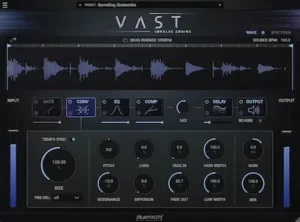
VAST is built around convolution, but describing it as a convolution reverb misses the point. The impulse response is only the starting point. Around it sits a processing environment that combines EQ, compression, gating, delay, wet/dry control, and impulse manipulation into a single workflow instead of scattering those stages across multiple insert slots.
That distinction has little to do with sound quality alone. Most professional studios already own excellent reverbs, delays, and dynamics processors. The question is how quickly those tools can be combined when an effect needs to evolve beyond a conventional room or plate. VAST reduces the amount of routing, plugin management, and automation required to reach that point.
The factory library includes more than 200 impulse responses, but the number itself isn’t the selling point. What’s more valuable is the variety. Alongside realistic spaces are synthetic textures, rhythmic responses, reverse environments, tonal impulses, and cinematic effects that encourage experimentation instead of simply recreating familiar rooms.
Custom impulse response support expands that flexibility considerably. Engineers can import hardware captures, field recordings, processed source material, or proprietary IR libraries without changing their existing workflow. That gives VAST a longer lifespan than processors that depend entirely on factory content, especially for studios that already maintain carefully curated impulse collections.
Heavyocity also addresses one of convolution’s less glamorous problems: resonance management. Experimental impulse responses often introduce narrow resonant peaks or excessive ringing that require corrective EQ before they become usable. VAST’s automatic resonance control reduces that cleanup, allowing producers to audition unconventional impulses more freely without constantly stopping to repair obvious frequency problems.
Where the plugin becomes genuinely useful is in day-to-day production. Instead of placing a convolution reverb on an auxiliary bus, adding compression after the return, inserting rhythmic gating, filtering the output, and automating several independent plugins, the entire effect can be developed inside one window. The underlying DSP isn’t fundamentally different from what experienced engineers already own—the workflow is.
Engineering Signal Flow Inside Heavyocity VAST
Unlike a conventional reverb inserted at the end of a processing chain, VAST allows multiple creative stages to interact around the impulse response itself. That integrated workflow reduces routing complexity and makes iterative sound design considerably faster.
Dry Source
↓
Impulse Engine
(IR loading • custom impulse responses)
↓
Resonance Management
(control of ringing and resonant buildup)
↓
Dynamics & Rhythmic Processing
(compression • gating • transient shaping)
↓
Delay & Spatial Motion
(tempo-synced movement • evolving reflections)
↓
EQ & Tonal Refinement
(spectral balance • mix integration)
↓
Wet/Dry Blend & Output
That becomes particularly valuable when designing transitions, vocal throws, cinematic impacts, atmospheric guitars, or evolving synth layers. Those effects rarely emerge from a single preset. They develop through dozens of small adjustments as the processor reacts to the source material. Keeping every major processing stage immediately accessible encourages experimentation instead of interrupting it.
The preset system reflects that philosophy. Rather than presenting finished sounds, most presets work best as production starting points. Engineers can quickly establish a spatial direction before reshaping the impulse response, dynamics, timing, and tonal balance to fit the arrangement. In practice, presets function more like reusable workflows than fixed creative decisions.
There are limits, however. VAST is not a replacement for the reverbs handling everyday mix duties. Natural vocal ambience, orchestral depth, drum rooms, and transparent acoustic placement remain better served by dedicated algorithmic or traditional convolution reverbs. Running VAST across dozens of channels simply because it can perform those tasks would be both inefficient and unnecessary.
Its strongest applications appear when the effect becomes part of the production rather than the mix. Modern records increasingly rely on vocal throws, reverse tails, risers, transition effects, layered ambience, and evolving spatial movement that carry as much musical information as the dry signal itself. In those situations, VAST behaves less like another insert plugin and more like a creative instrument built specifically for manipulating space.
That ultimately defines its role. Heavyocity hasn’t reinvented convolution processing, nor has it introduced fundamentally new DSP technology. What it has done is reorganize several familiar processes into a workflow that allows complex spatial effects to be built faster, revised more easily, and integrated into modern production sessions with considerably less friction.
Understanding the Impulse Engine: Why VAST Behaves Differently from Traditional Convolution Reverbs
Most convolution reverbs treat an impulse response as a finished destination. Once an IR is loaded, the remaining controls simply shape how much of that captured space reaches the output. Decay, filtering, pre-delay, and wet/dry balance may alter the presentation, but the underlying acoustic identity largely remains intact.
VAST approaches convolution from a different perspective. The impulse response is no longer the endpoint of the processing chain—it becomes the raw material that continuously reacts to additional processing. Compression changes how the impulse develops over time, gating reshapes its rhythmic envelope, equalization influences which frequencies continue feeding the convolution stage, and delay introduces new interactions that extend well beyond conventional room simulation.
That distinction changes how engineers work with impulse responses. Instead of searching for the “perfect” IR, producers can begin with one that is merely close to the desired direction and refine the result through multiple processing stages. In practice, the impulse response becomes one variable inside a larger sound-design system rather than the defining characteristic of the effect.
This is particularly noticeable when working with evolving source material. Synth pads, sustained guitars, drones, orchestral textures, and cinematic transitions continuously excite different parts of an impulse response as their harmonic content changes. Rather than producing a static ambience, VAST allows those interactions to evolve naturally throughout the performance, creating movement that often feels more integrated than layering several independent effects together.
Heavyocity’s resonance management also deserves attention because it addresses one of convolution processing’s least discussed limitations. Experimental impulse responses frequently generate narrow resonant peaks, excessive ringing, or dense frequency buildups that become distracting once additional instruments enter the arrangement. Automatic resonance control cannot eliminate every problematic interaction, but it substantially reduces the corrective EQ work that often follows creative convolution experiments.
Custom impulse responses extend the platform even further. Many experienced producers already maintain libraries of hardware captures, re-amped recordings, speaker impulses, field recordings, or self-created textures accumulated over years of production work. VAST allows those existing assets to become part of the same processing workflow rather than forcing users to rely exclusively on factory content. For professional studios, that flexibility is arguably more valuable than the size of the bundled library itself.
From an engineering perspective, one of the most useful characteristics is how VAST preserves the relationship between the dry and wet paths while the effect evolves. Many aggressive spatial processors blur transient definition or obscure rhythmic articulation once modulation becomes more complex. VAST generally maintains stronger transient integrity, making it easier to integrate large effects without completely disconnecting them from the original performance.
That does not mean convolution suddenly replaces every algorithmic reverb. Small rooms, realistic plates, drum ambience, and transparent vocal spaces are still served more efficiently by dedicated reverbs optimized for those specific tasks. The Impulse Engine is solving a different problem: giving engineers a faster way to build spatial effects that would normally require parallel processing, serial routing, multiple automation lanes, and several independent plugins.
Where VAST Improves Workflow—and Where It Doesn’t
Creative effects plugins often claim to replace entire FX chains with a single interface. In practice, most simply reorganize familiar controls without changing how engineers actually work. VAST deserves more credit than that, but its advantages come from workflow design rather than breakthrough DSP.
Convolution, compression, EQ, gating, delay, and impulse manipulation are all established technologies. Heavyocity hasn’t reinvented those processes. The real improvement comes from keeping them inside one cohesive workspace where each stage can be adjusted without constantly switching between inserts, auxiliary returns, or automation lanes.
That distinction matters because professional sessions rarely stall due to insufficient processing quality. They slow down because creative effects become increasingly difficult to manage. Building a transition for a trailer cue, a vocal throw, or an evolving synth texture often means combining several plugins across multiple buses before automation even begins. VAST shortens that process by reducing the amount of routing required to reach a usable starting point.
The advantage becomes obvious during iterative sound design. Instead of rebuilding an effects chain every time the creative direction changes, producers can reshape the impulse response, rebalance dynamics, adjust rhythmic movement, and refine tonal character from a single interface. The individual time savings are small, but over the course of a large production they add up to a noticeably faster creative process.
Its preset implementation supports that philosophy. Rather than functioning as finished sounds, most presets serve as practical launch points that invite modification. Experienced engineers rarely use presets unchanged, and VAST makes it easy to move beyond preset browsing into genuine sound development.
Custom impulse response support also gives the plugin greater long-term value. Studios with proprietary hardware captures, field recordings, or specialized IR collections can incorporate existing assets instead of rebuilding libraries around a closed ecosystem.
That said, VAST is not a universal replacement for conventional reverbs. Everyday mix tasks—placing vocals in a realistic room, creating subtle drum ambience, or adding transparent orchestral depth—remain faster and more predictable with dedicated algorithmic or traditional convolution reverbs. Using VAST across an entire mix would add unnecessary complexity where simpler tools are often the better choice.
The same applies to CPU management. While the plugin appears well optimized for convolution processing, creative impulse manipulation inevitably consumes more resources than many algorithmic reverbs. On modern production systems that rarely becomes a problem, but engineers working on large orchestral templates or dense post-production sessions should reserve VAST for tracks where its expanded processing capabilities provide a clear musical advantage.
Another practical consideration is automation. Housing multiple processing stages inside one plugin speeds up experimentation, but it also concentrates automation into a single insert. Engineers who prefer distributing processing across dedicated plugins may still find DAW-level automation easier to organize, particularly in collaborative sessions where projects move between multiple mixers.
Heavyocity’s marketing naturally emphasizes impossible spaces and revolutionary creative processing. The reality is more grounded. VAST succeeds not because it introduces entirely new DSP, but because it packages familiar technologies into a workflow that encourages experimentation without forcing engineers to assemble complex effects chains from scratch. That is a meaningful improvement—even if it is less dramatic than the marketing language suggests.
How VAST Stacks Up Against Today’s Leading Creative Effects Plugins
 Comparing VAST directly with traditional convolution reverbs leads to the wrong conclusion. Engineers shopping for realistic concert halls, scoring stages, or hardware emulations are solving a different problem than the one Heavyocity set out to address.
Products such as Audio Ease Altiverb and LiquidSonics Reverberate remain stronger choices when the goal is believable acoustic space. They excel at placing orchestras, dialogue, drums, and vocals into environments that feel natural rather than stylized. If realism is the priority, those tools remain difficult to surpass.
VAST operates much closer to the modern generation of cinematic effects processors. Its purpose isn’t simply adding ambience—it reshapes the relationship between the dry signal and the surrounding space, allowing impulse responses to become part of the musical arrangement instead of functioning as static reverbs.
That philosophy also separates VAST from the latest generation of intelligent algorithmic reverbs. While convolution-based processors focus on reshaping space itself, adaptive reverbs increasingly prioritize vocal clarity and mix transparency. We explored that contrasting approach in our FRCTL Audio AURA review, where the emphasis shifts from creative sound design toward preserving intelligibility inside dense productions.
That places it alongside processors such as Valhalla Supermassive, Output Portal, Arturia EFX Fragments, and Minimal Audio Rift. While each approaches sound design differently, they all prioritize transformation over transparency.
Where VAST distinguishes itself is by preserving the identity of the original source. Granular processors frequently fragment or completely reconstruct incoming audio. VAST tends to retain the timing, articulation, and musical phrasing of the performance while dramatically altering its spatial character. For many producers, that balance makes it easier to integrate into finished arrangements without rebuilding surrounding mix decisions.
Its custom impulse response support also creates a meaningful advantage over processors built around fixed algorithms. Studios with proprietary hardware captures or carefully curated IR libraries can continue using those assets inside a modern creative workflow instead of treating them as legacy resources.
The trade-offs are equally clear. VAST is not the fastest solution for everyday room simulation, transparent vocal ambience, or subtle mix placement. Those jobs remain better suited to dedicated reverbs designed specifically for realistic acoustic reproduction. Likewise, producers looking for extreme granular destruction or heavy distortion will often reach more quickly for Portal, Rift, or specialized granular processors.
| Plugin | Excels At | Ideal Production Tasks | Where VAST Has the Edge | Where the Alternative Leads |
|---|---|---|---|---|
| Heavyocity VAST | Convolution-driven spatial design | Cinematic effects, transitions, vocal throws, evolving textures | Unified IR workflow with integrated processing | Not intended as an everyday mix reverb |
| Audio Ease Altiverb | Real-world acoustic spaces | Film scoring, orchestral production, post-production | Far more experimental processing options | Superior realism and unmatched acoustic libraries |
| LiquidSonics Reverberate | Precision convolution reverb | Mixing, orchestral placement, natural ambience | Broader sound-design workflow | More detailed control over realistic convolution |
| Valhalla Supermassive | Algorithmic ambience | Synths, pads, ambient production, EDM | Custom IR support and integrated multi-stage processing | Lower CPU load, faster setup, free license |
| Output Portal | Granular processing | Experimental textures, glitch effects, transitions | Better preservation of source performance | More radical audio transformation |
| Minimal Audio Rift | Distortion and multiband sound shaping | Bass design, electronic production, aggressive processing | Convolution-based spatial manipulation | Far deeper saturation and distortion architecture |
Perhaps the most accurate way to view VAST is as a complement rather than a replacement. Studios already equipped with premium reverbs gain another category of processor—one focused on movement, texture, and evolving space rather than believable acoustics. That separation gives VAST a clearer identity than many multi-effects plugins that attempt to cover every production task equally well.
For film composers, trailer producers, electronic artists, and sound designers, that specialization is precisely its value. Mixing and mastering engineers working primarily with natural recordings will likely use it more selectively, reserving it for moments where the effect itself becomes part of the composition.
Real-World Mixing and Production Performance
 Creative effects are easy to overuse. A processor that sounds enormous in solo often disappears once drums, vocals, bass, and multiple layers begin competing for space. The real test is not whether an effect sounds impressive on its own, but whether it continues contributing something meaningful after the arrangement reaches full density.
VAST performs best when treated as a feature processor rather than a permanent insert. Instead of handling routine ambience, it works most effectively on moments that intentionally draw attention—vocal throws, transitions, reverse effects, atmospheric guitars, synth swells, or cinematic impacts. Used selectively, it creates depth without overwhelming the surrounding mix.
Vocals are among its strongest applications. Rather than replacing conventional vocal reverbs, VAST excels at building movement around individual phrases. Reverse tails, evolving reflections, rhythmic ambience, and transitional effects remain connected to the performance instead of sounding like disconnected layers placed behind it. Printing those effects to dedicated audio tracks also simplifies automation and helps reduce CPU usage in larger sessions.
Electric guitars benefit in a different way. Instead of adding another large reverb, VAST can generate textured spatial reflections that increase perceived width while preserving pick attack and midrange definition. This approach often produces more separation than simply extending decay time or increasing stereo spread.
Synth-based productions reveal another advantage. Pads, drones, arpeggiators, and evolving textures interact naturally with convolution because harmonic content continuously excites different regions of the impulse response. Producers working in ambient, melodic techno, hybrid orchestral music, or cinematic scoring can build movement that feels organic without relying on multiple modulation plugins or extensive automation.
Film and trailer composers will likely extract the greatest value from the plugin. Braams, impacts, transitions, risers, and tension beds frequently require layered processing that combines convolution, filtering, dynamics, delay, and automation. Consolidating those stages inside one processor reduces setup time while making iterative sound design considerably faster. Those creative decisions also influence how cinematic material behaves during the final mastering stage, particularly when preparing releases for streaming or theatrical delivery. If you’re working with orchestral or hybrid scores, our Film Score Mastering guide explains the translation challenges that appear after production is complete.
From a mixing perspective, restraint remains essential. Dense convolution effects can blur transients, narrow front-to-back depth, and reduce separation if they occupy too much of the stereo field. Checking mono compatibility, small speakers, headphones, and low-volume playback remains just as important as monitoring through full-range studio monitors. VAST doesn’t create those problems—it simply makes it easier to generate effects capable of exposing them.
Streaming delivery introduces another practical consideration. Loudness normalization itself has little influence on VAST, but lossy codecs can soften extremely diffuse ambience and reduce perceived stereo width. Engineers preparing mixes for Spotify, Apple Music, YouTube, or other streaming platforms should audition heavily processed effects after AAC or Ogg encoding rather than assuming the original session accurately represents the final release. For a deeper look at why finished mixes often change after upload, see our guide to mastering for streaming platforms.
Mastering engineers are unlikely to view VAST as a routine processing tool. Its strengths lie in production decisions made well before the stereo master is finalized. While convolution occasionally appears during creative mastering or restoration projects, deliberately complex spatial processing belongs much earlier in the production chain, where it can be balanced against the rest of the arrangement instead of imposed on the finished mix.
That production-first philosophy also explains why processors designed for creative work rarely replace dedicated mix-bus tools. Once arrangement and spatial decisions are complete, engineers typically shift toward subtle dynamic control rather than additional effects. We discussed that transition in our M Media Audio The New Yorker review, which examines a vari-mu bus compressor built for final mix polish instead of creative sound manipulation.
Performance appears well suited to modern production systems. Although convolution inevitably consumes more CPU than many algorithmic reverbs, current user feedback suggests VAST remains stable even in demanding sessions. Engineers building very large templates may still prefer printing elaborate effects once the sound is finalized, but that recommendation applies to virtually any processor designed for advanced spatial manipulation.
Ultimately, VAST’s greatest production advantage is practical rather than technical. It shortens the path from an initial idea to a finished spatial effect. For producers who routinely build cinematic textures, transitional effects, or evolving ambience, reducing that iteration time is often more valuable than introducing another algorithm into an already crowded plugin folder.
Best Production Scenarios for Heavyocity VAST
VAST delivers its best results when spatial processing becomes part of the composition rather than a finishing effect applied during mixing. Instead of replacing conventional reverbs across an entire session, it excels on production elements that need movement, depth, or dramatic transformation while remaining connected to the original performance.
Vocal throws and transition effects. Modern pop, hip-hop, EDM, and cinematic productions frequently rely on individual vocal phrases that momentarily step outside the main mix. VAST makes it possible to build reverse tails, evolving reflections, and rhythmic ambience that feel integrated with the performance instead of sounding like isolated effects layered behind it.
Trailer impacts, braams, and risers. Film and trailer composers often combine convolution, dynamics, filtering, delay, and automation to create tension-building transitions. VAST streamlines that process by allowing those elements to evolve inside a single processing environment, making iterative sound design significantly faster.
Synth motion and atmospheric textures. Pads, drones, arpeggiators, and sustained synth layers continuously excite different regions of an impulse response. Combined with modulation and dynamics, this produces evolving spatial movement that would otherwise require several dedicated processors working in parallel.
Electric guitars and ambient instruments. Instead of relying on longer decay times, VAST can generate textured reflections that increase perceived width while preserving transient attack and midrange definition. This approach often creates more separation than conventional stereo widening alone.
Game audio and cinematic environments. Interactive music and environmental sound design frequently demand spaces that evolve with the scene rather than remaining acoustically realistic. VAST is particularly effective for building atmospheric layers, transitions, and environmental textures that benefit from continuous movement instead of static ambience.
These scenarios also illustrate where VAST should be viewed as a production tool rather than a mixing utility. Its greatest strengths emerge before the final mix balance is established, allowing spatial effects to become part of the arrangement itself instead of being added after creative decisions have already been made.
When Heavyocity VAST Isn’t the Right Choice
One of the easiest ways to misjudge VAST is to expect it to perform every spatial processing task inside a mix. While the plugin is exceptionally capable of creating movement and complex environments, many everyday engineering decisions are still better handled by more specialized tools.
If your work revolves around realistic room placement, transparent vocal ambience, or natural orchestral depth, a dedicated algorithmic or traditional convolution reverb remains the more practical option. Those processors are designed to disappear into the mix rather than become part of the arrangement, making them faster to dial in during routine mixing sessions.
The same applies to drum rooms and acoustic instruments. Small spaces, short plates, and subtle early reflections rarely benefit from the additional complexity VAST introduces. In those situations, simplicity often produces better results than flexibility, particularly when CPU efficiency and low-latency monitoring are important during recording.
VAST is also unlikely to become a primary mastering processor. Mastering engineers generally avoid creative spatial manipulation once the stereo mix has been finalized, preferring tools that preserve phase relationships, transient integrity, and tonal balance with minimal coloration. While VAST can certainly contribute during experimental mastering projects, that represents a niche workflow rather than its intended application.
Producers who already own premium convolution reverbs such as Altiverb or LiquidSonics Reverberate should also view VAST as a complementary processor rather than a replacement. Those platforms continue to offer superior realism, while VAST expands creative possibilities through impulse manipulation and integrated effects processing.
Perhaps the clearest reason to skip VAST is simply workflow. If most of your sessions involve dialogue editing, podcast production, acoustic jazz, classical recording, or corrective mixing, the plugin’s strengths may never justify its place in your template. Its real value appears when spatial processing becomes part of the creative process instead of remaining a subtle finishing tool.
Who Will Get the Most Value from Heavyocity VAST
VAST is not designed to become the centerpiece of every production workflow, and that selective focus is one of its strengths. Producers who build complex spatial effects on a daily basis will benefit far more than engineers whose work revolves around transparent corrective processing.
Film composers, trailer producers, and hybrid orchestral writers are arguably the clearest audience. Their sessions often depend on evolving atmospheres, tension beds, braams, impacts, reverse transitions, and layered environments that require multiple processing stages before reaching a finished sound. VAST significantly shortens that process without forcing engineers to sacrifice control.
Electronic producers working in ambient, techno, cinematic EDM, experimental pop, or modern soundtrack production will also find substantial value. Rather than replacing existing reverbs, the plugin expands what can be achieved with impulse responses by making them part of the creative process instead of the final spatial effect.
Mixing engineers occupy a more nuanced position. Those who regularly create featured vocal effects, atmospheric guitars, transition elements, or production-focused automation will likely incorporate VAST into specific stages of a mix. Engineers working primarily with acoustic recordings, broadcast dialogue, podcasts, or orchestral realism may discover that conventional reverbs remain a faster and more appropriate choice for most sessions.
For mastering engineers, VAST should be viewed as an upstream production tool rather than a mastering processor. Its influence is greatest while arrangement, sound design, and mix decisions are still evolving, allowing creative spatial processing to become part of the record before final tonal and dynamic optimization begins.
Ultimately, VAST delivers the strongest return on investment for producers who spend more time creating sounds than simply placing them into realistic acoustic spaces. If your projects regularly demand movement, texture, and evolving environments, it fills a niche that relatively few plugins address with the same level of integration.
Verdict
Heavyocity VAST isn’t trying to become another flagship convolution reverb, and judging it by that standard misses its purpose entirely. Its value comes from accelerating a type of production work that normally requires multiple processors, extensive routing, and constant experimentation. For engineers who spend more time designing sounds than recreating realistic spaces, that difference is immediately noticeable.
What makes VAST worth considering isn’t revolutionary DSP. Convolution, compression, EQ, gating, and delay have existed for years. Heavyocity’s contribution is integrating those familiar tools into a workflow that makes complex spatial processing easier to build, refine, and revisit without sacrificing flexibility.
That doesn’t make it a universal solution. Engineers mixing acoustic recordings, orchestral sessions, dialogue, or transparent vocal productions will still reach first for dedicated algorithmic or traditional convolution reverbs. Likewise, mastering engineers have little reason to place VAST in a stereo processing chain where precision and subtlety take priority over creative transformation. If you’re unsure where creative effects should stop and mastering should begin, our article on Mixing vs Mastering explores that boundary in greater detail.
Its strongest audience is far more specific: film composers, trailer producers, electronic musicians, hybrid orchestral writers, sound designers, and mixers who regularly create transitions, vocal throws, evolving textures, and other production elements where the effect becomes part of the arrangement. In those workflows, VAST solves a practical problem rather than simply adding another option to an already crowded plugin folder.
Viewed in that context, VAST earns its place not by replacing existing reverbs, but by covering a gap that many studios still address with lengthy FX chains and repetitive setup work. If your productions depend on creative spatial processing, it’s one of the more thoughtfully designed convolution-based effects released in recent years. If your priorities are realism, transparency, or mastering accuracy, your current tools are likely to remain the better choice.
Independent Evaluation
| Category | Rating |
|---|---|
| Creative Sound Design | 9.6/10 |
| Workflow Efficiency | 9.7/10 |
| Creative Processing Quality | 9.2/10 |
| Mix Integration | 9.1/10 |
| CPU Efficiency | 8.8/10 |
| Value for Money | 9.3/10 |
| Overall | 9.3/10 |
Creative Sound Design — 9.6/10
VAST stands out by treating convolution as a creative medium instead of limiting it to realistic room simulation. The combination of impulse manipulation, dynamics, delay, and gating makes it exceptionally capable of producing evolving textures, cinematic transitions, and spatial effects that would otherwise require considerably more setup.
Workflow Efficiency — 9.7/10
This is where the plugin delivers its strongest practical advantage. Integrating multiple processing stages into a unified workspace reduces routing, plugin management, and repetitive setup, allowing producers to iterate on complex effects much faster than with conventional insert chains.
Sound Quality — 9.2/10
The underlying processing is clean, detailed, and capable of highly polished results. While VAST isn’t designed to outperform premium convolution reverbs in acoustic realism, its creative processing maintains excellent clarity even during aggressive spatial manipulation.
Mix Integration — 9.1/10
Feature effects remain surprisingly easy to place inside dense productions when used with restraint. The plugin excels on vocal throws, transitions, guitars, synths, and cinematic layers, although it is intentionally less suited to transparent everyday ambience.
CPU Efficiency — 8.8/10
Convolution processing inevitably requires more computing power than many algorithmic reverbs. Heavyocity has optimized VAST well, but large orchestral templates or sessions with numerous simultaneous instances will still benefit from freezing or printing complex effects once creative decisions are finalized.
Value for Money — 9.3/10
For producers who regularly create cinematic effects, hybrid orchestral productions, trailer music, or modern electronic sound design, VAST offers strong long-term value by replacing lengthy multi-plugin workflows with a faster and more cohesive production environment.
Overall — 9.3/10
Heavyocity VAST is not attempting to become another flagship convolution reverb, and that focus ultimately works in its favor. It fills a genuine gap between traditional ambience processors and experimental sound design tools, making it one of the more compelling creative effects plugins currently available for professional music production.
Great Production Deserves a Master That Doesn’t Undo It
Creative reverbs, cinematic textures, and detailed spatial effects are only successful if they survive the final stage of production. Professional mastering should preserve depth, punch, stereo imaging, and translation—not flatten the decisions you made while producing and mixing your track.
Before committing to a full project, upload up to 35 seconds of your mix and receive a free mastering demo. Hear how an experienced mastering engineer can improve clarity, balance, and playback across streaming platforms without sacrificing the character of your production.
Request your free mastering demo →
FAQ
Can Heavyocity VAST replace a traditional convolution reverb?
Not for most mixing applications. VAST focuses on creative spatial processing rather than realistic room simulation. Engineers mixing vocals, drums, orchestral recordings, or acoustic instruments will still benefit from dedicated reverbs designed for natural ambience.
Does VAST support third-party impulse responses?
Yes. You can import your own impulse responses, including hardware captures, custom recordings, and existing IR libraries. This significantly expands the plugin beyond its factory content and makes it easier to integrate into established production workflows.
Is Heavyocity VAST CPU intensive?
CPU usage is moderate for a convolution-based processor. Most modern systems can handle several active instances without difficulty, although printing complex effects remains a sensible approach in very large sessions.
Is VAST better for mixing or sound design?
It is primarily a sound design and creative production tool. While it can be used during mixing, its greatest strengths are cinematic transitions, vocal effects, evolving textures, and spatial processing that becomes part of the arrangement.
Can Heavyocity VAST replace a chain of creative effects plugins?
Yes, particularly for vocal throws, reverse tails, atmospheric delays, and other featured effects. It is less suited to subtle room ambience or transparent vocal placement.
Is Heavyocity VAST useful for mastering?
In most cases, no. The plugin is designed for creative processing during production and mixing rather than transparent stereo mastering where precision and consistency are the primary goals.
How does VAST compare with Valhalla Supermassive?
Supermassive specializes in expansive algorithmic ambience, while VAST combines convolution processing with custom impulse responses and integrated effects. They solve different production problems and often complement each other inside the same session.
Is VAST worth buying if you already own Altiverb or Reverberate?
Yes, if you regularly create cinematic textures or experimental spatial effects. Those plugins excel at realistic environments, while VAST focuses on creative sound manipulation rather than acoustic accuracy.
Who gets the most value from Heavyocity VAST?
Film composers, trailer producers, electronic musicians, sound designers, and mixers who frequently build transitions, atmospheric layers, and feature effects will benefit the most. Engineers focused primarily on transparent mixing or mastering will use it less often.

Yurii Ariefiev is a mastering engineer and audio production editor specializing in critical evaluations of professional music software. His reviews examine how plugins perform inside complete production workflows, with particular attention to translation, mix decisions, CPU efficiency, and long-term studio usability rather than feature lists or marketing claims.
This analysis evaluates Heavyocity VAST from the perspective of practical mixing, cinematic sound design, and mastering preparation, focusing on where convolution-based creative processing delivers measurable production value—and where conventional studio tools remain the better choice.