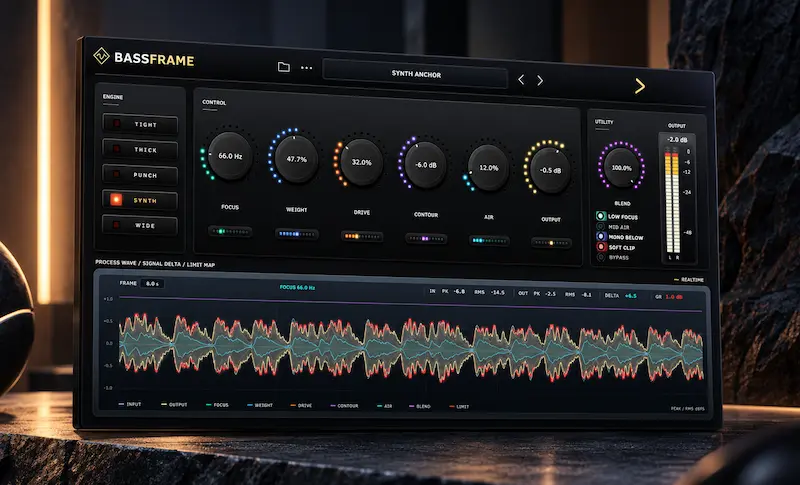
BassFrame is a multi-engine bass enhancement plugin for shaping weight, harmonics, punch, sub-bass, and stereo presence without building a separate processing chain for each task.
A bass track can already contain plenty of energy below 100 Hz and still fail to translate. The issue may be weak harmonics, an unstable fundamental, kick-and-bass masking, excessive stereo information in the lows, or sub energy that becomes a problem as soon as compression or limiting is applied. In those cases, another low-shelf boost usually makes the mix worse rather than better.
2B Played Music BassFrame approaches the problem as a dedicated low-end processor rather than a conventional EQ. Its five processing engines combine bass enhancement, harmonic coloration, subharmonic generation, punch shaping, and controlled stereo widening, with controls for Focus, Weight, Drive, Contour, Air, Blend, and Mono Below. The result is a tool aimed at shaping the behavior of the low end, not simply increasing its level.
That distinction is what matters in practice. Bass enhancement is already a crowded plugin category, so BassFrame has to earn its place by making recurring low-end decisions faster and producing results that hold up under real mix and mastering conditions.
Why More Bass Is Often the Wrong Fix
 Low-end enhancement is not simply a matter of boosting the fundamental. A bass part can contain substantial sub-100 Hz energy and still sound weak on smaller playback systems because the harmonics that define its pitch and character are not strong enough to survive outside a full-range monitoring environment. This is the basic reason harmonic bass enhancement remains useful: the ear can identify a low-frequency source from information well above its fundamental.
The problem becomes more difficult in a modern mix. Bass has to translate between full-range monitors, headphones, earbuds, small speakers, and club systems without losing its role in the arrangement. The target is not maximum sub-bass output. It is a low end that remains recognizable and controlled when the playback system, monitoring level, and downstream processing change.
A broad low-shelf boost can work when the mix genuinely lacks fundamental energy, but it is often the bluntest possible solution. Increasing the bottom octave raises peak level and headroom requirements, can aggravate room-mode problems during monitoring, and gives compressors and limiters more low-frequency energy to manage. If the kick and bass are already competing for the same space, another few dB of sub only makes the conflict harder to control.
Harmonic enhancement, subharmonic synthesis, saturation, and controlled stereo processing offer different ways to increase the perception of weight without relying entirely on additional fundamental energy. This distinction is particularly important with 808s and synthesized bass, where the relationship between the fundamental and the harmonics can determine whether added weight remains controlled in a mix; Pure SUB’s approach to separating those bass components is a useful example of that production problem being handled at the sound-design stage.
That is the territory BassFrame targets. Its five engines — Tight, Thick, Punch, Synth, and Wide — approach the low end from different angles, from controlled definition and harmonic density to octave-down synthesis and upper-bass width. The value of the plugin depends less on the number of modes than on how effectively those modes solve specific problems without replacing one problem with another.
How BassFrame Shapes the Low End
| BassFrame Control | Primary Function | Practical Starting Point |
|---|---|---|
| Tight | Focuses the low end and increases perceived definition | Start here when the bass feels loose or unfocused |
| Thick | Adds body and harmonic density | Use when the source feels thin rather than genuinely lacking sub |
| Punch | Emphasizes low-end impact | Useful for kicks and bass parts that need more forward impact |
| Synth | Adds pitch-following octave-down content | Best suited to pitched basses, 808s, and synth bass |
| Wide | Adds stereo presence while allowing the deepest lows to remain controlled | Use when the bass feels too narrow but the sub should stay centered |
Focus and Weight determine the main low-end emphasis, while Drive adds harmonic density. Contour and Air shape the balance around the processed range, and Output provides final level control. Low Focus, Mid Air, Mono Below, Blend, and Soft Clip extend the processor into frequency targeting, stereo management, parallel processing, and peak control.
The more important question is not how many processes BassFrame combines, but how its controls interact. Focus defines where the processor is working, Weight determines how much foundation is reinforced, while Drive changes the harmonic content that makes that added weight more audible. Contour and Air then become useful for deciding whether the enhancement remains concentrated in the bass region or starts changing the perceived balance of the source.
This makes BassFrame different from simply placing several processors in series. The controls are organized around the same low-end target, so the useful workflow is to choose the engine first, establish the frequency focus, then decide whether the result needs more fundamental weight, harmonic information, or upper-bass presence.
Give Your Low End the Space to Translate
Low-end enhancement is only useful when weight, punch, balance, and stereo information remain controlled across different playback systems. If you want to hear how your own mix responds to professional mastering, you can upload up to 35 seconds for a free mastering demo. Send Your Mix for a Free Mastering Demo →
Tight and Thick: Definition vs. Density
Tight is the logical choice when the source already has enough low-frequency content but lacks focus. On bass guitar, kick drums, or a bass bus, that can mean improving the sense of solidity without pushing additional sub energy into the mix. It is also the mode to try first when a low-end boost makes the source larger but less controlled.
Thick moves toward body and harmonic density. That distinction is important: if a bass sounds thin because it lacks useful upper harmonics, increasing its fundamental level is not necessarily the best fix. Adding harmonic content can make the instrument read more clearly on smaller playback systems while giving it more apparent weight on full-range monitors.
Neither approach requires a new DSP theory. The techniques are established. BassFrame’s advantage is the dedicated implementation: the engineer can move between different low-end behaviors without building and gain-staging a separate processing chain for each experiment.
Punch: More Impact Without Simply Adding Sub
Punch is aimed at impact and attack, making it more relevant to kick drums, short bass notes, drum loops, and aggressive electronic material than to sustained corrective work.
The useful distinction is between impact and dynamics correction. If a kick lacks definition because its envelope is too long, or a bass line feels inconsistent because of performance dynamics, a dedicated compressor or transient processor remains the more appropriate tool. BassFrame can change the character of the low end, but it cannot repair poor source dynamics or solve a timing conflict between kick and bass.
In a good source, however, Punch can be useful for bringing the low end forward without relying entirely on a broad bass boost. That makes it particularly relevant in dense arrangements where simply adding more sub would consume headroom without improving the perceived attack.
Synth: Pitch-Following Subharmonic Generation
The Synth engine is the most distinctive of the five engines because it is designed to add deeper low-frequency content to the source. For pitched bass material, this can provide a practical way to extend the sub region without manually building a separate bass layer.
That can be useful with 808s, synth basses, and bass guitar, particularly when the line moves through several notes. For synth-based bass, the source itself can also provide additional low-frequency material before any dedicated enhancement stage is applied; the sub-oscillator and driven bass architecture in Martinic Prodigy are examples of that source-level approach. A static sub layer can create uneven results because different notes may excite the system very differently.
There is an important limitation: pitch-dependent processing is only as useful as the source and the pitch detection. Complex bass sounds, noisy attacks, overlapping notes, distortion, or poorly defined fundamentals can make this type of processing less predictable. It should therefore be treated as a production tool to audition rather than an automatic replacement for a deliberately designed sub-bass track.
The underlying concept is well established in dedicated subharmonic processors. BassFrame’s differentiator is the integration of deeper bass extension with harmonic shaping, bass enhancement, stereo control, and blending in one processor.
Wide: Stereo Presence Above a Controlled Sub
Wide addresses a different problem: a bass sound can feel too narrow even when the deepest part of the signal should remain centered. Simply widening the entire bass track is usually a poor solution because low-frequency phase differences can weaken the center image and make the bottom end less stable in mono.
BassFrame’s Mono Below control fits that workflow. The useful approach is to keep the deepest information anchored while allowing higher bass harmonics and presence to contribute more stereo information. This can make a bass synth or processed bass guitar feel larger without turning the sub region into a stereo-effects problem.
Again, the engineering principle is not new. Frequency-dependent stereo management is standard practice. The benefit is having it integrated into the same processor that is generating and shaping the low end, which reduces routing and makes the effect easier to audition in context.
Blend, Delta, and Soft Clip: The Controls That Matter in Practice
The less glamorous controls may be more important to experienced engineers than the five headline modes. Blend makes parallel use practical, allowing aggressive processing to be mixed back with the original signal rather than forcing the processed path to carry the entire result. Delta monitoring is useful for checking what the processor is actually adding instead of judging the effect only from the louder processed signal.
Soft Clip is also relevant when enhancement creates new peaks. Low-frequency processing can produce disproportionately large level changes, particularly when subharmonics are introduced. Keeping peak control inside the same workflow can prevent the user from immediately having to add another clipper after the processor.
That does not make BassFrame a substitute for a proper mastering limiter or a precision clipping stage. It simply makes the processor more self-contained for sound-design and mixing tasks, where speed and controlled auditioning often matter more than building the most elaborate possible chain.
BassFrame in Practice: What to Listen For
Because the available product information does not establish independent listening measurements, the useful way to evaluate BassFrame is to compare each engine at matched output level rather than judging the processed signal simply by how much larger it sounds.
For Tight, listen for whether the bass becomes easier to place in the mix without a corresponding increase in uncontrolled sub energy. Thick should be evaluated for added harmonic density rather than simply louder fundamental content. With Punch, the relevant question is whether the low end gains impact without making the kick or bass feel unnaturally exaggerated.
The Synth engine deserves a separate check on pitched material. Compare sustained bass notes across the register and listen for whether the generated sub remains musically consistent as the source changes pitch. Complex or heavily distorted sources should be tested separately because pitch-dependent processing can become less predictable.
For Wide, check the result in stereo and mono. The useful outcome is additional perceived width or presence above the deepest low end without weakening the center or changing the apparent weight of the sub region.
Finally, bypass BassFrame at matched loudness. If the processed version only seems better because it is louder, the enhancement is not yet proven. The strongest result is a change that remains useful after level matching and survives different monitoring conditions.
Where BassFrame Can Actually Speed Up a Mix
 BassFrame’s strongest case is workflow efficiency rather than DSP novelty. The advantage appears when a low-end problem could be solved with several separate processors, but does not justify building a complex chain every time.
Take an 808 that sounds large on headphones but loses its identity on smaller speakers. The conventional approach might involve finding the useful frequency range with EQ, generating upper harmonics with saturation, adding a controlled sub layer, managing the stereo image, blending the result, and controlling the peaks created by the additional low end. Each stage is familiar, but the chain takes time to build and requires repeated gain-staging and level matching while the settings are auditioned.
BassFrame compresses much of that workflow into a single insert. The engineer can try harmonic enhancement, octave-down synthesis, stereo processing, and parallel blending without changing the routing. That is useful when speed matters — especially during production, mix revisions, or sessions where the same low-end problem appears across multiple tracks.
A bass guitar presents a different scenario. Suppose the fundamental is already strong, but the instrument loses definition once guitars, synths, and drums enter the arrangement. A low-shelf boost is unlikely to solve that. A better approach may be to focus the processing, introduce controlled harmonic content, and blend only enough of it back into the dry signal to improve articulation.
The same principle applies to kick drums and bass buses. Instead of stacking an EQ, saturation plugin, stereo utility, and clipper simply to test an idea, a dedicated low-end processor lets the engineer make the experiment quickly and decide whether the processing belongs in the mix at all.
That is the meaningful time saving: shortening the path from identifying a low-end problem to testing a viable solution. It is not a replacement for detailed processing when surgical control is required, but it can eliminate unnecessary setup for problems that do not warrant a six-plugin chain.
For an experienced engineer, that distinction matters. Workflow consolidation has value only when it preserves enough control to make useful decisions. BassFrame is most convincing when used as a fast problem-solving insert, not as a reason to abandon dedicated EQ, dynamics, saturation, or stereo tools that offer deeper control.
Where BassFrame Stops Helping
BassFrame can reshape a low end that is fundamentally working. It cannot repair a low end that is fundamentally wrong.
If the kick and bass are fighting in the same register, adding weight to either one can increase masking rather than definition. If the bass line is poorly voiced for the arrangement, octave-down processing can turn a musical problem into a larger spectral one. And if the mix already carries excessive energy below roughly 60 Hz, another bass-enhancement stage is usually the last thing it needs.
Source selection and arrangement still come first. Changing the bass sound, moving a kick transient, shortening a bass envelope, or carving competing frequencies can solve problems that no amount of enhancement will address cleanly. BassFrame is most effective after those decisions are already under control.
The limitations become more important in mastering. On a finished mix, BassFrame can be useful when the low end is slightly underdeveloped and a controlled amount of weight or harmonic information improves translation. It is a poor choice as a routine “make the master bigger” processor.
Subharmonic generation can have a disproportionate effect on a mastering chain. Additional energy at the bottom of the spectrum consumes headroom, changes how broadband compression and limiting respond, and can alter the balance between perceived loudness and actual peak level. It can also expose monitoring problems: a mastering engineer working in an untreated room may mistake room-mode energy for a deficiency in the master and compensate in the wrong direction.
There is another practical limitation. On a stereo mix, the engineer has far less control over the individual kick and bass relationship than at the mix stage. If the low end is already congested, broad enhancement is more likely to redistribute the problem than solve it. When the finished mix has a genuine bass imbalance, it is worth identifying what can actually be fixed in mastering before adding another low-end enhancement stage.
For that reason, BassFrame makes more sense as a mixing and production tool than as a permanent mastering-chain processor. In mastering, it should earn its place through a specific, audible improvement in translation — not simply because the processed version sounds larger at the monitoring position.
BassFrame vs. Other Bass Enhancement Plugins
| Plugin | Primary Strength | Best Use Case | Where BassFrame Differs |
|---|---|---|---|
| BassFrame | Multi-engine bass enhancement | You need weight, harmonics, punch, sub, and stereo options in one insert | Combines several low-end workflows instead of specializing in one processing method |
| Waves R-Bass | Perceived bass through harmonic enhancement | You mainly need bass to remain audible on smaller playback systems | BassFrame provides additional sub, punch, and stereo-oriented processing |
| Brainworx bx_subsynth | Dedicated subharmonic generation | You need focused control over synthesized low frequencies | BassFrame combines sub generation with several other bass-processing approaches |
| Leapwing RootOne | Controlled low-frequency enhancement | You want a focused processor for adding weight and sub information | BassFrame offers multiple processing engines rather than centering the workflow on one low-end enhancement approach |
| Baby Audio SubCulture | Sub-bass generation and bass enhancement | You primarily work with electronic bass and pitched low-frequency sources | BassFrame adds separate Tight, Thick, Punch, and Wide processing modes around its Synth engine |
| EQ + saturation + utility chain | Maximum control | You need surgical frequency, harmonic, dynamics, or stereo processing | BassFrame is faster to configure, but the modular chain remains more precise |
Choose BassFrame when: you regularly need several different types of bass enhancement and want to audition them from one insert.
Choose a dedicated processor when: you already know exactly which low-end operation is required and want deeper control over that specific process.
Choose a modular chain when: frequency precision, processing order, or detailed gain and dynamics control matters more than workflow speed.
The important point is that BassFrame is not a universal replacement for dedicated bass processors. Its competitive advantage is the combination of several low-end workflows in a single plugin. That makes it particularly relevant to production and mixing, where speed of experimentation can be more valuable than maximum control over one processing stage.
For a mastering engineer, the distinction is even more important. A specialized processor may be preferable when the task requires narrow, predictable intervention. BassFrame is more compelling during production and mixing, where trying several types of low-end enhancement quickly can be more valuable than having the deepest possible control over one processing stage.
The practical comparison is therefore straightforward: choose BassFrame for speed and breadth; choose a dedicated processor when precision in one specific low-end task matters more than having several tools in one insert.
BassFrame vs. 2B Played Music LowEnd Friend 2
The more important comparison may be inside 2B Played Music’s own lineup. LowEnd Friend 2 already addresses many of the problems BassFrame is designed to solve, including low-frequency enhancement, harmonic processing, saturation, distortion, limiting, and oversampling.
That makes BassFrame less of a replacement for an outdated product and more of a different approach to the same general problem. LowEnd Friend 2 is built around shaping and enhancing the existing low end, with deeper control over the processing chain. BassFrame puts more emphasis on distinct processing behaviors: Tight for controlled definition, Thick for harmonic weight, Punch for impact, Synth for octave-down generation, and Wide for additional stereo presence above the deepest lows.
For someone starting from scratch, that difference can matter. BassFrame is easier to approach as a dedicated low-end problem-solving insert: choose the behavior that matches the problem, adjust the intensity, blend it against the source, and move on. LowEnd Friend 2 makes more sense when the engineer wants to spend more time shaping the character and behavior of the processing itself.
For existing LowEnd Friend 2 owners, BassFrame is therefore a complementary workflow rather than an obvious upgrade. LowEnd Friend 2 remains the stronger choice when detailed low-end shaping is the priority; BassFrame becomes more interesting when quickly switching between distinct enhancement behaviors is the priority.
The practical buying decision is simple: if LowEnd Friend 2 already solves your recurring bass problems without slowing down your workflow, BassFrame adds limited value. If you frequently rebuild chains to test different combinations of harmonic enhancement, sub generation, punch, and stereo processing, BassFrame has a clearer reason to exist alongside it.
How BassFrame Affects Mix Translation
Low-end enhancement should be judged at matched loudness. This is particularly important with BassFrame because adding low-frequency energy can make a source sound immediately more impressive even when the underlying balance has not improved.
Level-match the processed and bypassed signals before making a decision. BassFrame’s monitoring and Output controls can help compare the processed signal against the original and assess what the processor is actually contributing, while the final judgment should be made in the context of the full mix rather than with the bass soloed.
Monitoring across different playback conditions is equally important. A low end that sounds convincing on full-range monitors may become excessive on headphones or disappear on a small speaker. Checking the result in mono is also useful when the Wide engine or other stereo processing is involved. The question is whether the bass retains its role in the arrangement when the playback system changes, not whether the processed version sounds larger in one monitoring setup.
Mastering adds another constraint. Additional sub energy raises the amount of low-frequency content entering the final dynamics stage, which can change how a limiter responds and consume headroom without producing a proportional increase in perceived weight. That is one reason a controlled amount of harmonic information can sometimes be more useful than simply pushing the fundamental lower and harder. The relationship between added low-frequency energy, clipping, limiting, and perceived loudness is explained in more detail in this guide to loudness and clipping in mastering.
Streaming does not change that basic engineering principle. Loudness normalization is not a substitute for spectral control, and an excessive sub-heavy balance remains excessive after normalization. The relevant test is what survives normalization and playback conversion: pitch definition, bass presence, kick/bass separation, and a stable low-end balance. This is also part of the broader problem of mastering for streaming platforms, where translation matters more than simply maximizing the amount of low-frequency energy.
For BassFrame, the practical takeaway is straightforward: use the plugin to improve the information and behavior of the low end, then verify that improvement survives level matching and changes in playback conditions. If the benefit disappears as soon as the level advantage is removed, the processing is probably adding size rather than solving the mix problem.
Who Will Get the Most From BassFrame?
Electronic producers and beatmakers have the clearest use case. 808s, synth basses, kicks, and bass-heavy arrangements often require quick changes in weight, harmonics, sub extension, or stereo presence. Having those options available from one insert makes BassFrame easier to justify in production than a processor designed around a single type of enhancement.
Mixing engineers are the next strongest fit, particularly when low-end enhancement comes up repeatedly across client work. BassFrame is useful as a specialized problem-solving processor: it can speed up experiments that might otherwise require several inserts, while still leaving the engineer free to replace it with more precise tools when the mix demands them.
Home-studio producers may actually see some of the largest workflow benefits. A producer who does not want to maintain a large collection of specialized processors can use BassFrame to explore harmonic enhancement, sub generation, punch, and controlled stereo width without assembling a separate chain for every task. The trade-off is reduced control compared with building the processing stage by stage.
Mastering engineers have a narrower reason to use it. BassFrame can earn a place when a finished mix needs a specific amount of low-end reinforcement or harmonic information, but it is not a compelling default mastering processor. At that stage, predictable and narrowly controlled changes are usually more valuable than having multiple enhancement modes in one plugin.
Professional studios with mature plugin collections should be the most selective buyers. If an existing low-end chain already covers subharmonics, saturation, EQ, stereo control, and clipping efficiently, BassFrame does not automatically add capability. Its justification is operational: repeated low-end tasks may become faster when several processing approaches are available in one insert.
In practical terms, BassFrame has the strongest ROI for producers and mixing engineers who make frequent low-end decisions. It is a nice-to-have production and mixing tool, not an essential addition to every mastering or professional studio setup.
BassFrame Price and Value for Mixing
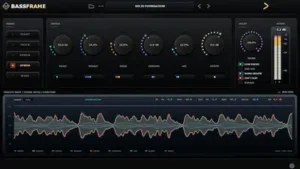 BassFrame sits in the affordable end of the dedicated bass-processing market. As of September 8, 2026, BassFrame is available for €29.99 at the introductory price, compared with the stated regular price of €69.99. The introductory offer runs until September 28, 2026, and a fully functional seven-day trial is available.
At around €30, the value proposition is straightforward. For a producer working regularly with 808s, synth basses, kick-heavy arrangements, or bass buses, BassFrame can function as a specialized utility that covers several common enhancement tasks in one insert. The low entry price also makes experimentation relatively inexpensive if the workflow genuinely saves time.
The regular €69.99 price requires a more demanding comparison. At that level, BassFrame is competing not only with dedicated bass processors but also with plugins an experienced engineer may already own for EQ, saturation, subharmonic generation, stereo control, and clipping. The question becomes whether the integrated workflow produces results that are either faster or more useful than the existing chain.
That makes the trial particularly important. The relevant test is not whether BassFrame can create more weight — it clearly can. The test is whether it produces a result you would otherwise spend significantly more time building, and whether you would reach for it again after the novelty of a new plugin wears off.
For producers and mixing engineers who frequently work on bass-heavy material, the introductory price is easy to justify if the workflow fits. At the regular price, it becomes a workflow purchase rather than a capability purchase: engineers who already have strong low-end tools should buy it only if its particular combination of processing modes is faster or more musically useful than what they already own.
Overall Rating
| Category | Rating |
|---|---|
| Low-End Problem Solving | 8.7/10 |
| Harmonic Enhancement | 8.3/10 |
| Subharmonic Generation | 8.2/10 |
| Stereo Low-End Control | 8.5/10 |
| Processing Integration & Control | 8.4/10 |
| Production Workflow Efficiency | 9.0/10 |
| Overall | 8.5/10 |
BassFrame scores highest for workflow efficiency because its five engines cover several recurring low-end tasks from one insert. The plugin is less compelling when the job requires surgical frequency correction, highly predictable mastering intervention, or detailed control over an individual processing stage.
The Synth engine is particularly useful for pitched bass sources, while Wide and Mono Below address a practical stereo-management problem that is easy to mishandle with conventional widening. The trade-off is that these integrated workflows provide less granular control than assembling dedicated processors individually.
The 8.5/10 overall rating therefore reflects BassFrame’s usefulness as a production and mixing utility rather than technical superiority over specialized processors.
BassFrame Verdict: A Useful Mixing Tool, Not a Must-Have
BassFrame is a strong option for producers and mixing engineers who repeatedly need to add weight, harmonic definition, sub extension, punch, or controlled stereo presence to low-frequency material.
Its main advantage is not that any individual process is unavailable elsewhere. EQs, saturation processors, subharmonic generators, stereo tools, and clippers can already cover most of the same territory. BassFrame’s advantage is that several of those approaches can be tested from one dedicated low-end interface.
That makes the plugin easier to justify in production than in mastering. On individual basses, 808s, kicks, and bass buses, the ability to audition different enhancement behaviors quickly can save setup time. On a finished mix, the same flexibility is less important because mastering usually benefits from smaller and more predictable interventions.
Bottom line: BassFrame is worth considering if low-end enhancement is a recurring part of your production or mixing workflow and its multi-engine approach gets you to useful results faster than your existing tools. At the introductory €29.99 price, the barrier to trying it is low; at the regular €69.99 price, existing owners of dedicated bass processors should rely on the seven-day trial before buying.
Does Your Low End Still Translate Outside the Studio?
Low-end enhancement can add weight, harmonics, punch, or stereo presence, but those changes only matter if the finished mix remains balanced when the monitoring environment changes. More sub energy is not automatically better, and problems between kick, bass, headroom, and dynamics can become more obvious after processing.
Instead of judging the result only inside your production setup, compare your mix with a professional mastering pass. Upload up to 35 seconds of your mix and get a free mastering demo prepared by a real mastering engineer, so you can hear the difference before deciding what your track actually needs. Upload your mix for a free mastering demo →
BassFrame FAQ
What sources work best with BassFrame?
BassFrame is most useful on pitched and low-frequency sources such as bass guitar, synth bass, 808s, kicks, and bass-heavy drum loops. It is less useful when the underlying problem is arrangement, tuning, or severe frequency masking.
What does the Synth engine do in BassFrame?
The Synth engine is designed to generate additional octave-down low-frequency content that follows the source pitch. It is particularly relevant to pitched bass material such as 808s, synth basses, and bass guitar, although complex or heavily distorted sources can make pitch-dependent processing less predictable.
Can BassFrame be used on a kick drum?
Yes. Tight and Punch are particularly relevant to kick processing when the source needs more low-end definition or impact. The result should be judged in the context of the kick-and-bass relationship rather than on the kick in isolation.
Does BassFrame widen sub bass?
Its Wide processing is designed to add stereo presence while keeping the deepest low frequencies controlled. The Mono Below control can further restrict the stereo content in the lowest range.
Is BassFrame a replacement for Waves R-Bass?
Not necessarily. R-Bass is focused primarily on perceived-bass enhancement through harmonic processing, while BassFrame combines that type of processing with sub generation, punch, and stereo-oriented options. The better choice depends on which workflow you use most often.
Should I buy BassFrame if I already own LowEnd Friend 2?
Only if BassFrame’s multi-engine workflow solves recurring tasks faster. LowEnd Friend 2 already covers substantial low-end enhancement and harmonic processing, so owning both is a workflow decision rather than a straightforward upgrade.
Does BassFrame run natively on Apple Silicon?
Yes. BassFrame supports native Apple Silicon on macOS and is available in AU, VST3, and AAX formats. On Windows, it is available in VST3 and AAX.
Is BassFrame better for mixing or mastering?
BassFrame is better suited to production and mixing. Its multiple enhancement engines are useful when shaping individual basses, 808s, kicks, and bass buses, while mastering usually requires smaller and more predictable low-frequency changes. It can still be useful in mastering for a specific low-end deficiency, but it should not be treated as a routine mastering processor.
Is BassFrame useful for mastering?
It can be useful for a specific low-end deficiency, but it is better suited to production and mixing. In mastering, additional subharmonic energy can affect headroom and limiter behavior, so smaller and more predictable interventions are usually preferable.
Is BassFrame worth buying at the regular €69.99 price?
It is worth considering if low-end enhancement is a recurring part of your workflow and BassFrame consistently gets results faster than your existing chain. If you already have dedicated tools that cover the same tasks efficiently, the regular price is harder to justify.

Yurii Ariefiev evaluates bass enhancement tools from the perspective of low-end translation and controlled processing. With BassFrame, the relevant engineering questions are how harmonic enhancement, subharmonic generation, and low-frequency shaping affect perceived weight without unnecessarily increasing fundamental energy.
Particular attention belongs to the relationship between added low-end information, headroom, and stereo control. For this type of processor, useful results depend on whether the enhancement remains stable and intelligible when the signal is level-matched and monitored under different playback conditions.
☕ Buy me a coffee