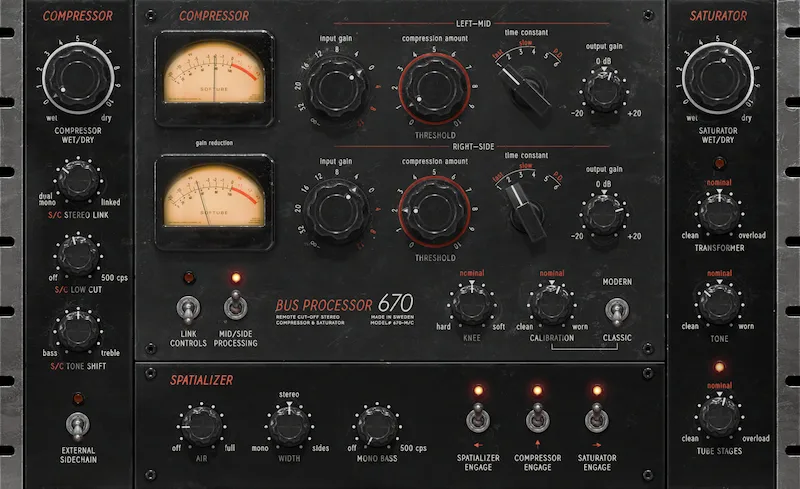
Softube Bus Processor 670: A Modern Variable-Mu Compressor for Mix Bus and Mastering
Softube Bus Processor 670 enters one of the most competitive segments of the audio production market. Engineers already have access to numerous Fairchild-inspired plug-ins, ranging from vintage-focused emulations to mastering-oriented variable-mu processors. Recreating the sound of a classic compressor is no longer enough. The challenge is no longer recreating vintage hardware. The challenge is making that compression philosophy relevant inside modern production workflows.
Bus Processor 670 is Softube’s attempt to answer that question. Built around the compression characteristics that made the Fairchild 670 influential, the plug-in extends beyond traditional emulation by integrating saturation controls, advanced sidechain options, M/S processing, stereo shaping tools, and modern session recall. The goal is not strict historical accuracy. It is to apply the musical qualities of variable-mu compression within contemporary mixing and mastering workflows.
That positioning places Bus Processor 670 in a different category from many Fairchild-style competitors. Rather than competing solely on analog authenticity, it targets engineers who view a bus processor as a decision-making tool that influences density, harmonic structure, stereo presentation, and overall mix cohesion. Whether that approach delivers a meaningful advantage depends less on how closely it replicates vintage hardware and more on how effectively those additional controls translate into real-world production results.
- Why Modern Bus Processors Matter More Than Ever
- Softube Chose Workflow Over Nostalgia
- Variable-Mu Compression Beyond Simple Gain Reduction
- The Saturation Stage May Be the Most Important Part of Bus Processor 670
- Sidechain Control Matters More Than Vintage Authenticity
- Spatial Processing Is Where the Real Risks Begin
- Where Bus Processor 670 Makes Sense in a Mixing Workflow
- Mastering Applications: Where Bus Processor 670 Helps—and Where It Can Hurt
- Where Bus Processor 670 Sits in the Current Variable-Mu Market
- Who Is Bus Processor 670 Actually For?
- Verdict
Softube Bus Processor 670 at a Glance
- Variable-mu compression architecture inspired by the Fairchild 670
- Independent tube and transformer saturation controls
- Calibration control for compression-dependent saturation behavior
- Advanced sidechain filtering and stereo linking
- M/S output controls
- Air band, mono maker and stereo widening tools
- VST, VST3, AU and AAX support
- Console 1 and Flow Studio integration
Why Modern Bus Processors Matter More Than Ever
 The role of a bus processor has changed significantly over the past decade. In modern production, the mix bus is no longer reserved for a small amount of final glue compression before mastering. Many engineers now make critical tonal, dynamic, and spatial decisions directly on the stereo bus, often shaping the overall character of a mix long before the mastering stage begins.
Several factors have driven this shift. Streaming platforms have reduced the incentive to chase extreme loudness, while playback environments have become increasingly unpredictable. A mix may be evaluated on studio monitors, earbuds, Bluetooth speakers, smartphones, laptops, and in-car systems within the same day. Maintaining consistency across those environments requires more than peak control. It requires careful management of density, balance, stereo information, and harmonic content.
This is why bus processor design has become a highly competitive category. Different compression architectures influence a mix in fundamentally different ways. VCA designs remain a staple for engineers who want punch, forward motion, and predictable control. Optical compressors are often chosen for their smooth gain reduction and unobtrusive behavior. Variable-mu compressors occupy a different space, shaping dynamics in a way that tends to feel less mechanical and more connected to the musical movement of the source material.
Bus Processor 670 is built around that philosophy. Its appeal is not aggressive level control or obvious compression effects. The variable-mu approach is traditionally valued for its ability to increase perceived density, reinforce harmonic weight, and tighten a mix without drawing attention to the gain reduction itself. In an era where translation and long-term listenability often matter more than raw loudness, those characteristics remain highly relevant.
Softube Chose Workflow Over Nostalgia
The defining decision behind Bus Processor 670 is not its Fairchild inspiration. It is Softube’s willingness to move beyond it.
The market is already saturated with Fairchild emulations. Engineers can choose from numerous plug-ins that focus on recreating the hardware’s compression curves, harmonic behavior, controls, and operating quirks. For a new entrant, competing solely on analog authenticity would offer little differentiation.
Softube took a different route. Rather than treating the Fairchild 670 as a historical artifact that must be replicated component by component, Bus Processor 670 uses the variable-mu architecture as a foundation for a broader mix bus and mastering processor. The focus shifts from preserving vintage limitations to expanding practical control over how compression interacts with modern productions.
This reflects a larger change in professional audio software. Most engineers are not building sessions around nostalgia. They are building sessions around efficiency, repeatability, and translation. A processor that requires multiple supporting plug-ins to achieve contemporary workflow requirements is no longer automatically preferable simply because it is closer to the original hardware. Similar questions are emerging across the industry, including in software instruments, as discussed in this Arturia Memory V review, where vintage inspiration and modern workflow requirements do not always point in the same direction.
The Fairchild 670 earned its reputation through its ability to add density, harmonic richness, and dynamic control without sounding overtly compressed. Those characteristics remain desirable today. The difference is that modern productions often demand additional control over stereo width, low-frequency management, sidechain behavior, and harmonic shaping. These are not fringe requirements. They are routine mix bus and mastering considerations.
Bus Processor 670 addresses those demands directly. The plug-in retains the variable-mu philosophy at its core, but extends it into areas the original hardware never attempted to solve. Whether that approach appeals to an engineer depends largely on expectations. Those searching for a museum-piece Fairchild recreation may find more suitable alternatives elsewhere. Those looking for a modern bus processor influenced by the strengths of variable-mu compression will likely understand what Softube is trying to accomplish.
Variable-Mu Compression Beyond Simple Gain Reduction
The defining characteristic of a variable-mu compressor is not its tone. It is the way compression adapts to the material passing through it.
Unlike VCA designs, where ratio behavior remains relatively predictable, variable-mu circuits continuously alter their response as signal level changes. Compression becomes progressively more assertive as the input increases, creating a dynamic relationship that feels less imposed on the source material and more connected to its natural movement.
This behavior is one reason variable-mu compression remains a fixture on mix buses and mastering chains decades after the original hardware was introduced. Rather than aggressively controlling peaks, it tends to reshape dynamic energy across the entire program. The result is often perceived as density, weight, and cohesion rather than obvious compression.
On a mix bus, that distinction matters. A well-implemented variable-mu design can pull individual elements closer together without stripping transient information from the drums or pushing vocals unnaturally forward. Instead of sounding compressed, the mix often feels more unified, with fewer elements competing for attention.
Reproducing that behavior in software is considerably more difficult than modeling a static frequency response or adding harmonic coloration. In a variable-mu circuit, compression and harmonic generation are interconnected processes. Changes in gain reduction influence harmonic behavior, while harmonic content can affect how the compression is perceived. The interaction is continuous rather than linear.
This is where Bus Processor 670 becomes more interesting than a typical vintage emulation. The inclusion of a dedicated Calibration control suggests that Softube is not merely recreating a fixed operating point. Instead, the plug-in gives engineers direct influence over the relationship between compression and saturation, allowing the processor to move between cleaner dynamic control and more overt harmonic shaping. In practical terms, that provides a level of customization that would be difficult—or impossible—to achieve with the original hardware.
For mix engineers, this creates opportunities to fine-tune how density is generated. For mastering engineers, it offers another layer of control over perceived weight and tonal complexity without immediately reaching for additional processors. Whether that flexibility proves more valuable than strict analog authenticity will depend on the user, but it represents a distinctly modern interpretation of variable-mu workflow.
The Saturation Stage May Be the Most Important Part of Bus Processor 670
 Most discussions about Bus Processor 670 naturally focus on its variable-mu compression engine. In practice, however, the saturation section may have a greater impact on day-to-day workflow than the compressor itself.
One of the limitations of many vintage-inspired processors is that harmonic coloration arrives as a byproduct of the model. Engineers can adjust thresholds, time constants, or input levels, but the balance between compression and saturation remains largely predetermined by the emulation. Bus Processor 670 takes a different approach by separating tube and transformer saturation into independent controls.
That distinction is more significant than it may initially appear. Tube saturation and transformer saturation affect a mix in fundamentally different ways. Tube harmonics often increase perceived depth, density, and tonal richness, particularly through the midrange. Transformer saturation tends to influence transient shape, low-frequency solidity, and overall weight. While both contribute to an analog character, they do not solve the same production problems.
Separating those behaviors allows engineers to target specific outcomes rather than accepting a fixed coloration profile. A mix that already contains substantial harmonic complexity may benefit from transformer weight without additional tube saturation. A sparse arrangement may benefit from added harmonic density while preserving transient definition. Traditional hardware rarely offers that level of selective control.
This becomes particularly relevant on the mix bus, where small harmonic adjustments can influence how a production translates across different playback systems. Perceived punch, vocal presence, low-end stability, and stereo depth are often affected as much by harmonic structure as by EQ or compression settings.
The dedicated wet/dry control extends that flexibility further. Instead of committing to a fully saturated signal path, engineers can blend harmonic enhancement against the original source and fine-tune the point where coloration improves density without reducing clarity. That capability is especially useful during mastering, where subtle changes often produce larger perceptual differences than aggressive processing.
Viewed through that lens, Bus Processor 670 is not simply a variable-mu compressor with added saturation. It is a harmonic shaping tool built around a variable-mu compressor. For many engineers, that distinction may ultimately define its value more than the Fairchild-inspired compression topology itself.
Sidechain Control Matters More Than Vintage Authenticity
Low-frequency management remains one of the biggest challenges in modern bus compression. Contemporary productions routinely contain far more sub-bass energy than the material for which classic variable-mu hardware was originally designed. When that low-end information dominates the detector circuit, compression decisions can become disconnected from what listeners actually perceive as balance.
The result is familiar to most mix engineers. A kick drum or 808 transient triggers gain reduction across the entire mix, causing vocals, guitars, synths, and ambience to move unnecessarily. The compressor reacts to energy concentration rather than musical importance.
This is where modern sidechain control becomes critical. Bus Processor 670 includes filtering and linking options that allow engineers to determine how much influence low frequencies have over the compression behavior. While these features are common in contemporary processors, their importance is often underestimated.
A variable-mu compressor that responds too aggressively to sub-bass content can lose much of the smooth, program-dependent behavior that makes the topology attractive in the first place. Controlling the detector path allows the processor to respond more consistently to the overall mix rather than being dominated by a handful of low-frequency events.
The benefits become particularly apparent in modern genres where low-end occupies a significant portion of the available headroom. Hip-hop, EDM, trap, cinematic music, and contemporary pop frequently combine deep bass extension with high average energy levels. Without sidechain management, maintaining density and punch simultaneously becomes considerably more difficult.
The stereo linking options add another layer of practical control. Compression behavior can change dramatically depending on how the detector responds to information across the stereo field. Engineers working with wide synth arrangements, layered backing vocals, orchestral elements, or modern stereo production techniques often need more control than traditional hardware workflows provide.
From a production standpoint, these additions are less about convenience and more about adaptation. The original Fairchild was designed for a different recording era, different arrangements, and different playback systems. Modern sidechain control acknowledges that reality. For many engineers, it will have a greater impact on everyday usability than any attempt to replicate every characteristic of vintage hardware.
Spatial Processing Is Where the Real Risks Begin
Compression and saturation are relatively predictable tools. Spatial processing is not. This is arguably the section of Bus Processor 670 that deserves the most scrutiny from experienced mix and mastering engineers.
The plug-in includes features that extend far beyond traditional variable-mu compression: stereo widening, mono maker, air enhancement, and independent M/S output control. These tools can solve genuine production problems, but they can also create issues that remain hidden until a mix leaves the studio.
Stereo widening is a good example. Increasing perceived width often produces an immediate sense of size and openness, particularly during short listening sessions. The problem is that width is rarely evaluated under ideal conditions. Once a master encounters lossy codecs, Bluetooth playback, smart speakers, mobile devices, soundbars, or partial mono summing, exaggerated side information can behave very differently from what was heard in the control room.
The same principle applies to high-frequency enhancement. Additional air can increase apparent detail, separation, and perceived resolution. It can also push codec artifacts forward, exaggerate harshness in bright mixes, and increase listening fatigue during long playback sessions. A master that sounds exciting during a thirty-second comparison may become less convincing after repeated listening.
The mono maker is arguably the most practical addition in this section. Modern productions often contain substantial stereo information in the low end, particularly when synthesizers, sampled instruments, stereo effects, and layered processing chains are involved. Tightening low-frequency imaging can improve translation across club systems, consumer playback devices, vinyl cutting workflows, and streaming platforms where low-end stability remains critical.
The inclusion of M/S output control further shifts Bus Processor 670 away from traditional Fairchild territory and into mastering-oriented workflow design. Small adjustments to mid and side balance can sometimes achieve what EQ, compression, or stereo widening cannot. Used carefully, these controls offer valuable corrective and enhancement options without requiring additional processors.
The broader takeaway is that spatial tools should not be evaluated by how dramatic they sound. They should be evaluated by how well they survive translation. Bus Processor 670 gives engineers substantial control over stereo presentation, but those controls demand restraint. In many cases, the most successful settings will be the ones listeners never consciously notice.
Where Bus Processor 670 Makes Sense in a Mixing Workflow
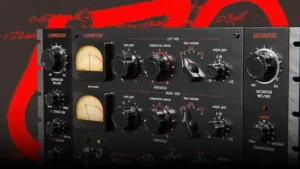 Bus Processor 670 is unlikely to become the first compressor engineers reach for when the goal is maximum punch, aggressive transient control, or obvious bus compression. Its strengths lie elsewhere. The plug-in is designed for situations where density, harmonic texture, and overall mix cohesion are more important than raw impact.
That distinction becomes important when evaluating where the processor fits within a modern session. SSL-style bus compressors often excel at creating forward momentum and rhythmic energy. Their ability to tighten drums and reinforce groove has made them a staple across countless productions. Variable-mu compression typically serves a different purpose. Rather than emphasizing attack, it tends to influence how elements blend together over time.
This characteristic makes Bus Processor 670 particularly relevant for productions built around tonal depth and musical continuity. Rock, indie, singer-songwriter projects, orchestral hybrids, jazz-influenced arrangements, and many contemporary pop productions often benefit more from subtle density enhancement than from additional transient aggression. In these contexts, excessive punch can sometimes make a mix feel fragmented rather than cohesive.
The processor is especially interesting during the later stages of mixing, when most corrective decisions have already been made and attention shifts toward presentation. At that point, engineers are often evaluating how the mix feels rather than whether individual elements are technically balanced. Small changes in harmonic content, dynamic behavior, and stereo perception can have a greater impact than another round of EQ adjustments.
A practical example would be a modern pop production that already feels balanced but lacks depth and cohesion. In that situation, Bus Processor 670 can often contribute more through subtle harmonic enrichment and low-ratio variable-mu compression than through additional EQ or limiting. The processor is less about correcting mistakes and more about shaping how finished material feels during playback.
Bus Processor 670 appears well suited to that role. Rather than functioning as a problem-solving compressor, it operates more like a finishing processor that influences the overall character of the mix. The combination of variable-mu compression, saturation control, and stereo management allows engineers to shape density and depth without assembling a chain of separate processors to achieve similar results.
This workflow closely mirrors how high-end variable-mu hardware has historically been used in professional studios. The goal was rarely aggressive gain reduction. Instead, engineers relied on these designs to add a sense of refinement, weight, and cohesion that became apparent only when the processor was bypassed. Bus Processor 670 follows that same philosophy, but with considerably more control than the original hardware ever provided.
Mastering Applications: Where Bus Processor 670 Helps—and Where It Can Hurt
Mastering places Bus Processor 670 under a far more demanding microscope than mix bus processing. The evaluation criteria are fundamentally different from mixing, as every processing decision must survive translation across real-world playback environments rather than simply improving internal balance. This distinction becomes clearer when examining the practical differences between mixing and mastering in professional production workflows. A mix compressor only needs to improve the internal balance of a production. A mastering processor must survive translation across streaming platforms, codecs, consumer playback systems, headphones, smart speakers, automotive environments, and monitoring systems that the engineer will never hear.
That distinction changes how the plug-in should be evaluated. Features that appear attractive during mixing do not automatically become assets during mastering. Every stage of processing must justify itself against a simple question: does it improve translation, or does it merely make the master sound more impressive inside the studio?
The strongest mastering application for Bus Processor 670 is not aggressive compression. It is controlled density enhancement. Variable-mu compression has long been valued because it can reduce dynamic contrast without creating the obvious artifacts often associated with harder compression topologies. When used conservatively, the result is frequently perceived as greater solidity, continuity, and weight rather than increased loudness.
The saturation section expands those possibilities further. Small amounts of harmonic enrichment can increase perceived density and presence without requiring additional limiting or higher integrated loudness. This distinction is increasingly important in streaming-focused production, where perceived impact often matters more than chasing higher meter readings or aggressive normalization targets discussed in this LUFS mastering guide. This becomes particularly valuable in the streaming era, where normalization has reduced the practical advantage of pursuing extreme loudness targets. Engineers increasingly compete through perceived quality rather than raw level.
At the same time, Bus Processor 670 contains enough enhancement tools to create problems if approached without restraint. This accumulation effect is one of the most common reasons a master can sound impressive during processing yet become less convincing after export. Over-processing remains a recurring issue in both home and professional studios and frequently contributes to the types of translation failures discussed in this guide to common mastering problems. Individually, each process may appear beneficial. Combined, they can easily push a master beyond the point of stability.
This is especially relevant when evaluating codec translation. Harmonic saturation alters spectral density. Air enhancement increases high-frequency energy. Stereo widening affects side information. Lossy codecs react to all three. A master that sounds larger, brighter, and wider in a controlled monitoring environment may become less coherent once converted for streaming distribution.
The importance of translation becomes even greater as production workflows continue expanding beyond traditional stereo delivery. Immersive and object-based formats introduce additional variables that can expose processing decisions in unexpected ways, a trend explored in this analysis of MPEG-H versus Dolby Atmos and the broader evolution of immersive audio production.
Bus Processor 670 is arguably best viewed as a selective mastering tool rather than an all-in-one mastering solution. In professional mastering environments, processors like this typically occupy a specific role within a larger signal path rather than acting as a complete solution by themselves, a concept explored in greater detail in this guide to the mastering chain. The plug-in provides enough control to shape dynamics, harmonic content, and stereo presentation, but the most successful mastering workflows will rarely rely on every section simultaneously. In practice, the strongest results often come from identifying the single problem that needs solving and using the processor to address that issue without disturbing everything else.
That philosophy mirrors professional mastering itself. The goal is rarely to make a track sound dramatically different. The goal is to improve translation while preserving the artistic decisions that already work. Bus Processor 670 is capable of supporting that objective, but only when its flexibility is matched by disciplined decision-making.
Where Bus Processor 670 Sits in the Current Variable-Mu Market
Bus Processor 670 enters a category that is already populated by highly capable competitors. The challenge is not finding a variable-mu compressor. The challenge is determining which interpretation of the concept best matches a particular workflow.
Some developers focus on recreating the behavior of specific hardware units as accurately as possible. Others use classic topologies as a foundation for modern production tools. Bus Processor 670 clearly belongs to the second group. Understanding that distinction is important because many competing products pursue fundamentally different goals despite sharing similar visual references and marketing language.
| Plugin | Primary Focus | Best Fit | Potential Drawback |
|---|---|---|---|
| Softube Bus Processor 670 | Modern variable-mu workflow | Mix bus processing, mastering, harmonic shaping | Less focused on strict Fairchild authenticity |
| Pulsar Mu | Precision mastering control | Dedicated mastering environments | More specialized workflow |
| UAD Fairchild 670 | Vintage Fairchild recreation | Classic coloration and historical character | Limited modern workflow features |
| IK Multimedia Vintage Tube Compressor 670 | Accessible vintage-style compression | General-purpose analog coloration | Less depth in advanced processing options |
| Acustica Ultramarine | Heavy analog character | Engineers prioritizing coloration | Higher workflow and system demands |
The closest conceptual competitor is arguably Pulsar Mu. Both products extend beyond simple vintage emulation and incorporate features intended for contemporary mastering and mix bus applications. The difference lies in emphasis. Pulsar Mu is built primarily around mastering precision, while Bus Processor 670 appears designed to function as a broader tone-shaping processor capable of handling both mixing and mastering responsibilities.
UAD Fairchild 670 occupies a different position entirely. Engineers typically choose it because they want a recognizable Fairchild-style response and coloration. Workflow flexibility is secondary. Bus Processor 670 takes the opposite approach, prioritizing control and adaptability over historical recreation.
This distinction ultimately defines the target audience. Engineers searching for the closest possible software approximation of a Fairchild will likely continue gravitating toward dedicated emulations. Engineers looking for a variable-mu processor that integrates compression, saturation, stereo management, and mastering-oriented workflow tools inside a single environment may find Bus Processor 670 the more practical option.
In that sense, Softube is competing less with traditional Fairchild recreations and more with the growing category of modern mix bus processors that combine multiple stages of tonal and dynamic shaping into a unified workflow. That is a significantly different market position—and arguably a more relevant one for contemporary production environments.
Softube Bus Processor 670 vs Pulsar Mu
Pulsar Mu remains one of the strongest references in the software variable-mu category, making it an inevitable comparison for Bus Processor 670. Although both plug-ins draw inspiration from classic tube compression concepts, they target slightly different workflows.
Pulsar Mu is primarily a mastering-focused processor. Its design emphasizes precision, detailed control over dynamic behavior, and the ability to perform subtle adjustments that survive demanding mastering environments. Many mastering engineers use it as a dedicated dynamics processor rather than a broader tone-shaping platform.
Bus Processor 670 approaches the problem from a wider perspective. Compression is only one part of the workflow. Saturation, stereo management, sidechain control, harmonic calibration, and spatial processing are integrated directly into the processor, allowing it to function as a more comprehensive mix bus and mastering tool.
As a result, the choice between the two often depends less on sound quality and more on workflow priorities. Engineers building highly specialized mastering chains may prefer Pulsar Mu’s focused approach. Producers and mix engineers looking for a processor that combines multiple stages of bus treatment inside a single environment may find Bus Processor 670 more practical.
Neither plug-in clearly replaces the other. Pulsar Mu remains one of the stronger options for dedicated mastering applications, while Bus Processor 670 offers a broader feature set that aligns more closely with contemporary hybrid mixing and mastering workflows.
Softube Bus Processor 670 vs UAD Fairchild 670
Although both plug-ins draw inspiration from the Fairchild 670, they are designed for different objectives. UAD Fairchild 670 focuses on recreating the behavior, coloration, and workflow of the original hardware as closely as possible. Bus Processor 670 uses the same historical reference point but expands far beyond traditional emulation.
Engineers choosing UAD Fairchild 670 are typically searching for a recognizable vintage compression character and a workflow that remains close to the hardware. Bus Processor 670 targets users who want variable-mu compression integrated with modern production tools such as saturation control, advanced sidechain options, stereo management, and M/S processing.
In practical terms, UAD Fairchild 670 behaves more like a dedicated character compressor, while Bus Processor 670 functions as a broader mix bus and mastering platform. The decision often depends less on sound quality and more on whether historical authenticity or workflow flexibility is the higher priority.
Who Is Bus Processor 670 Actually For?
Bus Processor 670 is not aimed at engineers searching for the most authentic Fairchild recreation available. The market already offers several established options for that purpose. Softube’s design makes more sense when viewed as a modern bus processor that happens to be built around a variable-mu foundation.
The plug-in is likely to appeal most to mix engineers who prefer making broad tonal and dynamic decisions from a limited number of processors rather than constructing long chains of specialized tools. Compression, harmonic shaping, stereo management, and low-end control all exist within a single environment, reducing the need for multiple plug-ins performing adjacent tasks.
That workflow becomes even more relevant for engineers working inside Softube’s Console 1 ecosystem. Direct hardware integration allows Bus Processor 670 to function as part of a tactile mixing environment rather than a standalone plug-in window, while Flow Studio users benefit from tighter session management and recall. For engineers handling large projects with frequent revisions, these workflow considerations can be just as important as the compression characteristics themselves.
That workflow becomes particularly attractive in high-volume production environments where speed and repeatability matter. Modern sessions often involve constant revisions, alternate versions, streaming deliverables, instrumental mixes, and stem exports. A processor that consolidates several stages of bus treatment can simplify recall and reduce unnecessary complexity.
Bus Processor 670 also makes sense for producers who regularly work across multiple genres. Its architecture is flexible enough to support modern pop, rock, electronic music, cinematic productions, and hybrid arrangements without forcing users into a heavily genre-specific compression aesthetic.
The audience becomes narrower at the mastering level. Engineers who already rely on dedicated mastering chains built around specialized compression, saturation, M/S processing, and stereo imaging tools may view Bus Processor 670 as a complementary option rather than a central processor. In those environments, the value comes from its particular variable-mu character rather than the convenience of its integrated feature set.
Expectation management is important here. Bus Processor 670 should not be evaluated as a software replacement for a Fairchild 670. It should be evaluated as a contemporary mix bus and mastering processor that borrows the strengths of variable-mu compression while addressing production requirements that did not exist when the original hardware was designed. Engineers approaching it from that perspective are far more likely to understand where its real value lies.
Pricing and Availability
Softube Bus Processor 670 is available for macOS and Windows in VST, VST3, AU and AAX formats. The plug-in launched at an introductory price of $99 USD before moving to its regular $149 USD price point. It is also included in selected Softube subscription bundles.
Potential Drawbacks
Bus Processor 670 is a capable processor, but its flexibility introduces several tradeoffs that potential users should understand before purchasing.
The first is complexity. Engineers accustomed to traditional Fairchild-style compressors may find themselves navigating a broader set of decisions involving saturation, stereo imaging, M/S balance, sidechain behavior, and harmonic calibration. The additional control expands creative possibilities, but it also increases the likelihood of over-processing.
Another consideration is product identity. Bus Processor 670 occupies an unusual position between vintage emulation and modern workflow processor. Engineers seeking a highly authentic Fairchild experience may prefer dedicated recreations that focus entirely on historical behavior rather than workflow expansion.
The integrated spatial processing tools also require discipline. Stereo widening, air enhancement, and M/S output adjustments can produce impressive results during short listening sessions while creating translation problems that only become apparent on consumer playback systems or after streaming delivery.
None of these issues are design flaws. They are consequences of a processor that gives users significantly more control than traditional variable-mu hardware. Engineers who value flexibility will likely view that as a strength. Engineers looking for simplicity may see it differently.
Verdict
Bus Processor 670 is most successful when viewed as a modern bus processor informed by Fairchild principles rather than a software recreation of the Fairchild itself. That distinction shapes both its strengths and its limitations.
Softube has deliberately moved away from the increasingly crowded market of hardware-faithful emulations and focused instead on workflow integration. Compression, harmonic shaping, sidechain management, stereo control, and mastering-oriented utilities are combined into a single processor designed for contemporary production environments rather than historical accuracy.
The result is a plug-in that addresses many of the practical challenges engineers face when building mix bus and mastering chains today. Variable-mu compression provides the foundation, but the broader value comes from the interaction between dynamics, saturation, low-end management, and stereo control. In many situations, those workflow advantages will matter more than whether every aspect of the original hardware has been replicated.
Bus Processor 670 is unlikely to become the definitive choice for engineers whose primary objective is obtaining the closest possible Fairchild experience inside a DAW. Several dedicated emulations remain better suited to that purpose. Its audience is different. This plug-in is aimed at engineers who want the musical behavior associated with variable-mu compression while retaining the flexibility expected from modern software.
In a market filled with vintage recreations, that approach gives Bus Processor 670 a clearer identity than many competing releases. It is not trying to preserve the past. It is trying to adapt one of audio’s most respected compression concepts to the realities of modern mixing and mastering. For many engineers, that may ultimately be the more useful objective.

Yurii Ariefiev is a mastering engineer specializing in stereo mastering, mix translation, loudness optimization, and playback consistency across streaming platforms. His editorial work focuses on the technical behavior of mastering tools, monitoring systems, signal chains, and real-world audio delivery.
This analysis evaluates Softube Bus Processor 670 from a practical engineering perspective, examining how its compression architecture, saturation design, sidechain behavior, and stereo processing influence actual mixing and mastering workflows rather than relying on marketing claims or feature lists.
FAQ
Can Bus Processor 670 replace multiple mix bus plug-ins?
In many sessions, yes. The combination of variable-mu compression, saturation, stereo control, M/S adjustment, and low-end management can reduce the need for separate processors. Whether it fully replaces a larger chain depends on how specialized your workflow is.
How much gain reduction is typically effective on a mix bus with Bus Processor 670?
Most mix engineers will achieve the best results between 0.5 dB and 2 dB of average gain reduction. The processor is generally more effective at shaping density and cohesion than delivering aggressive compression.
Is Bus Processor 670 designed more for analog character or transparent processing?
It leans toward character. Even at conservative settings, the variable-mu architecture and saturation stages are intended to influence tone, depth, and perceived weight rather than disappear completely.
How does Bus Processor 670 perform on modern bass-heavy genres?
Its sidechain controls make it considerably more adaptable than traditional variable-mu hardware. Proper sidechain filtering can prevent kick drums and sub-bass content from dominating the compression behavior.
Is Bus Processor 670 practical for large mixing sessions?
For most modern systems, yes. However, engineers working with high track counts may still prefer to reserve the plug-in for mix buses, stem buses, or mastering chains rather than inserting multiple instances across an entire session.
Can the plug-in improve perceived loudness without additional limiting?
To a degree. Harmonic enhancement and program-dependent compression can increase perceived density and presence, often making a mix feel louder without significant changes to integrated LUFS.
Does Bus Processor 670 make sense in a mastering chain that already includes dedicated saturation and imaging processors?
Not always. Engineers with highly specialized mastering chains may use only the compression section or specific features rather than relying on the entire processor.
Is Bus Processor 670 a good choice for stem mastering?
Potentially. The combination of variable-mu compression, harmonic shaping, and stereo control can be useful when working with stems that require additional cohesion before final limiting.
How does it compare to using an SSL-style compressor on the stereo bus?
The two approaches solve different problems. SSL-style compressors typically emphasize punch, groove, and transient control. Bus Processor 670 focuses more on density, harmonic weight, and overall mix continuity.
Can Bus Processor 670 create translation problems if overused?
Yes. Excessive saturation, stereo widening, air enhancement, and compression can accumulate quickly. The plug-in is most effective when used to solve specific mix or mastering objectives rather than engaging every processing stage simultaneously.
Who is likely to get the most value from Bus Processor 670?
Mix engineers, producers, and mastering engineers who want variable-mu character combined with modern workflow flexibility will benefit most. Users seeking the closest possible software recreation of a Fairchild 670 may prefer dedicated emulation-focused alternatives.