PSP auralComp v2.0 Adds FET, VCA and OldTimer Compression for Dolby Atmos and Immersive Audio Workflows
PSPaudioware has released PSP auralComp v2.0, a significant update to its surround and immersive dynamics processor aimed at engineers working beyond traditional stereo formats. The update introduces three new compressor models, enhanced metering, workflow refinements, and several stability fixes designed to improve daily use in complex production environments.
While multi-channel dynamics processing remains a niche segment compared to conventional stereo plugins, demand for immersive audio tools continues to grow as Dolby Atmos adoption expands across music, film, gaming, and streaming platforms. Against that backdrop, PSP’s latest update arrives at a time when engineers are increasingly looking for workflow-efficient solutions capable of handling large-format sessions without sacrificing familiar compression behavior.
The release does not radically redefine the category, but it strengthens PSP auralComp’s position in a market that still offers relatively few dedicated compression tools designed specifically for immersive audio production.
PSP Broadens auralComp Beyond Its Original Opto Design
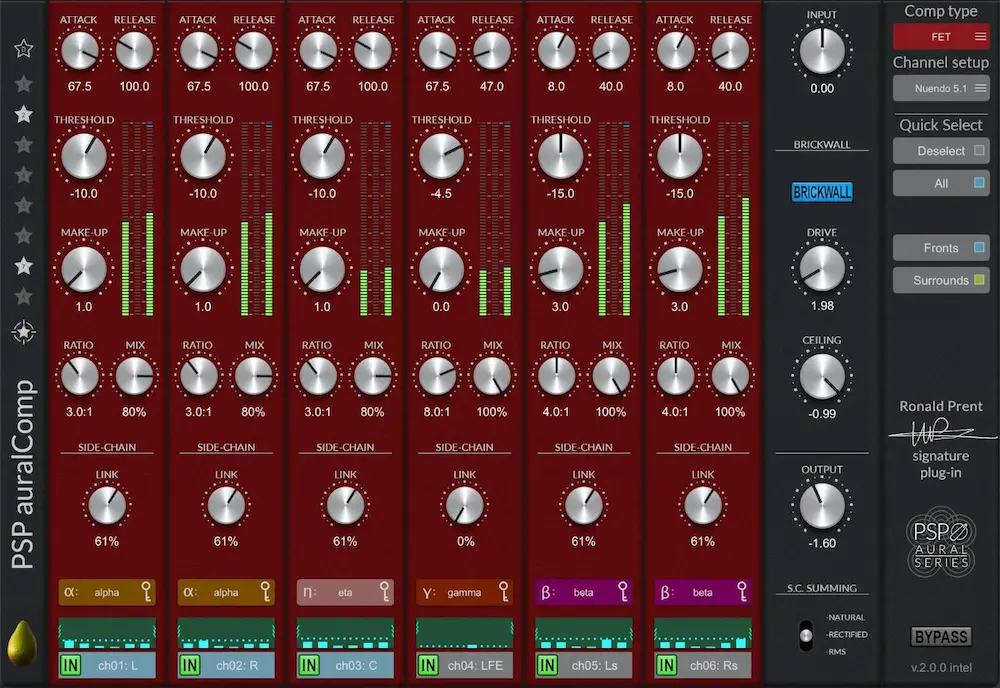
The headline feature of version 2.0 is the addition of three new compressor architectures alongside the original Opto model. Users can now choose between Opto, FET, VCA, and OldTimer-style compression behaviors depending on the material and production requirements.
The original Opto mode remains available, although its interface has been visually updated from graphite to navy blue. The newly introduced FET mode targets faster transient response, VCA aims for tighter and more controlled dynamics management, while the OldTimer-inspired model appears intended to provide a more vintage-oriented compression character.
PSP has also added limiter gain reduction metering, giving users clearer visibility into how aggressively the dynamics section is operating. Although seemingly minor, improved metering can have substantial workflow implications when managing multiple channels simultaneously across immersive sessions.
Additional changes include an updated operation manual, interface refinements, and fixes addressing latency compensation behavior, idle-state level inconsistencies, and several crash scenarios involving sidechain routing controls.
Why This Update Matters for Modern Immersive Workflows
The significance of PSP auralComp v2.0 is less about individual features and more about what it reflects regarding the evolution of immersive production workflows.
For decades, compressor development largely focused on stereo mixing and mastering applications. Although compression plays an important role in both stages, its purpose changes significantly depending on where it is applied in the production process. Engineers working in immersive formats face many of the same decision-making challenges discussed in traditional mixing versus mastering workflows, but across a far more complex speaker environment. Even as surround formats existed in film production, relatively few plugin manufacturers built dedicated dynamics processors capable of treating immersive formats as a primary use case rather than an afterthought.
As Dolby Atmos music production becomes increasingly common, engineers are encountering challenges that traditional stereo compressors were never designed to address. Managing dynamics across multiple speaker arrays introduces questions of image stability, channel consistency, spatial balance, and translation that simply do not exist in stereo environments.
PSP auralComp was developed specifically for these scenarios, and version 2.0 expands its flexibility by allowing engineers to select different compression behaviors without leaving the immersive processing environment.
For professionals working in Atmos music mixing, film post-production, broadcast audio, or game audio, reducing the need for multiple plugin chains can translate directly into faster decision-making and cleaner session management.
The Practical Value—and Limitations—of the New Compressor Models
The addition of FET, VCA, and OldTimer-inspired modes will likely attract attention because compressor topology remains one of the most familiar decision-making frameworks among mixing engineers. The release also follows a broader movement toward task-specific processing tools. Earlier this month, Three-Body Technology introduced Transi-Q, an equalizer designed around transient-focused decision making. While Transi-Q approaches dynamics from an EQ perspective and auralComp focuses on compression, both products reflect growing demand for more specialized control over transient behavior and mix definition.
However, it is important to separate practical workflow benefits from marketing language.
Simply adding multiple compressor types does not automatically guarantee dramatically different sonic outcomes. In many modern digital dynamics processors, the distinction between modeled compressor behaviors can range from highly noticeable to relatively subtle depending on source material, settings, and monitoring conditions.
The real question is whether these models offer meaningful operational differences when applied to multi-channel content.
If the new modes provide genuinely distinct envelope characteristics, timing responses, and gain reduction behavior across immersive formats, they could become valuable tools for engineers balancing spatial consistency and musical dynamics.
Independent testing will ultimately determine how far those differences extend in real-world production scenarios.
The limiter gain reduction meter may prove equally important despite receiving less attention in marketing materials. Dynamics decisions become significantly more difficult to evaluate when working across numerous channels, and additional visual feedback can improve confidence during critical processing stages.
A Growing Market for Specialized Immersive Audio Processing
The release also highlights a broader trend within the professional audio software industry.
Over the past several years, plugin developers have increasingly shifted resources toward immersive audio production. Manufacturers that previously focused almost exclusively on stereo processing are now building Atmos-ready tools, multi-channel reverbs, spatial monitoring systems, and surround-compatible dynamics processors.
Companies such as Waves, iZotope, Nugen Audio, Flux, and others have expanded immersive capabilities throughout their product ecosystems as adoption continues to spread among both commercial facilities and independent creators. The trend extends beyond dynamics processing. Recent releases such as Samplicity ScoreStage demonstrate how developers are increasingly focusing on spatial positioning, depth perception, and immersive soundstage control rather than traditional stereo-only workflows. Together, these releases point toward a broader shift in professional audio software development driven by Atmos and surround production requirements.
Despite that growth, dedicated immersive compression remains a relatively underserved category compared to equalization, metering, loudness analysis, or spatial effects processing.
That leaves room for products such as PSP auralComp to establish themselves as workflow standards among engineers who regularly work in surround and Atmos environments.
Whether immersive music production ultimately becomes a dominant format remains open for debate, but investment in immersive-capable infrastructure across streaming platforms and professional studios continues to increase.
How Engineers May Use auralComp in Real Production Environments
From a practical production perspective, PSP auralComp appears most relevant to engineers managing complete immersive buses rather than individual object processing.
Applications could include Atmos stem control, surround music buses, film mix management, broadcast program processing, and final-stage dynamics control before delivery. In many ways, immersive dynamics processing introduces similar decision points to those found in a traditional mastering signal path. The difference is that engineers must evaluate how compression affects an entire spatial field rather than a stereo image alone. This mirrors many of the challenges explored when examining a modern mastering chain, where every processing stage influences translation, balance, and overall playback consistency.
The plugin’s usefulness for mastering engineers may depend largely on the type of mastering work being performed. Traditional stereo mastering remains the dominant commercial market, but Atmos mastering and immersive release preparation continue to expand, particularly among major-label projects.
As immersive release formats become more common, engineers are placing greater emphasis on translation testing and final playback validation before distribution. Compression decisions that appear correct inside a production session may behave differently across consumer playback systems once an Atmos release reaches listeners.
Latency management also remains an important consideration. The inclusion of a latency compensation fix suggests PSP is paying attention to operational reliability, an area that becomes increasingly important as session complexity grows.
For engineers working under demanding production schedules, stability improvements often provide more value than headline-grabbing new features.
Unlike many conventional stereo processors, PSP auralComp enters a relatively small category of dedicated Dolby Atmos and immersive audio compression tools. For engineers searching for an Atmos compressor plugin capable of handling surround buses and immersive mastering workflows, the number of available options remains surprisingly limited.
Surround compression remains a relatively specialized area of audio production. While stereo bus compressors are available in virtually every DAW ecosystem, engineers working with surround buses and multi-channel program material often have far fewer dedicated processing options available.
Pricing, Compatibility, and Availability
PSP auralComp v2.0 is available now for macOS and Windows.
The plugin supports VST3, AU, and AAX formats, covering most major professional production environments.
PSPaudioware is offering an introductory price of $99, significantly below the regular list price of $299. The promotional pricing is scheduled to run through May 17, after which standard pricing is expected to apply.
Existing PSP customers should review upgrade eligibility directly through PSPaudioware’s licensing system, as upgrade paths may vary depending on previous purchases and account status.
Conclusion
PSP auralComp v2.0 is not a revolutionary release, but it represents a meaningful expansion of a specialized tool designed for an increasingly relevant segment of professional audio production.
The addition of multiple compressor models brings greater flexibility to immersive workflows, while metering enhancements and stability improvements address practical concerns that matter during daily production work.
For engineers heavily involved in Dolby Atmos, surround mixing, post-production, or immersive mastering, the update warrants attention. For stereo-only users, however, the release is unlikely to alter existing workflows.
Whether PSP auralComp ultimately becomes a standard Atmos dynamics processor remains to be seen. However, the release reflects a broader industry trend: immersive audio tools are gradually moving from niche post-production environments into mainstream music production workflows.
FAQ
When was PSP auralComp v2.0 released?
PSPaudioware announced version 2.0 as the latest update to its immersive audio dynamics processor, adding new compressor models and workflow enhancements.
What are the new compressor types in PSP auralComp v2.0?
The update adds FET, VCA, and OldTimer-style compressor modes alongside the original Opto compressor model.
Is PSP auralComp designed for Dolby Atmos production?
Yes. The plugin was developed specifically for surround and immersive audio workflows, including Dolby Atmos production environments.
Does PSP auralComp work for stereo mixing and mastering?
It can be used in stereo projects, but its primary value comes from multi-channel and immersive audio applications.
Which plugin formats are supported?
PSP auralComp v2.0 supports VST3, AU, and AAX formats on both Windows and macOS systems.
Will existing users receive a free update?
Upgrade eligibility depends on PSPaudioware’s licensing policies and individual customer accounts.
How does PSP auralComp compare to traditional stereo compressors?
Unlike conventional compressors designed primarily for stereo buses, PSP auralComp was built specifically to manage dynamics across multi-channel and immersive audio formats.
Is CPU usage likely to increase with the new compressor models?
Actual CPU impact will depend on session size, channel count, host DAW, and selected processing modes. Independent benchmarking has not yet established definitive performance differences.
Is PSP auralComp compatible with Dolby Atmos workflows?
Yes. PSP auralComp was specifically designed for surround and immersive audio production, making it suitable for Dolby Atmos mixing, multi-channel bus processing, and other immersive audio workflows.
What are alternatives to PSP auralComp?
Engineers working in immersive audio production may also consider solutions from Nugen Audio, Waves, Flux, and other developers offering multi-channel dynamics processing tools. The best choice depends on workflow requirements, channel configuration, and production environment.
Can PSP auralComp be used for immersive mastering?
Yes. While the plugin can be used during mixing and post-production, it may also be useful in immersive mastering workflows where engineers need precise control over dynamics across surround and Dolby Atmos delivery formats.